NAG-002914 · Accepted whole
A tame nondiscrete curve with no original-field F5 model
G Stable inertia and original-field models
Open in the English reader · PDF page 2003
Statement · exact TeX
\NextLinkTarget{foundations.nag002914.original}
\begin{proposition}[A tame nondiscrete curve with no original-field F5 model]
\label{cand:f5exist:quarticobstruction}
Use the admitted field and quadratic extension
\[
 K=\widehat{\bigcup_{r\geq0}\mathbf C((t^{1/3^r}))},\qquad
 v(t)=1,\qquad L=K(s),\quad s^2=t.
\]
Then $v(K^\times)=\mathbf Z[1/3]$ is dense, $L/K$ is tame Galois
of degree two, and both residue fields are $\mathbf C$.
The curve
\[
 C:\quad Z^4=t^2(X^4+Y^4)\ \subset\ \mathbf P^2_K
\]
is smooth, projective and geometrically connected of genus three.
It admits a smooth projective stable model over $L^\circ$, but
admits no F5 model over $K^\circ$. The geometric dual graph of the
supplied stable model has a single vertex and no edges, and is fixed
by the Galois action. Thus invariant stable vertices do not imply
even existence of some original-field F5 model.
\end{proposition}
Full selected proof · exact TeX
\begin{proof}
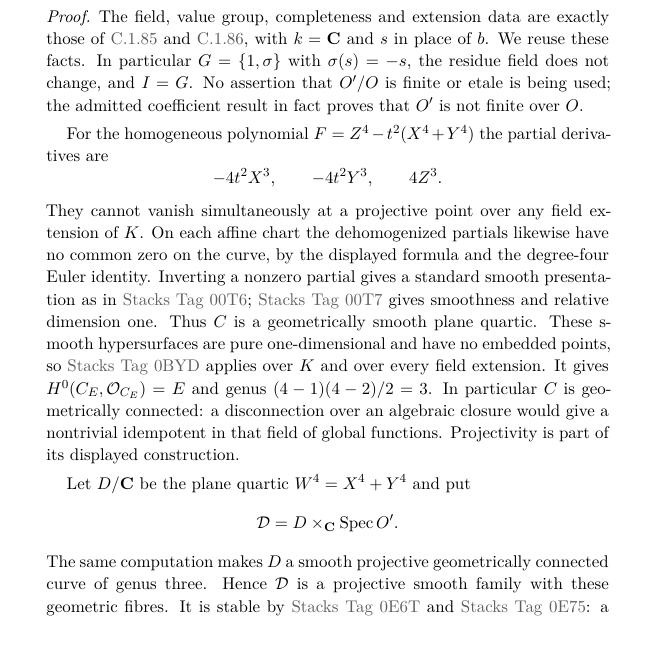
The field, value group, completeness and extension data are exactly
those of \dep{cand:f5sub:invariantmidpoint} and
\dep{cand:f5tame:nondiscretecoefficients}, with $k=\mathbf C$ and
$s$ in place of $b$. We reuse these facts. In particular
$G=\{1,\sigma\}$ with $\sigma(s)=-s$, the residue field does not
change, and $I=G$. No assertion that $O'/O$ is finite or etale is
being used; the admitted coefficient result in fact proves that
$O'$ is not finite over $O$.

For the homogeneous polynomial
$F=Z^4-t^2(X^4+Y^4)$ the partial derivatives are
\[
       -4t^2X^3,\qquad -4t^2Y^3,\qquad 4Z^3.
\]
They cannot vanish simultaneously at a projective point over any
field extension of $K$. On each affine chart the dehomogenized
partials likewise have no common zero on the curve, by the displayed
formula and the degree-four Euler identity. Inverting a nonzero
partial gives a standard smooth presentation as in \hypertarget{foundations.nag002914.stacks.00T6.quartic-jacobian}{}\stacks{00T6};
\hypertarget{foundations.nag002914.stacks.00T7.given-quartic-smooth}{}\stacks{00T7} gives smoothness and relative dimension one.
Thus $C$ is a geometrically smooth plane quartic. These smooth
hypersurfaces are pure one-dimensional and have no embedded points,
so \hypertarget{foundations.nag002914.stacks.0BYD.given-quartic-cohomology}{}\stacks{0BYD} applies over $K$ and over every field extension.
It gives $H^0(C_E,\mathcal O_{C_E})=E$ and genus
$(4-1)(4-2)/2=3$. In particular $C$ is geometrically connected:
a disconnection over an algebraic closure would give a nontrivial
idempotent in that field of global functions. Projectivity is part
of its displayed construction.

Let $D/\mathbf C$ be the plane quartic $W^4=X^4+Y^4$ and put
\[
 \mathcal D=D\times_{\mathbf C}\operatorname{Spec}O'.
\]
\hypertarget{foundations.nag002914.stacks.00T7.constant-quartic-smooth}{}The same computation makes $D$ a smooth projective geometrically
\hypertarget{foundations.nag002914.stacks.0BYD.constant-quartic-cohomology}{}connected curve of genus three. \hypertarget{foundations.nag002914.stacks.0E6L.constant-family-universal-h0}{}Hence $\mathcal D$ is a projective
smooth family with these geometric fibres. It is stable by
\hypertarget{foundations.nag002914.stacks.0E6T.constant-family-prestable}{}\stacks{0E6T} and \hypertarget{foundations.nag002914.stacks.0E75.constant-family-stable}{}\stacks{0E75}: a smooth connected genus-three
curve has no rational tails or bridges. There is an $L$-isomorphism
\[
 \phi:C_L\xrightarrow{\ \sim\ }D_L,
       \qquad [X:Y:Z]\longmapsto[X:Y:Z/s].
\]
Indeed $s^4=t^2$, and multiplication of the third coordinate by
$s$ gives its inverse. This supplies the required stable model with
generic-fibre identification.

Under $\phi$, the canonical semilinear action of $\sigma$ is the
coefficient action of $\sigma$ together with
\[
        \tau:[X:Y:W]\longmapsto[X:Y:-W].
\]
For example, the pullback of $W=Z/s$ is $Z/(-s)=-W$.
This action extends to $\mathcal D$, since $\tau$ is defined over
$\mathbf C$ and preserves its equation. Uniqueness in
\dep{cand:stablegaloisaction} identifies it with the specified action
on the stable model. On the special fibre it is $\tau$, which sends
$[1:0:1]$ to the distinct point $[1:0:-1]$. It is therefore not
the identity on the special fibre.

If an F5 model of $C$ over $O$ existed, Lemma~\ref{cand:f5exist:stableinertia}
would force this action to be the identity, a contradiction.
Finally, the geometric special fibre of $\mathcal D$ is a smooth
connected curve, hence has one irreducible component and no nodes.
Its geometric dual graph therefore has one vertex and no edges;
the action fixes that graph. This graph statement does not assert
that its geometric component vertex descends to an original-field
F5 vertex.
\end{proof}
Typeset reader excerpt
Typed proof inputs
No explicit typed target in the exported bindings.
Reader cross-references
Proof map
Verified map inputs · NAG-002914
No addressable selected proof input is recorded in this projection.
NAG-002914 · A tame nondiscrete curve with no original-field F5 model · Chapter argument