NAG-003026 · Accepted whole
Nonsaturation on an irreducible very affine nodal curve
Proper direct image on historical ordinary compact tests
Open in the English reader · PDF page 1850
Statement · exact TeX
\begin{example}[Nonsaturation on an irreducible very affine nodal curve]\label{ex:node}
Assume $\operatorname{char}K\ne2$. There is an integral, reduced, connected very affine curve $U=\Spec A$ and a nonempty principal open $U_h$ such that $M_A\to M_{A_h}$ has a quotient containing an element of exact order $2$. Explicitly, take
\[
 A=K[x^{\pm1},z^{\pm1}]/\bigl((z-1)^2-x(x-1)^2\bigr),
 \qquad h=x-1.
 \tag{6}\label{eq:node}
\]
\end{example}
Full selected proof · exact TeX
\begin{proof}
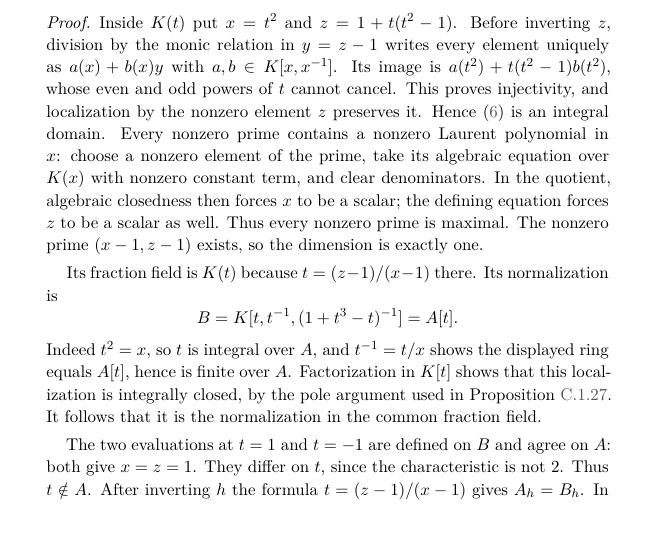
Inside $K(t)$ put $x=t^2$ and $z=1+t(t^2-1)$. Before inverting $z$, division by the monic relation in $y=z-1$ writes every element uniquely as $a(x)+b(x)y$ with $a,b\in K[x,x^{-1}]$. Its image is $a(t^2)+t(t^2-1)b(t^2)$, whose even and odd powers of $t$ cannot cancel. This proves injectivity, and localization by the nonzero element $z$ preserves it. Hence (\ref{eq:node}) is an integral domain. Every nonzero prime contains a nonzero Laurent polynomial in $x$: choose a nonzero element of the prime, take its algebraic equation over $K(x)$ with nonzero constant term, and clear denominators. In the quotient, algebraic closedness then forces $x$ to be a scalar; the defining equation forces $z$ to be a scalar as well. Thus every nonzero prime is maximal. The nonzero prime $(x-1,z-1)$ exists, so the dimension is exactly one.

Its fraction field is $K(t)$ because $t=(z-1)/(x-1)$ there. Its normalization is
\[
              B=K[t,t^{-1},(1+t^3-t)^{-1}]=A[t].
\]
Indeed $t^2=x$, so $t$ is integral over $A$, and $t^{-1}=t/x$ shows the displayed ring equals $A[t]$, hence is finite over $A$. Factorization in $K[t]$ shows that this localization is integrally closed, by the pole argument used in Proposition~\ref{prop:coordinates}. It follows that it is the normalization in the common fraction field.

The two evaluations at $t=1$ and $t=-1$ are defined on $B$ and agree on $A$: both give $x=z=1$. They differ on $t$, since the characteristic is not $2$. Thus $t\notin A$. After inverting $h$ the formula $t=(z-1)/(x-1)$ gives $A_h=B_h$. In particular $t\in A_h^\times$, while its class modulo constants does not come from $A^\times$: an equality $t=cu$ would put $t$ in $A$. But $t^2=x\in A^\times$. Its image in $A_h^\times/A^\times$ therefore has exact order $2$.

The presentation gives a closed embedding of $U$ in $\Gm^2$, and $A_h$ is generated by the units $x,z,h$ and their inverses, so $U_h$ is also very affine. Both rings are integral and $h\ne0$, giving irreducibility, reducedness and connectedness. At $x=z=1$, with local coordinates $X=x-1$ and $Y=z-1$, the equation is $Y^2-X^2-X^3$; its two distinct tangent lines are $Y=\pm X$. Thus this is an ordinary node.
\end{proof}
Typeset reader excerpt
Typed proof inputs
- NAG-003020 · selected whole (selected exact local pole argument reused)
- NAG-003020 · selected whole
- NAG-003020 · selected whole (requires)
Reader cross-references
Proof map
Verified map inputs · NAG-003026
Registered proof input
- NAG-003020 · Two different saturation questions · accepted whole
NAG-003026 · Nonsaturation on an irreducible very affine nodal curve · Chapter argument