NAG-003052 · Accepted whole
Two semipositive systems on the point blowup
I Descent of the polarized mixed tower
Open in the English reader · PDF page 2138
Statement · exact TeX
\begin{proposition}[Two semipositive systems on the point blowup]
\label{f9md:blowup}
The special fibre is $V'+F$ with both multiplicities one. Its two
component DVR norms are
\[
 |f(\xi_{V'})|=|f(\xi_0)|,\qquad
 \left|\sum_ma_mz^m\right|(\xi_F)=\max_m|a_m|\,|\pi|^{|m|},
\]
where $z_i=Z_i/Z_0$ and $\xi_0$ is the standard unit-radius Gauss
point. Put $A=H\otimes\cO(-F)$. Both $H$ and $A$ are generated by
global sections and have semipositive model metrics. For positive integers
$m_1,\ldots,m_d$ and $D=\prod_i m_i$, their mixed degrees are
\begin{equation}\label{ex68:model:eq:blowupdegrees}
\begin{array}{c|cc}
 &V'&F\\ \hline
 H^{m_1},\ldots,H^{m_d}&D&0\\
 A^{m_1},\ldots,A^{m_d}&0&D
\end{array}
\end{equation}
Consequently the pullbacks of the standard model lines give
$\mu_H=D\delta_{\xi_0}$ on both models, verifying
\eqref{ex68:model:eq:degreecriterion}. The other semipositive system gives
$\mu_A=D\delta_{\xi_F}$. Although $H$ and $A$ have the same generic
line bundle, $A$ is not being treated as the pullback of that standard
metrized line.
\end{proposition}
Full selected proof · exact TeX
\begin{proof}
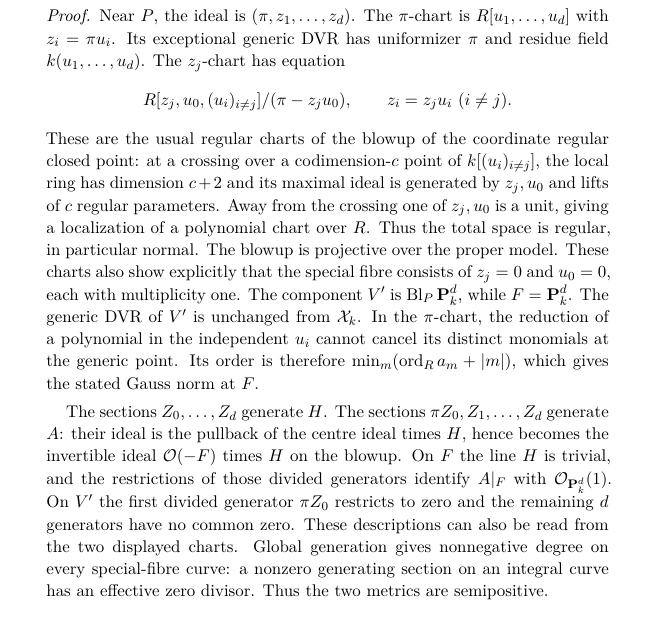
Near $P$, the ideal is $(\pi,z_1,\ldots,z_d)$. The $\pi$-chart is
$R[u_1,\ldots,u_d]$ with $z_i=\pi u_i$. Its exceptional generic
DVR has uniformizer $\pi$ and residue field $k(u_1,\ldots,u_d)$.
The $z_j$-chart has equation
\[
 R[z_j,u_0,(u_i)_{i\ne j}]/(\pi-z_ju_0),
 \qquad z_i=z_ju_i\ (i\ne j).
\]
These are the usual regular charts of the blowup of the coordinate
regular closed point: at a crossing over a codimension-$c$ point of $k[(u_i)_{i\ne j}]$,
the local ring has dimension $c+2$ and its maximal ideal is generated
by $z_j,u_0$ and lifts of $c$ regular parameters. Away from the crossing
one of $z_j,u_0$ is a unit, giving a localization of a polynomial
chart over $R$. Thus
the total space is regular, in particular normal. The blowup is
projective over the proper model. These charts also
show explicitly that the special fibre consists of $z_j=0$ and
$u_0=0$, each with multiplicity one. The component $V'$ is
$\operatorname{Bl}_P\mathbf P^d_k$, while $F=\mathbf P^d_k$.
The generic DVR of $V'$ is unchanged from $\cX_k$.
In the $\pi$-chart, the reduction of a polynomial in the independent
$u_i$ cannot cancel its distinct monomials at the generic point.
Its order is therefore $\min_m(\ord_R a_m+|m|)$, which gives the
stated Gauss norm at $F$.

The sections $Z_0,\ldots,Z_d$ generate $H$. The sections
$\pi Z_0,Z_1,\ldots,Z_d$ generate $A$: their ideal is the pullback
of the centre ideal times $H$, hence becomes the invertible ideal
$\cO(-F)$ times $H$ on the blowup. On $F$ the line $H$ is trivial,
and the restrictions of those divided generators identify
$A|_F$ with $\cO_{\mathbf P^d_k}(1)$. On $V'$ the first divided
generator $\pi Z_0$ restricts to zero and the remaining $d$ generators
have no common zero. These descriptions can also be read from the two
displayed charts. Global generation gives nonnegative degree on every
special-fibre curve: a nonzero generating section on an integral curve
has an effective zero divisor. Thus the two metrics are semipositive.

For $H$ on $V'$, use $Z_0+Z_i$, $1\leq i\leq d$. Each avoids $P$,
and their common zero is the single rational point
$Q=[1:-1:\cdots:-1]\ne P$, where $p$ is an isomorphism. Raising the
$i$th section to $m_i$ gives the local algebra
$k[t_1,\ldots,t_d]/(t_1^{m_1},\ldots,t_d^{m_d})$, of length $D$
by its monomial basis. On $F$, choose nonzero constant sections of the
trivial restrictions of $H$; there is no intersection. This proves the
first row of \eqref{ex68:model:eq:blowupdegrees}.

For $A$ on $F=\mathbf P^d_k$, $d$ coordinate hyperplanes meet at a
rational point and the same powers give length $D$. On $V'$, the
remaining divided coordinate generators define the resolution of
projection from $P$ to $\mathbf P^{d-1}_k$. In the $z_j$-chart this is
$[z_1:\cdots:z_d]=[u_1:\cdots:1:\cdots:u_d]$; its fibre direction
is the line through $P$. The $d$ coordinate hyperplanes of
$\mathbf P^{d-1}$ have empty total intersection. Their pullbacks
intersect properly through each nonempty stage (the chart fibres are
one-dimensional), and the final intersection is empty. Taking powers
preserves that support and gives degree zero. This proves the second
row. Substituting the degrees and the two multiplicities into
\eqref{ex68:model:eq:measure} proves all measure assertions.
\end{proof}
Typeset reader excerpt
Typed proof inputs
- NAG-000182 · selected whole (explicit current dependencies)
- NAG-001707 · selected whole (explicit current dependencies)
- NAG-002830 · selected whole (explicit current dependencies)
- NAG-003046 · selected whole (explicit current dependencies)
- NAG-003048 · selected whole (explicit current dependencies)
Proof map
Verified map inputs · NAG-003052
AND · joint registered proof inputs
- NAG-000182 · Multiplicativity of the weighted Gauss norm · accepted whole
- NAG-001707 · Affine analytification and its mapping property · accepted whole
- NAG-002830 · Exact logarithmic integral on a proper model · accepted whole
- NAG-003046 · Codimension-one coefficients under a modification · accepted whole
- NAG-003048 · Exact component-degree criterion for model measures · accepted whole
NAG-003052 · Two semipositive systems on the point blowup · Chapter argument