NAG-003099 · Accepted whole
Ambient regular representatives; F8NM-R
F Descent of an algebraized polarized tower
Open in the English reader · PDF page 2001
Statement · exact TeX
\begin{proposition}[Ambient regular representatives; F8NM-R]\label{fnd:nag003099:regular-quotient-representatives}
Ambient \(S_1\) is unnecessary for local regular numerator and denominator
representatives of a unit in the total quotient sheaf. Such
representatives remain regular after every actual affinoid restriction,
and their pullbacks to the reduced components are nonzero and regular.
Equality of two representations \(a/b=c/d\) gives \(ad=bc\) after
an actual common ordinary refinement. Componentwise nonvanishing alone
is not a substitute for ambient regularity.
\end{proposition}
Full selected proof · exact TeX
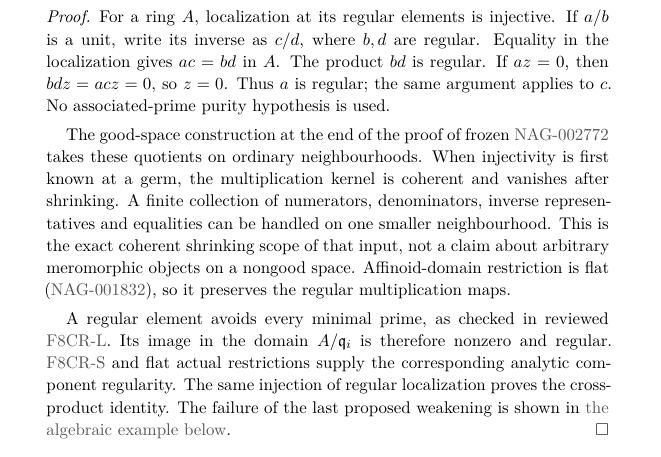
\begin{proof}
For a ring \(A\), localization at its regular elements is injective.
If \(a/b\) is a unit, write its inverse as \(c/d\), where \(b,d\)
are regular. Equality in the localization gives \(ac=bd\) in \(A\).
The product \(bd\) is regular. If \(az=0\), then \(bdz=acz=0\),
so \(z=0\). Thus \(a\) is regular; the same argument applies to
\(c\). No associated-prime purity hypothesis is used.

The good-space construction at the end of the proof of frozen
\hyperref[fnd:nag002772:ordinary-quotient-shrinking]{NAG-002772} takes these quotients on ordinary neighbourhoods.
When injectivity is first known at a germ, the multiplication kernel is
coherent and vanishes after shrinking. A finite collection of numerators,
denominators, inverse representatives and equalities can be handled on
one smaller neighbourhood. This is the exact coherent shrinking scope
of that input, not a claim about arbitrary meromorphic objects on a
nongood space. Affinoid-domain restriction is flat
(\tagg{NAG-001832}), so it preserves the regular multiplication maps.

A regular element avoids every minimal prime, as checked in reviewed
\hyperref[prop:length]{F8CR-L}. Its image in the domain \(A/\mathfrak q_i\) is therefore
nonzero and regular. \hyperref[fnd:nag002966:component-support]{F8CR-S} and flat actual restrictions supply the
corresponding analytic component regularity. The same injection of
regular localization proves the cross-product identity. The failure
of the last proposed weakening is shown in \hyperref[fnd:nag003099:algebraic-obstruction]{the algebraic example below}.
\end{proof}
Typeset reader excerpt
Typed proof inputs
- NAG-001560 · selected whole
- NAG-001560 · selected whole (selected native whole)
- NAG-001624 · selected whole
- NAG-001624 · selected whole (selected native whole)
- NAG-001832 · selected whole, export unavailable
- NAG-001832 · selected whole, export unavailable (selected native whole)
- NAG-002772 · selected whole (exact gate pending serial selection)
- NAG-002964 · selected whole
- NAG-002964 · selected whole (selected native whole)
- NAG-002966 · selected whole (exact gate pending serial selection)
- NAG-003099 · selected whole
Proof map
Verified map inputs · NAG-003099
AND · joint registered proof inputs
- NAG-001560 · Closed submodules and controlled matrix images · accepted whole Exact source window 128–134
- NAG-001624 · Kiehl and Theorem B on the analytic G-site · accepted whole Exact source window 137–141
- NAG-001832 · Result 2.38.2 · accepted whole; PDF destination Exact source windows 142–143, 146–148
- NAG-002772 · Cartier coefficient transport with scoped gluing; F8ST-C-R1 · accepted whole Exact source window 136–142
- NAG-002964 · Full lengths at a regular principal prime; F8CR-L · accepted whole Exact source window 145–147
- NAG-002966 · Component scope and support; F8CR-S · accepted whole Exact source window 146–148
NAG-003099 · Ambient regular representatives; F8NM-R · Chapter argument