\begin{theorem}[Supported projection and horizontal--vertical induction]
\label{f9sc:induction}
The value \eqref{ex68:support:eq:J} is independent of the permitted signed
presentations and symmetric in all $d+1$ inputs. Let
$p:\cY\to\cX$ be a supplied proper dominant map of integral proper
flat models of the same relative dimension, and put
$N=[K(\cY):K(\cX)]$. With the actual pulled-back factor data and
supports on $\cY$, one has
\begin{equation}\label{ex68:support:eq:Jprojection}
                         J_{\cY}=N J_{\cX}.
\end{equation}
Normality of $\cY$ is not needed for this supported equality.

At the ordinary height-one DVRs of $\cX$, write
\[
 \divi_{\cL_0}(\sigma_0)=\sum_{H\ \mathrm{horizontal}}a_H[H]
                  +\sum_{V\ \mathrm{vertical}}a_V[V].
\]
Let $J_H$ be the construction \eqref{ex68:support:eq:J} on $H$ using the remaining
$d$ pulled-back presentations and denominator $\prod_{i=1}^d e_i$.
Put $\delta_V=\delta(V;\cL_1|_V,\ldots,\cL_d|_V)$. Then
\begin{equation}\label{ex68:support:eq:induction}
 J_{\cX}=\frac1{e_0}\sum_Ha_H J_H
       +\frac{\lambda}{e_0\prod_{i=1}^d e_i}\sum_Va_V\delta_V.
\end{equation}
Thus the horizontal coefficients are exactly those of
$\divi(s_0)$ on the generic fibre. For the root model metric and the
specified finite model measure, the second summand is
\begin{equation}\label{ex68:support:eq:log}
 \int-\log\|s_0\|\,d\mu,\qquad
 -\log\|s_0(\xi_V)\|=\frac{\lambda a_V}{e_0b_V},\qquad
 \mu=\sum_V\frac{b_V\delta_V}{\prod_{i=1}^d e_i}\delta_{\xi_V}.
\end{equation}
It is a finite total-variation integral, regardless of signs of the
mixed degrees. At fixed metrics, replacing any $s_i$ by $\pi s_i$
changes $J$ by $+\lambda$ times the corresponding model-measure mass.
Only \eqref{ex68:support:eq:totalempty} is required; no pairwise proper intersection
or generic nonvanishing on every intermediate cycle is imposed.
\end{theorem}
Full selected proof · exact TeX
\begin{proof}
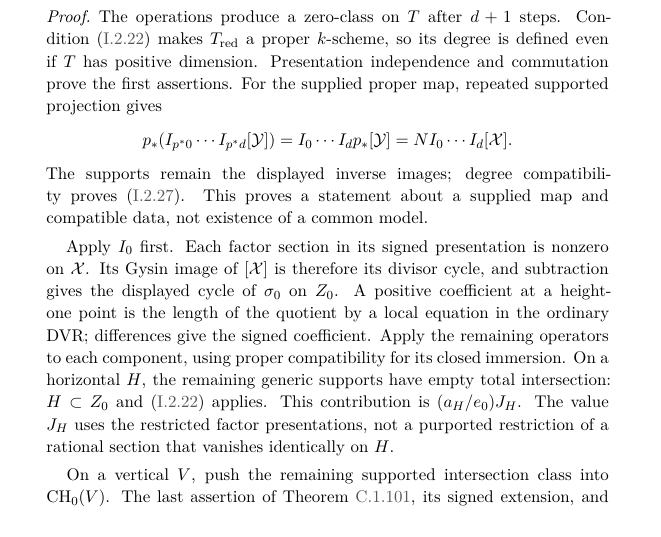
The operations produce a zero-class on $T$ after $d+1$ steps.
Condition~\eqref{ex68:support:eq:totalempty} makes $T_{\mathrm{red}}$ a proper
$k$-scheme, so its degree is defined even if $T$ has positive dimension.
Presentation independence and commutation prove the first assertions.
For the supplied proper map, repeated supported projection gives
\[
 p_*(I_{p^*0}\cdots I_{p^*d}[\cY])
       =I_0\cdots I_d p_*[\cY]
       =N I_0\cdots I_d[\cX].
\]
The supports remain the displayed inverse images; degree compatibility
proves \eqref{ex68:support:eq:Jprojection}. This proves a statement about a supplied
map and compatible data, not existence of a common model.

Apply $I_0$ first. Each factor section in its signed presentation is
nonzero on $\cX$. Its Gysin image of $[\cX]$ is therefore its divisor
cycle, and subtraction gives the displayed cycle of $\sigma_0$ on
$Z_0$. A positive coefficient at a height-one point is the length of
the quotient by a local equation in the ordinary DVR; differences give
the signed coefficient. Apply the remaining operators to each component,
using proper compatibility for its closed immersion. On a horizontal
$H$, the remaining generic supports have empty total intersection:
$H\subset Z_0$ and \eqref{ex68:support:eq:totalempty} applies. This contribution is
$(a_H/e_0)J_H$. The value $J_H$ uses the restricted factor presentations,
not a purported restriction of a rational section that vanishes
identically on $H$.

On a vertical $V$, push the remaining supported intersection class
into $\CH_0(V)$. The last assertion of Theorem~\ref{f9sc:refined-supported},
its signed extension, and proper compatibility show that the result is
$c_1(\cL_1|_V)\cdots c_1(\cL_d|_V)[V]$. This push stays inside
the proper vertical scheme $V$, so it preserves the relevant degree.
It gives $a_V\delta_V$ and proves \eqref{ex68:support:eq:induction}. Localization
at $\pi$ identifies the horizontal DVR with its generic-fibre DVR.
Since $\sigma_0=s_0^{e_0}$, its horizontal coefficient is $e_0$
times the coefficient of $\divi(s_0)$.

For \eqref{ex68:support:eq:log}, the point $\xi_V$ has norm
$|f(\xi_V)|=|\pi|^{\ord_V(f)/b_V}$ and generic scheme support.
A model frame gives the stated root norm. Multiplying its negative
logarithm by the mass cancels $b_V$, giving exactly the vertical
summand of \eqref{ex68:support:eq:induction}. All these finitely many values are
finite; the zero/pole locus is null for the finite atomic measure.
This proves the integral assertion by a finite sum, without a limit.

Finally $s_i\mapsto\pi s_i$ changes the model divisor by
$e_i\divi(\pi)$ and may enlarge its support by the special fibre.
Its first supported operation on $[\cX]$ gives
$e_i\sum_Vb_V[V]$. Commutation and the same vertical calculation give
\[
 \Delta J=\frac{\lambda}{\prod_{j\ne i}e_j}
              \sum_V b_V\delta(V;(\cL_j|_V)_{j\ne i}),
\]
with positive sign. This is the stated model mass; identifying it with
a generic-fibre degree would require the separate specialization result.
\end{proof}
\begin{theorem}[Supported projection and algebraic horizontal--vertical induction]
\label{f9sc:induction-algebraic}
The value \eqref{eq:f9sc:induction-value} is independent of the permitted signed
presentations and symmetric in all $d+1$ inputs. Let
$p:\cY\to\cX$ be a supplied proper dominant map of integral proper
flat models of the same relative dimension, and put
$N=[K(\cY):K(\cX)]$. With the actual pulled-back factor data and
supports on $\cY$, one has
\begin{equation}\label{eq:f9sc:induction-projection}
                         J_{\cY}=N J_{\cX}.
\end{equation}
Normality of $\cY$ is not needed for this supported equality.

At the ordinary height-one DVRs of $\cX$, write
\[
 \divi_{\cL_0}(\sigma_0)=\sum_{H\ \mathrm{horizontal}}a_H[H]
                  +\sum_{V\ \mathrm{vertical}}a_V[V].
\]
Let $J_H$ be the construction \eqref{eq:f9sc:induction-value} on $H$ using the remaining
$d$ pulled-back presentations and denominator $\prod_{i=1}^d e_i$.
Put $\delta_V=\delta(V;\cL_1|_V,\ldots,\cL_d|_V)$. Then
\begin{equation}\label{eq:f9sc:algebraic-induction}
 J_{\cX}=\frac1{e_0}\sum_Ha_H J_H
       +\frac{\lambda}{e_0\prod_{i=1}^d e_i}\sum_Va_V\delta_V.
\end{equation}
Thus the horizontal coefficients are exactly those of
$\divi(s_0)$ on the generic fibre. At fixed model lines, identifications and root exponents, replacing
$s_i$ by $\pi s_i$ and enlarging its support by the special fibre when
needed changes the supported value by
\[
 \Delta J=\frac{\lambda}{\prod_{j\ne i}e_j}
              \sum_V b_V\,\delta\bigl(V;(\cL_j|_V)_{j\ne i}\bigr).
\]
Only \eqref{eq:f9sc:induction-total-empty} is required; no pairwise proper intersection
or generic nonvanishing on every intermediate cycle is imposed.
\end{theorem}
Selected scope proof · exact TeX
\begin{proof}
The operations produce a zero-class on $T$ after $d+1$ steps.
Condition~\eqref{eq:f9sc:induction-total-empty} makes $T_{\mathrm{red}}$ a proper
$k$-scheme, so its degree is defined even if $T$ has positive dimension.
Presentation independence and commutation prove the first assertions.
For the supplied proper map, repeated supported projection gives
\[
 p_*(I_{p^*0}\cdots I_{p^*d}[\cY])
       =I_0\cdots I_d p_*[\cY]
       =N I_0\cdots I_d[\cX].
\]
The supports remain the displayed inverse images; degree compatibility
proves \eqref{eq:f9sc:induction-projection}. This proves a statement about a supplied
map and compatible data, not existence of a common model.

Apply $I_0$ first. Each factor section in its signed presentation is
nonzero on $\cX$. Its Gysin image of $[\cX]$ is therefore its divisor
cycle, and subtraction gives the displayed cycle of $\sigma_0$ on
$Z_0$. A positive coefficient at a height-one point is the length of
the quotient by a local equation in the ordinary DVR; differences give
the signed coefficient. Apply the remaining operators to each component,
using proper compatibility for its closed immersion. On a horizontal
$H$, the remaining generic supports have empty total intersection:
$H\subset Z_0$ and \eqref{eq:f9sc:induction-total-empty} applies. This contribution is
$(a_H/e_0)J_H$. The value $J_H$ uses the restricted factor presentations,
not a purported restriction of a rational section that vanishes
identically on $H$.

On a vertical $V$, push the remaining supported intersection class
into $\CH_0(V)$. The support-forgetting first Chern assertion of
Theorem~\ref{f9sc:refined-supported}, its signed extension in Proposition~\ref{f9sc:signed},
and proper compatibility show that the result is
$c_1(\cL_1|_V)\cdots c_1(\cL_d|_V)[V]$. This push stays inside
the proper vertical scheme $V$, so it preserves the relevant degree.
It gives $a_V\delta_V$ and proves \eqref{eq:f9sc:algebraic-induction}. Localization
at $\pi$ identifies the horizontal DVR with its generic-fibre DVR.
Since $\sigma_0=s_0^{e_0}$, its horizontal coefficient is $e_0$
times the coefficient of $\divi(s_0)$.

Finally $s_i\mapsto\pi s_i$ changes the model divisor by
$e_i\divi(\pi)$ and may enlarge its support by the special fibre.
Its first supported operation on $[\cX]$ gives
$e_i\sum_Vb_V[V]$. Commutation and the same vertical calculation give
\[
 \Delta J=\frac{\lambda}{\prod_{j\ne i}e_j}
              \sum_V b_V\delta(V;(\cL_j|_V)_{j\ne i}),
\]
with positive sign.
\end{proof}