NAG-003129 · Accepted whole
Exact acquisition criterion, allowing tensor powers
Proper direct image on historical ordinary compact tests
Open in the English reader · PDF page 1935
Statement · exact TeX
\begin{theorem}[Exact acquisition criterion, allowing tensor powers]
\label{f9mi:criterion}
Computing data exist if and only if \eqref{eq:f9mi:criterion} holds for
every $i$. More precisely, start with any finite supplied family of
model presentations of the metrics and any model supports for their
Cartier data whose generic restrictions are the $S_i$. After taking
suitable positive tensor powers, there is a common normal
generic-identity refinement carrying signed presentations on the
respective inverse images of those supports. No additional support
is needed in this refinement assertion.

The condition holds for all rational Cartier data on their divisor
supports when $X$ is locally factorial. It also holds when every
Weil divisor on $X$ has a positive Cartier multiple, in particular
for a normal $\mathbf Q$-factorial $X$.
\end{theorem}
Full selected proof · exact TeX
\begin{proof}
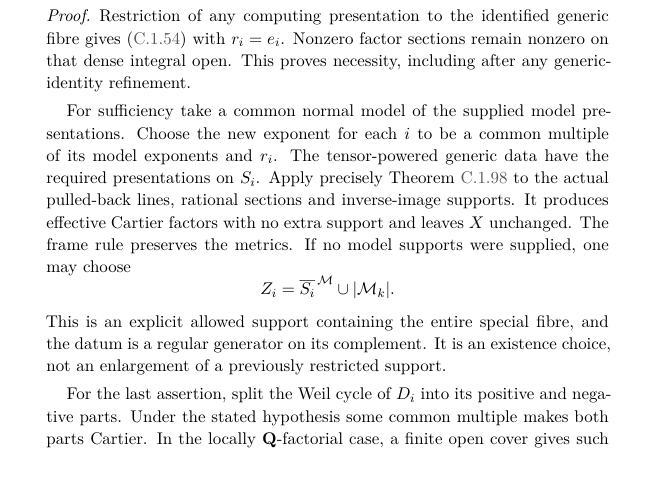
Restriction of any computing presentation to the identified generic
fibre gives \eqref{eq:f9mi:criterion} with $r_i=e_i$. Nonzero factor
sections remain nonzero on that dense integral open. This proves
necessity, including after any generic-identity refinement.

For sufficiency take a common normal model of the supplied model
presentations. Choose the new exponent for each $i$ to be a common
multiple of its model exponents and $r_i$. The tensor-powered generic
data have the required presentations on $S_i$. Apply precisely
Theorem~\ref{f9cn:presentation} to the actual pulled-back lines, rational
sections and inverse-image supports. It produces effective Cartier
factors with no extra support and leaves $X$ unchanged. The frame
rule preserves the metrics. If no model supports were supplied,
one may choose
\[
              Z_i=\overline{S_i}^{\,\cM}\cup|\cM_k|.
\]
This is an explicit allowed support containing the entire special
fibre, and the datum is a regular generator on its complement.
It is an existence choice, not an enlargement of a previously
restricted support.

For the last assertion, split the Weil cycle of $D_i$ into its
positive and negative parts. Under the stated hypothesis some common
multiple makes both parts Cartier. In the locally $\mathbf Q$-factorial
case, a finite open cover gives such a common multiple. They are effective Cartier:
in every normal local ring their local equations have nonnegative
orders at all height-one points, hence are regular by \st{031T}(2).
The difference is the chosen multiple of $D_i$, since a rational
local equation of order zero everywhere is a unit by the same
argument as in Theorem~\ref{f9mi:metric}. This gives the required
presentation. Local factoriality is the case with no powers needed.
\end{proof}
Typeset reader excerpt
Typed proof inputs
- NAG-003036 · selected whole (exact reviewed native application)
- NAG-003043 · selected whole (exact reviewed native application)
- NAG-003126 · selected whole (reviewed local context prerequisite)
Reader cross-references
Proof map
Verified map inputs · NAG-003129
AND · joint registered proof inputs
- NAG-003036 · The normalized diagonal gives a common model · accepted whole Exact source window 158
- Choose the exact normalized diagonal model for the fixed generic identifications
- NAG-003043 · Exact generic criterion for acquiring presentations · accepted whole Exact source window 162
- Build signed factors on the exact prescribed inverse-image supports
- NAG-003126 · Metric equality and compatible powered extensions · accepted whole Exact source window 152–185
- Reviewed local context or earlier result used within this exact original proof.
NAG-003129 · Exact acquisition criterion, allowing tensor powers · Chapter argument