NAG-003133 · Accepted whole
Failures of weaker replacement statements
Proper direct image on historical ordinary compact tests
Open in the English reader · PDF page 1937
Statement · exact TeX
\begin{proposition}[Failures of weaker replacement statements]
\label{f9mi:failures}
The following limitations already occur in the present dimensional
scope.
\begin{enumerate}
\item Equal induced model metrics need not make the specified
      generic isomorphism extend on a nonnormal initial model,
      even when both underlying model lines are trivial.
\item Abstractly equal model extensions, without their generic
      identifications, can induce different metrics and different
      values in \eqref{eq:f9mi:value}.
\item Normality of $X$ does not imply the generic
      power-presentation condition on its prescribed divisor support.
      The quadric example of Proposition~\ref{f9cn:obstruction} fails it
      for every positive power.
\end{enumerate}
\end{proposition}
Full selected proof · exact TeX
\begin{proof}
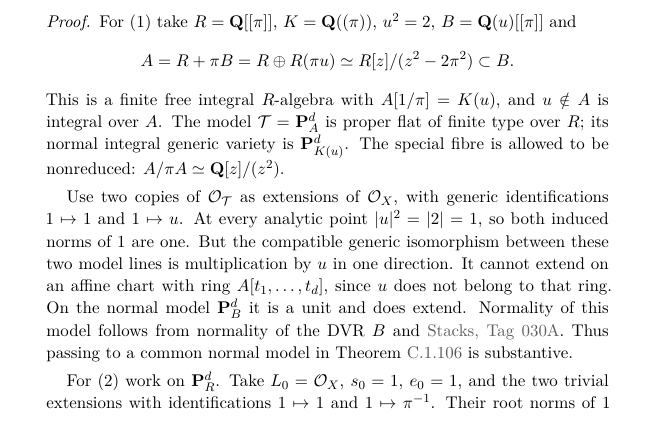
For (1) take $R=\mathbf Q[[\pi]]$, $K=\mathbf Q((\pi))$,
$u^2=2$, $B=\mathbf Q(u)[[\pi]]$ and
\[
 A=R+\pi B=R\oplus R(\pi u)
           \simeq R[z]/(z^2-2\pi^2)\subset B.
\]
This is a finite free integral $R$-algebra with $A[1/\pi]=K(u)$,
and $u\notin A$ is integral over $A$. The model
$\cT=\mathbf P^d_A$ is proper flat of finite type over $R$;
its normal integral generic variety is $\mathbf P^d_{K(u)}$.
The special fibre is allowed to be nonreduced:
$A/\pi A\simeq\mathbf Q[z]/(z^2)$.

Use two copies of $\cO_{\cT}$ as extensions of $\cO_X$, with
generic identifications $1\mapsto1$ and $1\mapsto u$.
At every analytic point $|u|^2=|2|=1$, so both induced norms of
$1$ are one. But the compatible generic isomorphism between these
two model lines is multiplication by $u$ in one direction.
It cannot extend on an affine chart with ring $A[t_1,\ldots,t_d]$,
since $u$ does not belong to that ring. On the normal model
$\mathbf P^d_B$ it is a unit and does extend. Normality of this
model follows from normality of the DVR $B$ and \st{030A}.
Thus passing to a common normal model in
Theorem~\ref{f9mi:metric} is substantive.

For (2) work on $\mathbf P^d_R$. Take $L_0=\cO_X$, $s_0=1$,
$e_0=1$, and the two trivial extensions with identifications
$1\mapsto1$ and $1\mapsto\pi^{-1}$. Their root norms of $1$
are respectively $1$ and $|\pi|$. For $1\leq i\leq d$ take the
standard extension of $\cO_X(1)$ with section $Z_i$.
Set $S_0=\varnothing$ and $S_i=\{Z_i=0\}$; the total generic
intersection is empty. The first computation has model section
$\sigma_0=1$ and value zero. In the second $\sigma_0=\pi$.
Its first intersection is the full special fibre. Intersecting
with $Z_1,\ldots,Z_d$ gives the $k$-rational point
$[1:0:\cdots:0]$ with length one. The second value is therefore
$+\lambda$. This verifies the sign without using the pending
logarithmic induction theorem.

For (3) use the proper normal quadric
$ad-bc=0$ in $\mathbf P^4_K$ and $f=a/c$, with prescribed support
$P_0\cup P_1$, $P_0=\{a=b=0\}$, $P_1=\{c=d=0\}$.
The reviewed obstruction proof establishes that every effective
Cartier divisor supported on this union near the vertex has zero
coefficients at both planes: its pullback to the displayed small
resolution restricts as $\cO_{\mathbf P^1}(m+n)$ on the
exceptional curve, while a principal local divisor restricts
trivially; $m,n\geq0$ force $m=n=0$.
A signed presentation of $r\divi(f)$ would thus have zero
coefficients at both planes, contradicting $r,-r$ for every $r>0$.
\end{proof}
Typeset reader excerpt
Typed proof inputs
- CLAUSE:NAG-003112:supported_gysin_1_4 · selected scope (reviewed local context prerequisite)
- NAG-003044 · selected whole (exact reviewed native application)
- NAG-003126 · selected whole (reviewed local context prerequisite)
Reader cross-references
Proof map
Verified map inputs · NAG-003133
AND · joint registered proof inputs
- CLAUSE:NAG-003112:supported_gysin_1_4 · supported gysin 1 4 · selected scope Exact source window 260–311
- Reviewed local context or earlier result used within this exact original proof.
- NAG-003044 · A principal divisor with no presentation on its support · accepted whole Exact source window 255
- Effective-support obstruction for every positive power
- NAG-003126 · Metric equality and compatible powered extensions · accepted whole Exact source window 260–311
- Reviewed local context or earlier result used within this exact original proof.
NAG-003133 · Failures of weaker replacement statements · Chapter argument