NAG-003146 · Accepted whole
Result G.0.25
G Stable inertia and original-field models
Open in the English reader · PDF page 2045
Source provenance: transcription from the printed reader.
Statement and full selected proof · exact TeX
% PDF-derived reading copy. The signed historical source evidence accompanies this file.
\begingroup
\def\ord{\operatorname{ord}}
\def\Spec{\operatorname{Spec}}
\section*{Normalizers in exact Kummer descent}
\noindent{\small\textit{PDF-derived transcription.} Historical English reader,
Section 1.55, Lemma 1.55.4, printed pages 220--221. The standing context is
from printed pages 216--217. The historical original TeX remains unlocated.}\par\medskip
The lemma uses the valued-field convention, the exact Kummer step (K*)
and the action convention below. The remaining definitions record the
surrounding historical terminology.
% PDF-derived standing context. The reader's provenance banner precedes it.
\subsection*{Standing context}
% @witness context 226:52-54
Throughout, a valued field is complete and nontrivially real-valued, with
additive valuation \(v\), actual valuation ring \(F^\circ\), maximal ideal
\(\mathfrak m_F\), value group \(\Gamma_F\), and residue field \(\widetilde F\).
Finite extensions carry their unique extending absolute values. Their existence,
uniqueness and
% @witness context_continued 227:4-33
completeness are \hyperref[fnd:finiteextensionnorms]{\texttt{NAG-001450}}. Simple residue roots lift by
\hyperref[cand:completevaluationhenselian]{\texttt{NAG-002049}}.

For a finite separable extension \(E/K\), the \emph{explicit tame hypotheses}
in this patch mean all three conditions
% @formula Tg 227
\begin{equation}\tag{Tg}
\begin{gathered}
 e=[\Gamma_E:\Gamma_K],\qquad f=[\widetilde E:\widetilde K],\qquad [E:K]=ef,\\
 e\in(K^\circ)^\times,\qquad \widetilde E/\widetilde K\text{ separable}.
\end{gathered}
\end{equation}
Thus defectlessness is an assumption, not a consequence of the other two
conditions. An \emph{actual unramified lift} means the finite separable residue
lift constructed by \hyperref[cand:residueextensionlift]{\texttt{NAG-002050}}; in the Galois case its
valuation rings have the finite free etale torsor property of
\hyperref[v036:f5:unramifiedcoefficients]{\texttt{NAG-002262}}.

An \emph{exact Kummer step} \(F\subset F(s)\) of degree \(n\ge2\) means the
precise coefficient class of \hypertarget{foundations.nag003146.use.nag002610.exact-kummer-coefficients}{}\hyperref[cand:f5tame:charactercriterion]{\texttt{NAG-002610}}:
% @formula K* 227
\begin{equation}\tag{K*}
\begin{gathered}
 n\in(F^\circ)^\times,\qquad \zeta\in F^\circ,\qquad
 \ord(\zeta)=\ord(\bar\zeta)=n,\\
 s^n\in F^\times,\qquad v(s)>0,\qquad jv(s)\notin\Gamma_F\quad(0<j<n).
\end{gathered}
\end{equation}
Its integral extension is faithfully flat but need not be finite. We use left
scheme actions \(\rho_g\) covering \(\Spec(g^{-1})\), and linearizations
\(\rho_g^*\mathcal L\simeq\mathcal L\), as in the frozen mixed packet.
Identity on a special fibre always means identity on the entire scheme or
restricted module, including its structure sheaf.

% PDF-derived transcription. Historical TeX anchor cand:f5gen:normalizerdescent, line 284.
% @witness statement 230:19-29
\NextLinkTarget{foundations.nag003146.pdf-derived}
\begin{lemma}[Retaining a normalizer action at a Kummer step]
\label{cand:f5gen:normalizerdescent}
Let \(F/E\) be an exact Kummer step with group \(Q\). Let a finite group \(P\)
act on \(F\) by isometric field automorphisms preserving \(E\), with
\(Q\triangleleft P\), and suppose its restriction to \(Q\) is the specified
Galois action. Let \(Z/F^\circ\) be projective, flat, finitely presented
and nodal of relative dimension one, with a compatible semilinear
\(P\)-action. Suppose \(Q\) acts identically on the entire special scheme.
Then the canonical \(Q\)-descent \(Z_E/E^\circ\) carries a canonical
semilinear \(P/Q\)-action, and its base-change comparison is \(P\)-equivariant.

A \(P\)-linearized relatively ample invertible sheaf with identity \(Q\)-action
on its full residue module descends to a relatively ample \(P/Q\)-linearized
invertible sheaf on \(Z_E\). Both descents are functorial for equivariant
isomorphisms with their specified comparisons. The action of \(P/Q\) on \(E\)
need not be faithful; there is no unramified hypothesis on any lower field.
\end{lemma}
% @witness proof 230:31-51
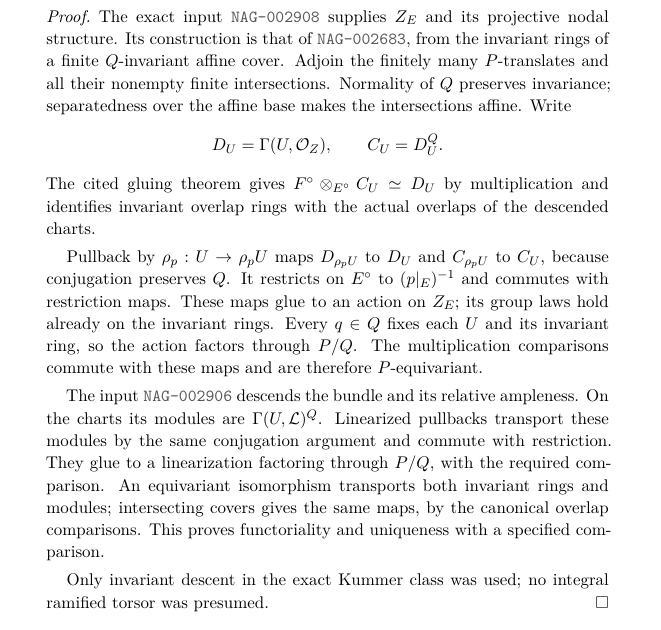
\begin{proof}
The exact input \hypertarget{foundations.nag003146.use.nag002908.projective-nodal-model}{}\hyperref[cand:f5proj:projectivedescent]{\texttt{NAG-002908}} supplies \(Z_E\)
and its projective nodal structure. Its construction is that of
\hypertarget{foundations.nag003146.use.nag002683.invariant-affine-chart-gluing}{}\hyperref[cand:f5glue:globaldescent]{\texttt{NAG-002683}}, from the invariant rings of a finite
\(Q\)-invariant affine cover. Adjoin the finitely many \(P\)-translates
and all their nonempty finite intersections. Normality of \(Q\) preserves
invariance; separatedness over the affine base makes the intersections affine.
Write
% @formula invariant_charts 230
\[
 D_U=\Gamma(U,\mathcal O_Z),\qquad C_U=D_U^Q.
\]
The cited gluing theorem gives \(F^\circ\otimes_{E^\circ}C_U\simeq D_U\)
by multiplication and identifies invariant overlap rings with the actual
overlaps of the descended charts.

Pullback by \(\rho_p:U\to\rho_pU\) maps \(D_{\rho_pU}\) to \(D_U\) and
\(C_{\rho_pU}\) to \(C_U\), because conjugation preserves \(Q\). It restricts
on \(E^\circ\) to \((p|_E)^{-1}\) and commutes with restriction maps.
These maps glue to an action on \(Z_E\); its group laws hold already on the
invariant rings. Every \(q\in Q\) fixes each \(U\) and its invariant ring,
so the action factors through \(P/Q\). The multiplication comparisons
commute with these maps and are therefore \(P\)-equivariant.

The input \hypertarget{foundations.nag003146.use.nag002906.same-linearized-bundle}{}\hyperref[cand:f5proj:linebundledescent]{\texttt{NAG-002906}} descends the bundle and
its relative ampleness. On the charts its modules are \(\Gamma(U,\mathcal L)^Q\).
Linearized pullbacks transport these modules by the same conjugation argument
and commute with restriction. They glue to a linearization factoring through
\(P/Q\), with the required comparison. An equivariant isomorphism transports
both invariant rings and modules; intersecting covers gives the same maps,
by the canonical overlap comparisons. This proves functoriality and uniqueness
with a specified comparison.

% @witness proof_continued 231:4-5
Only invariant descent in the exact Kummer class was used; no integral
ramified torsor was presumed.
\end{proof}
\endgroup
Typeset reader excerpt
Typed proof inputs
- NAG-002610 · selected whole (prerequisites)
- NAG-002683 · selected whole (prerequisites)
- NAG-002906 · selected whole (prerequisites)
- NAG-002908 · selected whole (prerequisites)
- NAG-002610 · selected whole (explicit current dependencies)
- NAG-002683 · selected whole (explicit current dependencies)
- NAG-002906 · selected whole (explicit current dependencies)
- NAG-002908 · selected whole (explicit current dependencies)
Proof map
Verified map inputs · NAG-003146
AND · joint registered proof inputs
- NAG-002610 · Character modules give an exact integral test · accepted whole
- NAG-002683 · Effective descent of a supplied separated nodal curve · accepted whole
- NAG-002906 · Line bundles and relative ampleness · accepted whole
- NAG-002908 · Projective descent in the exact tame Kummer class · accepted whole