NAG-003149 · Accepted whole
A noncyclic obstruction surviving unramified base change
G Stable inertia and original-field models
Open in the English reader · PDF page 2038
Source provenance: transcription from the printed reader.
Statement and full selected proof · exact TeX
\NextLinkTarget{foundations.nag003149.pdf-derived}
\begin{proposition}[A noncyclic obstruction surviving unramified base change]
\label{f5gt:pdf-derived:noncyclicexample}
Give \(\mathbb Q(x,y)\) the valuation trivial on \(\mathbb Q\) with
\(v(x)=1\) and \(v(y)=\sqrt2\), defined on polynomials by the least monomial
value, and let \(K\) be its completion. Then \(\Gamma_K=\mathbb Z+\sqrt2\mathbb Z\)
and \(\widetilde K=\mathbb Q\). For
% @formula 25 233
\begin{equation}\label{eq:f5gt:pdf-derived:quadratic-generators}
 L=K(u,w),\qquad u^2=x,\qquad w^2=y,
\end{equation}
the field extension is tame Galois, of degree and value index four, with
unchanged residue field, and
% @formula 26 233
\begin{equation}\label{eq:f5gt:pdf-derived:noncyclic-quotients}
 \Gal(L/K)=I\simeq(\mathbb Z/2)^2,\qquad
 \Gamma_L/\Gamma_K\simeq(\mathbb Z/2)^2.
\end{equation}
The same assertions hold over any actual finite unramified extension \(N/K\)
after replacing \(L\) by \(LN\), with residue field \(\widetilde N\) and
degree four over \(N\). Consequently no such base change converts this into
one full-value-index cyclic Kummer step. Two exact quadratic steps suffice.
This is a complete rank-one nondiscrete example.
\end{proposition}
\par\smallskip\noindent{\small\textit{Direct inputs} \hyperref[fnd:finiteextensionnorms]{\texttt{NAG-001450}}, \hyperref[cand:residueextensionlift]{\texttt{NAG-002050}}, \hyperref[f5gt:pdf-derived:radicalsteps]{\texttt{NAG-003143}}.}\par\smallskip
\begin{proof}
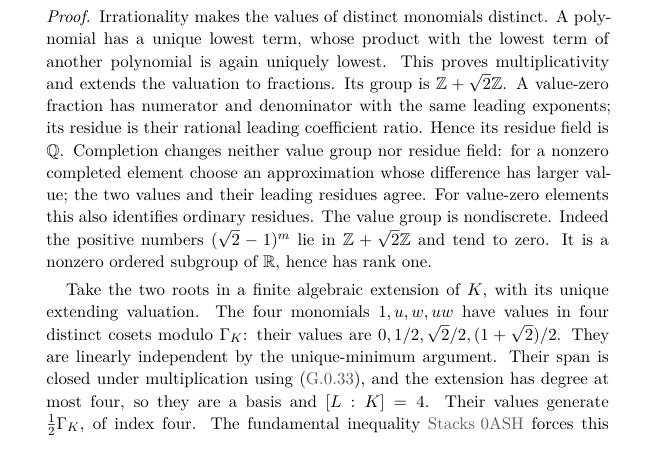
Irrationality makes the values of distinct monomials distinct. A polynomial
has a unique lowest term, whose product with the lowest term of another
polynomial is again uniquely lowest. This proves multiplicativity and extends
the valuation to fractions. Its group is \(\mathbb Z+\sqrt2\mathbb Z\).
A value-zero fraction has numerator and denominator with the same leading
exponents; its residue is their rational leading coefficient ratio.
Hence its residue field is \(\mathbb Q\). Completion changes neither value
group nor residue field: for a nonzero completed element choose an
approximation whose difference has larger value; the two values and their
leading residues agree. For value-zero elements this also identifies
ordinary residues. The value group is nondiscrete. Indeed the positive
numbers \((\sqrt2-1)^m\) lie in \(\mathbb Z+\sqrt2\mathbb Z\) and tend to zero.
It is a nonzero ordered subgroup of \(\mathbb R\), hence has rank one.

Take the two roots in a finite algebraic extension of \(K\), with its unique
extending valuation. The four monomials \(1,u,w,uw\) have values in four
distinct cosets modulo \(\Gamma_K\): their values are
\(0,1/2,\sqrt2/2,(1+\sqrt2)/2\).
They are linearly independent by the unique-minimum argument. Their span is
closed under multiplication using \eqref{eq:f5gt:pdf-derived:quadratic-generators}, and the extension has degree at most
four, so they are a basis and \([L:K]=4\). Their values generate
\(\frac12\Gamma_K\), of index four. The fundamental inequality \stacks{0ASH}
forces this to be the whole value group and forces residue degree one.
Independent sign changes of \(u,w\) are four automorphisms, giving \eqref{eq:f5gt:pdf-derived:noncyclic-quotients};
they are all inertia. Residue characteristic zero, equality of degree with
value index, and unchanged residue verify all of \eqref{eq:f5gt:pdf-derived:tame-hypotheses}.

The tower \(K\subset K(u)\subset L\) has value index and degree two at each
step: the new value classes are represented by \(1/2\) and \(\sqrt2/2\),
respectively. Their positive generators and the root \(-1\), of residue
order two, satisfy \eqref{eq:f5gt:pdf-derived:exact-kummer}. For any actual unramified \(N/K\), its value group
is still \(\Gamma_K\). Lemma~\ref{f5gt:pdf-derived:radicalsteps} proves \(L\otimes_K N=LN\), degree
and value index four, and unchanged residue over \(N\). The four sign changes
extend on this tensor product, giving the same noncyclic inertia and value
quotient. A single \eqref{eq:f5gt:pdf-derived:exact-kummer} step of degree four has a cyclic value quotient of
order four and a cyclic Galois group. Both conflict with \eqref{eq:f5gt:pdf-derived:noncyclic-quotients}. This proves
the asserted obstruction, even if \(N\) contains a primitive fourth root
of unity.
\end{proof}
Typeset reader excerpt
Typed proof inputs
- NAG-001450 · selected whole (prerequisites)
- NAG-002050 · selected whole (prerequisites)
- NAG-003143 · selected whole (prerequisites)
- STACKS-0ASH · named external application
- NAG-001450 · selected whole (explicit current dependencies)
- NAG-002050 · selected whole (explicit current dependencies)
- NAG-003143 · selected whole (explicit current dependencies)
Reader cross-references
Proof map
Verified map inputs · NAG-003149
AND · joint registered proof inputs
- NAG-001450 · Finite-dimensional norms and finite field extensions · accepted whole
- NAG-002050 · Lifting a finite separable residue extension · accepted whole
- NAG-003143 · Corrected radicals and a value basis · accepted whole
NAG-003149 · A noncyclic obstruction surviving unramified base change · Chapter argument