NAG-001524 · Accepted whole
Effective descent of finite modules for a Laurent pair
2 Analytic spaces, morphisms and fibres
Open in the English reader · PDF page 237
Statement · exact TeX
\begin{theorem}[\bi{Effective descent of finite modules for a Laurent pair}{Laurent 对上的有限模有效下降}]\label{fnd:laurentfiniteeffectivedescent}
\bi{The functor from finite $A$-modules to finite Laurent gluing data, given by ordinary base change to $A_+$ and $A_-$, is an equivalence of categories. Its inverse sends the datum to $N=\ker\delta$. This $N$ is a finite $A$-module, and its norm induced from $N_+\oplus N_-$ is uniformly equivalent to its canonical finite-module norm. The canonical maps}
{从有限 $A$-模到有限模 Laurent 粘合数据的函子,即对 $A_+$ 与 $A_-$ 作普通基变换,是范畴等价。其逆将粘合数据送到 $N=\ker\delta$。这个 $N$ 是有限 $A$-模,其从 $N_+\oplus N_-$ 诱导的范数与 canonical 有限模范数一致等价。典范映射}
\[
 A_\tau\otimes_A N\longrightarrow N_\tau\qquad(\tau=+,-,0)
\]
\bi{are bounded isomorphisms with bounded inverses, and the same assertions hold for separated completed tensor products. In particular, the sequence $0\to N\to N_+\oplus N_-\xrightarrow{\delta}N_0\to0$ is norm-strict exact. All assertions extend to a radius $r\in|K^\times|$ by scalar rescaling.}
{均为有界同构,且具有有界逆;对于 separated completed tensor products,相同结论成立。特别地,序列 $0\to N\to N_+\oplus N_-\xrightarrow{\delta}N_0\to0$ 为 norm-strict 正合。通过标量缩放,全部结论延伸到任意半径 $r\in|K^\times|$。}
\end{theorem}
Full selected proof · exact TeX
\begin{proof}
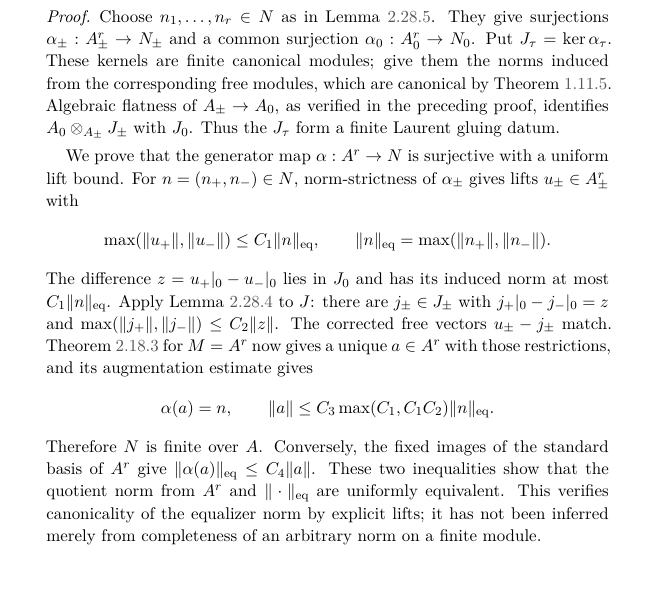
\bi{Choose $n_1,\ldots,n_r\in N$ as in Lemma~\ref{fnd:laurentgluinggenerators}. They give surjections $\alpha_\pm:A_\pm^r\to N_\pm$ and a common surjection $\alpha_0:A_0^r\to N_0$. Put $J_\tau=\ker\alpha_\tau$. These kernels are finite canonical modules; give them the norms induced from the corresponding free modules, which are canonical by Theorem~\ref{fnd:strictfinitemodules}. Algebraic flatness of $A_\pm\to A_0$, as verified in the preceding proof, identifies $A_0\otimes_{A_\pm}J_\pm$ with $J_0$. Thus the $J_\tau$ form a finite Laurent gluing datum.}
{按 Lemma~\ref{fnd:laurentgluinggenerators} 选择 $n_1,\ldots,n_r\in N$。它们给出满射 $\alpha_\pm:A_\pm^r\to N_\pm$ 及共同的满射 $\alpha_0:A_0^r\to N_0$。令 $J_\tau=\ker\alpha_\tau$。这些核为有限 canonical 模;给它们配备从相应自由模诱导的范数,由 Theorem~\ref{fnd:strictfinitemodules},这些范数也是 canonical 的。前一证明已经核验 $A_\pm\to A_0$ 代数平坦,因此 $A_0\otimes_{A_\pm}J_\pm$ 与 $J_0$ 识别。故各 $J_\tau$ 构成有限模 Laurent 粘合数据。}

\bi{We prove that the generator map $\alpha:A^r\to N$ is surjective with a uniform lift bound. For $n=(n_+,n_-)\in N$, norm-strictness of $\alpha_\pm$ gives lifts $u_\pm\in A_\pm^r$ with}
{下面证明生成映射 $\alpha:A^r\to N$ 满射,并具有统一提升界。对 $n=(n_+,n_-)\in N$,由 $\alpha_\pm$ 的 norm-strict 性,可取提升 $u_\pm\in A_\pm^r$ 满足}
\[
 \max(\|u_+\|,\|u_-\|)\leq C_1\|n\|_{\rm eq},
 \qquad \|n\|_{\rm eq}=\max(\|n_+\|,\|n_-\|).
\]
\bi{The difference $z=u_+|_0-u_-|_0$ lies in $J_0$ and has its induced norm at most $C_1\|n\|_{\rm eq}$. Apply Lemma~\ref{fnd:laurentgluingcoboundary} to $J$: there are $j_\pm\in J_\pm$ with $j_+|_0-j_-|_0=z$ and $\max(\|j_+\|,\|j_-\|)\leq C_2\|z\|$. The corrected free vectors $u_\pm-j_\pm$ match. Theorem~\ref{fnd:laurentlocalizationmodules} for $M=A^r$ now gives a unique $a\in A^r$ with those restrictions, and its augmentation estimate gives}
{差 $z=u_+|_0-u_-|_0$ 属于 $J_0$,其诱导范数至多为 $C_1\|n\|_{\rm eq}$。将 Lemma~\ref{fnd:laurentgluingcoboundary} 应用于 $J$,可取 $j_\pm\in J_\pm$,使 $j_+|_0-j_-|_0=z$ 且 $\max(\|j_+\|,\|j_-\|)\leq C_2\|z\|$。修正后的自由向量 $u_\pm-j_\pm$ 相互匹配。将 Theorem~\ref{fnd:laurentlocalizationmodules} 应用于 $M=A^r$,得到唯一的 $a\in A^r$ 具有这些限制;该定理的增广估计给出}
\[
 \alpha(a)=n,
 \qquad \|a\|\leq C_3\max(C_1,C_1C_2)\|n\|_{\rm eq}.
\]
\bi{Therefore $N$ is finite over $A$. Conversely, the fixed images of the standard basis of $A^r$ give $\|\alpha(a)\|_{\rm eq}\leq C_4\|a\|$. These two inequalities show that the quotient norm from $A^r$ and $\|\cdot\|_{\rm eq}$ are uniformly equivalent. This verifies canonicality of the equalizer norm by explicit lifts; it has not been inferred merely from completeness of an arbitrary norm on a finite module.}
{因此 $N$ 在 $A$ 上有限。反方向,$A^r$ 的标准基具有固定的像,故有 $\|\alpha(a)\|_{\rm eq}\leq C_4\|a\|$。这两个不等式说明来自 $A^r$ 的商范数与 $\|\cdot\|_{\rm eq}$ 一致等价。因此,等化子范数的 canonical 性由显式提升得到,并非仅仅从有限模上某个范数的完备性推断。}

\bi{Let $J=\ker(A^r\xrightarrow{\alpha}N)$. The free Laurent equalizer identifies $J$ with $\ker(J_+\oplus J_-\to J_0)$. Lemma~\ref{fnd:laurentgluinggenerators}, now applied to this kernel datum, says that $A_\pm J=J_\pm$ inside $A_\pm^r$. Ordinary right exactness of tensor products, \cite[Tag 00DF, Lemma 10.12.10]{StacksAlg}, therefore identifies both $A_\pm\otimes_A N$ and $N_\pm$ with $A_\pm^r/J_\pm$. The same conclusion for $A_0$ follows by tensor associativity, \cite[Tag 00D2, Lemma 10.12.7]{StacksAlg}. These canonical algebraic isomorphisms are bounded with bounded inverses by Theorem~\ref{fnd:strictfinitemodules}. Proposition~\ref{fnd:strictfinitetensor} then gives the completed-tensor statements. No exactness claim for the completed tensor product of arbitrary Banach modules occurs.}
{令 $J=\ker(A^r\xrightarrow{\alpha}N)$。自由模的 Laurent equalizer 将 $J$ 与 $\ker(J_+\oplus J_-\to J_0)$ 识别。再对这个核的粘合数据应用 Lemma~\ref{fnd:laurentgluinggenerators},可知在 $A_\pm^r$ 中有 $A_\pm J=J_\pm$。由普通张量积的右正合性,即 \cite[Tag 00DF, Lemma 10.12.10]{StacksAlg},$A_\pm\otimes_A N$ 与 $N_\pm$ 都与 $A_\pm^r/J_\pm$ 识别。对 $A_0$ 的相同结论来自张量积结合律 \cite[Tag 00D2, Lemma 10.12.7]{StacksAlg}。由 Theorem~\ref{fnd:strictfinitemodules},这些典范代数同构及其逆均有界。再应用 Proposition~\ref{fnd:strictfinitetensor},即得完备张量积的结论。这里没有使用任意 Banach 模的完备张量积正合性。}

\bi{A compatible pair of morphisms of gluing data preserves the two equalizers and hence gives an $A$-linear map between the descended modules. The canonical base-change isomorphisms recover the original morphisms. Conversely, starting from a finite $A$-module, Theorem~\ref{fnd:laurentlocalizationmodules} identifies its equalizer with that same module. These statements verify that the two functors are mutually inverse, including on morphisms. The equalizer is closed, its norm is canonical by the preceding estimates, and the last map is norm-strict by Lemma~\ref{fnd:laurentgluingcoboundary}; thus the asserted sequence is norm-strict exact. For $r=|c|$ with $c\in K^\times$, replace $f$ by $f/c$, $T$ by $T/c$ and $U$ by $cU$. This is the isometric radius normalization of the displayed presentations and proves the last assertion.}
{粘合数据之间的相容态射对保持两个 equalizer,因此给出下降模之间的 $A$-线性映射。典范基变换同构又恢复原来的态射。反之,从有限 $A$-模出发时,Theorem~\ref{fnd:laurentlocalizationmodules} 将所得 equalizer 与原模识别。这些论证说明两个函子在对象和态射上均互逆。等化子闭,且由前述估计其范数为 canonical;最后的映射由 Lemma~\ref{fnd:laurentgluingcoboundary} 为 norm-strict,故所列序列为 norm-strict 正合。若 $r=|c|$ 且 $c\in K^\times$,将 $f$ 换为 $f/c$、$T$ 换为 $T/c$、$U$ 换为 $cU$。这是所列表示的等距半径归一化,从而证明最后的断言。}
\end{proof}
Standing context 1 · exact TeX
\section{\bi{Finite modules and Laurent descent}{有限模与 Laurent 下降}}\label{fnd:finitemodulelaurentdescent}

\bi{Tate exactness concerns the localizations of a module that is already defined over the original algebra. For coherence we must also construct a global module from finite modules given separately on a covering. The additional analytic step is a bounded lifting argument for arbitrary finite Laurent gluing data. We then use maximal residue fields to obtain generators and apply the lifting argument once more to the relations. This reconstructs the method of Kiehl's theorem as developed in \cite[\S9.4.3, Lemmas 5--6, pp.~378--382]{BGR84}, with the finite-module norms and the restricted site specified explicitly.}
{Tate 正合性处理的是已经定义在原代数上的模的局部化。凝聚性还要求从覆盖各部分分别给出的有限模构造整体模。额外的解析步骤,是对任意有限模 Laurent 粘合数据证明有界提升。随后借助极大剩余域取得生成元,并对关系模再次应用提升论证。下面重构 \cite[\S9.4.3, Lemmas 5--6, pp.~378--382]{BGR84} 所展开的 Kiehl 定理的方法,同时明确有限模范数及所用的受限 site。}

\bi{Unless an additional hypothesis is stated, $K$ is a complete real-valued non-Archimedean field, its valuation may be trivial, and $A$ is a strict $K$-affinoid algebra with a norm-admissible Banach norm. Relation ideals are actual ideals; their closedness and the canonical norms of finite modules are supplied by Theorem~\ref{fnd:strictfinitemodules}. The zero algebra and its zero module are allowed separately. Radii belong to $|K^\times|$ and can be scaled to one. Ordinary tensor products in this section are algebraic tensor products. A completed-tensor assertion is made only after its finite-module comparison has been established.}
{除非另行声明,$K$ 是完备的实值非阿基米德域,允许赋值平凡;$A$ 为配备 norm-admissible Banach 范数的 strict $K$-affinoid 代数。关系理想均指实际理想;其闭性及有限模的 canonical 范数由 Theorem~\ref{fnd:strictfinitemodules} 给出。零代数及其零模作为独立情形允许在内。半径属于 $|K^\times|$,可缩放为一。本节的普通张量积均为代数张量积;只有在建立相应有限模比较之后,才作出完备张量积的断言。}
Standing context 2 · exact TeX
\begin{definition}[\bi{Finite Laurent gluing data}{有限模 Laurent 粘合数据}]\label{fnd:laurentfinitegluingdatum}
\bi{For the next three results fix $f\in A$ and use the following actual quotient algebras with their quotient norms:}
{在下面三个结果中固定 $f\in A$,并使用下列实际商代数及其商范数:}
\[
 \begin{aligned}
 A_+&=A\{T\}/(T-f),& A_-&=A\{U\}/(1-fU),\\
 A_0&=A\{T,U\}/(T-f,TU-1).
 \end{aligned}
\]
\bi{A finite Laurent gluing datum means finite modules $N_+$ over $A_+$ and $N_-$ over $A_-$, together with an $A_0$-linear isomorphism between $A_0\otimes_{A_+}N_+$ and $A_0\otimes_{A_-}N_-$. Denote the common module by $N_0$, the two maps by $\rho_+,\rho_-$, and their difference by $\delta$. Equip the finite modules with canonical norms. A morphism of such data is a pair of local module maps commuting with the given overlap isomorphisms.}
{有限模 Laurent 粘合数据是指 $A_+$ 上的有限模 $N_+$、$A_-$ 上的有限模 $N_-$,以及 $A_0\otimes_{A_+}N_+$ 与 $A_0\otimes_{A_-}N_-$ 之间的一个 $A_0$-线性同构。将共同的模记作 $N_0$,将两个映射记作 $\rho_+,\rho_-$,其差记作 $\delta$。给各有限模配备 canonical 范数。这类数据之间的态射,是与给定交叠同构交换的一对局部模映射。}
\end{definition}

\bi{The gluing isomorphism and its inverse are bounded by Theorem~\ref{fnd:strictfinitemodules}. Thus boundedness follows from the finite canonical module structure.}
{由 Theorem~\ref{fnd:strictfinitemodules},粘合同构及其逆有界。因此有界性由有限 canonical 模结构推出。}
Typeset reader excerpt
Typed proof inputs
- NAG-001403 · selected whole (sealed native whole)
- NAG-001404 · selected whole (sealed native whole)
- NAG-001434 · selected whole (sealed native whole)
- NAG-001437 · selected whole (sealed native whole)
- NAG-001439 · selected whole (sealed native whole)
- NAG-001447 · selected whole (sealed native whole)
- NAG-001522 · selected whole (sealed native whole)
- NAG-001523 · selected whole (earlier independently reviewed whole proposal)
- STACKS-00D2 · named external application (exact existing frozen Stacks consumer)
- STACKS-00DF · named external application (exact existing frozen Stacks consumer)
- APP-STACKS-00D2@NAG-001524:exact-original-358-site-8 · named external application
- APP-STACKS-00D2@NAG-001524:exact-original-358-site-8 · named external application (requires)
- APP-STACKS-00DF@NAG-001524:exact-original-358-site-7 · named external application
- APP-STACKS-00DF@NAG-001524:exact-original-358-site-7 · named external application (requires)
- NAG-001403 · selected whole
- NAG-001403 · selected whole (requires)
- NAG-001404 · selected whole
- NAG-001404 · selected whole (requires)
- NAG-001434 · selected whole
- NAG-001434 · selected whole (requires)
- NAG-001437 · selected whole
- NAG-001437 · selected whole (requires)
- NAG-001439 · selected whole
- NAG-001439 · selected whole (requires)
- NAG-001447 · selected whole
- NAG-001447 · selected whole (requires)
- NAG-001522 · selected whole
- NAG-001522 · selected whole (requires)
- NAG-001523 · selected whole
- NAG-001523 · selected whole (requires)
Reader cross-references
Proof map
Verified map inputs · NAG-001524
AND · joint registered proof inputs
- NAG-001403 · Finite modules over strict affinoids · accepted whole
- NAG-001404 · Finite tensor comparison with an affinoid target · accepted whole
- NAG-001434 · Strict weighted adjunction and relation quotients · accepted whole
- NAG-001437 · Adjoining variables after a quotient · accepted whole
- NAG-001439 · The quotient-algebra Laurent sequence · accepted whole
- NAG-001447 · Elementary flatness and strict finite-module exactness · accepted whole
- NAG-001522 · Bounded lifting for arbitrary finite Laurent data · accepted whole
- NAG-001523 · Global matching elements generate the local modules · accepted whole
Unlinked source pointers
These pointers have no operative linked edge in this map.
APP-STACKS-00D2@NAG-001524:exact-original-358-site-8APP-STACKS-00DF@NAG-001524:exact-original-358-site-7STACKS-00D2STACKS-00DF
NAG-001524 · Effective descent of finite modules for a Laurent pair · Chapter argument