NAG-001439 · Accepted whole
The quotient-algebra Laurent sequence
2 Analytic spaces, morphisms and fibres
Open in the English reader · PDF page 173
Statement · exact TeX
\begin{theorem}[\bi{The quotient-algebra Laurent sequence}{商代数上的 Laurent 序列}]\label{fnd:laurentlocalizationmodules}
\bi{Let $M$ be a finite $A$-module, give it the quotient norm from a chosen surjection $A^m\to M$, and fix $f\in A$ and $r\in|K^\times|$. Put}
{设 $M$ 为有限 $A$-模,配备所选满射 $A^m\to M$ 诱导的商范数,并固定 $f\in A$ 与 $r\in|K^\times|$。记}
\[
 \begin{split}
 A_+&=A\{r^{-1}T\}/(T-f),\\
 A_-&=A\{rU\}/(1-fU),\\
 A_0&=A\{r^{-1}T,rU\}/(T-f,TU-1),\\
 M_\tau&=A_\tau\otimes_A M\qquad(\tau\in\{+,-,0\}).
 \end{split}
\]
\bi{Give each $M_\tau$ its quotient norm from $A_\tau^m$. These are finite canonical modules over the corresponding strict quotient algebras, and the ordinary-to-completed tensor maps are isometries. There are canonical isometric identifications}
{给每个 $M_\tau$ 配备来自 $A_\tau^m$ 的商范数。它们为相应 strict 商代数上的有限 canonical 模,且从普通张量积到完备张量积的映射均为等距同构。存在典范等距识别}
\[
 M_+\simeq P_+,\qquad M_-\simeq P_-,\qquad M_0\simeq P_0,
\]
\bi{where $P_+,P_-,P_0$ are the coefficient quotients of Corollary~\ref{fnd:strictcoefficientlaurentpair}. Under them the quotient-algebra maps give exactly the coefficient inclusions used there, and hence}
{其中 $P_+,P_-,P_0$ 为 Corollary~\ref{fnd:strictcoefficientlaurentpair} 中的系数商。在这些识别下,商代数映射恰好对应那里使用的系数包含映射,因而}
\[
 0\longrightarrow M
 \xrightarrow{m\mapsto(1\otimes m,1\otimes m)}
 M_+\oplus M_-
 \xrightarrow{(u,v)\mapsto u|_0-v|_0}
 M_0\longrightarrow0
\]
\bi{is strict exact with the same augmentation estimate and final quotient isometry. Moreover, the two maps to $A_0$ induce an isometric isomorphism $A_+\widehat\otimes_A A_-\simeq A_0$. If the norm on $M$ is replaced by any uniformly equivalent canonical norm, the identifications are uniformly bounded isomorphisms and the sequence remains strict exact.}
{为 strict exact,并具有相同的 augmentation estimate 以及最后的 quotient isometry。此外,两个到 $A_0$ 的映射诱导等距同构 $A_+\widehat\otimes_A A_-\simeq A_0$。若将 $M$ 的范数换成任意 uniformly equivalent 的 canonical 范数,则这些识别成为具有有界逆的有界同构,而序列仍为 strict exact。}
\end{theorem}
Full selected proof · exact TeX
\begin{proof}
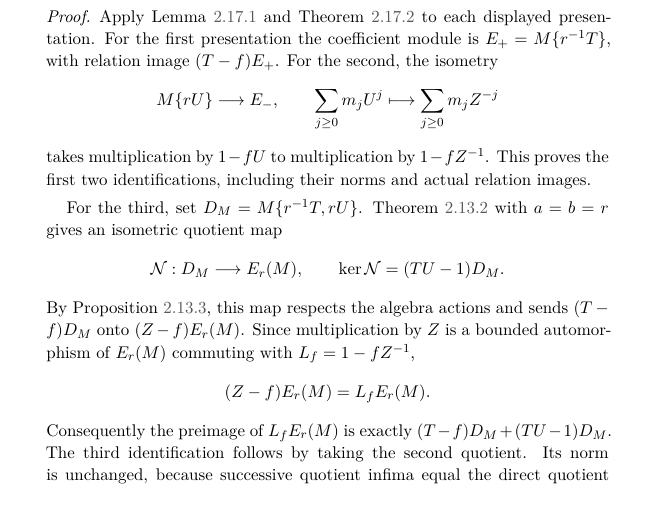
\bi{Apply Lemma~\ref{fnd:strictweightedquotient} and Theorem~\ref{fnd:strictquotientmodule} to each displayed presentation. For the first presentation the coefficient module is $E_+=M\{r^{-1}T\}$, with relation image $(T-f)E_+$. For the second, the isometry}
{对每个所列表示应用 Lemma~\ref{fnd:strictweightedquotient} 与 Theorem~\ref{fnd:strictquotientmodule}。第一个表示的系数模为 $E_+=M\{r^{-1}T\}$,关系像为 $(T-f)E_+$。对第二个表示,等距映射}
\[
 M\{rU\}\longrightarrow E_-,\qquad
 \sum_{j\geq0}m_jU^j\longmapsto\sum_{j\geq0}m_j Z^{-j}
\]
\bi{takes multiplication by $1-fU$ to multiplication by $1-fZ^{-1}$. This proves the first two identifications, including their norms and actual relation images.}
{将乘以 $1-fU$ 的算子送到乘以 $1-fZ^{-1}$ 的算子。这证明前两个识别,并同时确定其范数和实际关系像。}

\bi{For the third, set $D_M=M\{r^{-1}T,rU\}$. Theorem~\ref{fnd:laurentcoefficientnormalform} with $a=b=r$ gives an isometric quotient map}
{对第三个表示,记 $D_M=M\{r^{-1}T,rU\}$。在 Theorem~\ref{fnd:laurentcoefficientnormalform} 中取 $a=b=r$,得到等距商映射}
\[
 \mathcal N:D_M\longrightarrow E_r(M),\qquad
 \ker\mathcal N=(TU-1)D_M.
\]
\bi{By Proposition~\ref{fnd:laurentcoefficientfunctoriality}, this map respects the algebra actions and sends $(T-f)D_M$ onto $(Z-f)E_r(M)$. Since multiplication by $Z$ is a bounded automorphism of $E_r(M)$ commuting with $L_f=1-fZ^{-1}$,}
{由 Proposition~\ref{fnd:laurentcoefficientfunctoriality},该映射与代数作用相容,并将 $(T-f)D_M$ 满射到 $(Z-f)E_r(M)$。由于乘以 $Z$ 是 $E_r(M)$ 的有界自同构,且与 $L_f=1-fZ^{-1}$ 交换,}
\[
 (Z-f)E_r(M)=L_fE_r(M).
\]
\bi{Consequently the preimage of $L_fE_r(M)$ is exactly $(T-f)D_M+(TU-1)D_M$. The third identification follows by taking the second quotient. Its norm is unchanged, because successive quotient infima equal the direct quotient infimum, as in Lemma~\ref{fnd:iteratedstrictquotients}. Theorem~\ref{fnd:strictquotientmodule} identifies that same direct quotient with $M_0$ and its stated canonical norm.}
{因此 $L_fE_r(M)$ 的原像恰为 $(T-f)D_M+(TU-1)D_M$。再取第二个商,便得到第三个识别。其范数保持不变,因为依次取商的下确界等于直接取商的下确界,正如 Lemma~\ref{fnd:iteratedstrictquotients} 中的论证。Theorem~\ref{fnd:strictquotientmodule} 又将该直接商与 $M_0$ 及其所列 canonical 范数相识别。}

\bi{On coefficients, the maps to $M_0$ send $T^jm$ to $Z^jm$ and $U^jm$ to $Z^{-j}m$. Constant elements $m$ map to the same constant class. These identities hold first for polynomial families and then for all series by continuity. They verify every arrow of the displayed sequence, including the sign of the difference map. Corollary~\ref{fnd:strictcoefficientlaurentpair} now proves strict exactness and all its stated norm estimates.}
{在系数上,到 $M_0$ 的映射分别将 $T^jm$ 送到 $Z^jm$,将 $U^jm$ 送到 $Z^{-j}m$;常数元素 $m$ 则送到同一个常数类。这些恒等式先对多项式系数族成立,再由连续性推广到全部级数。由此核对所列序列的每个箭头,包括差映射的符号。现在应用 Corollary~\ref{fnd:strictcoefficientlaurentpair},即得 strict exactness 及其全部范数估计。}

\bi{Theorem~\ref{fnd:strictpresentationpushout} identifies $A_+\widehat\otimes_A A_-$ isometrically with}
{Theorem~\ref{fnd:strictpresentationpushout} 将 $A_+\widehat\otimes_A A_-$ 等距识别为}
\[
 A\{r^{-1}T,rU\}/(T-f,1-fU).
\]
\bi{The ideals $(T-f,1-fU)$ and $(T-f,TU-1)$ are equal, because}
{两个理想 $(T-f,1-fU)$ 与 $(T-f,TU-1)$ 相等,因为}
\[
 1-fU=U(T-f)-(TU-1),\qquad
 TU-1=U(T-f)-(1-fU).
\]
\bi{They are quotients of the same normed coefficient algebra by the same actual ideal, so their quotient norms also agree. This gives the last algebra isometry with the asserted maps. Finally, uniform comparison constants for two norms on $M$ pass to their coefficient spaces, projective tensor seminorms and quotients. This proves the assertion about another canonical norm. The proof includes $f=0$, nonunits, and zero quotient algebras; it uses no localization flatness.}
{它们是同一个赋范系数代数模同一个实际理想的商,故商范数也相等。这给出最后的代数等距同构,并与所述映射相容。最后,$M$ 上两种范数的统一比较常数同样适用于其系数空间、projective tensor seminorm 及各商,因而得到更换 canonical 范数后的结论。该证明包括 $f=0$、非单位元和零商代数,没有使用局部化平坦性。}
\end{proof}
Standing context 1 · exact TeX
\section{\bi{Iterated quotients and elementary Laurent diagrams}{迭代商与 elementary Laurent 图表}}\label{fnd:r1intersectioninterfaces}

\bi{The preceding quotient construction permits a direct comparison of presentations. We first show that adjoining a second block of variables commutes with taking a quotient, with equality of the resulting norms. We then identify the coefficient Laurent sequence with a sequence of finite modules over explicit strict affinoid quotient algebras. These are statements about Banach algebras and modules; identifying them with sections on analytic domains requires the geometric localization theorem.}
{前面的商构造使我们能够直接比较不同表示。先证明添入第二组变量与取商相容,并且所得范数相等;随后将系数 Laurent 序列识别为一列显式 strict affinoid 商代数上的有限模。这里的结论属于 Banach 代数与模的范畴;将它们识别为解析域上的截面,还需要几何局部化定理。}

\bi{Throughout this section, $K$ is complete for its fixed real-valued non-Archimedean absolute value, which may be trivial, and $A$ is a strict $K$-affinoid algebra with the norm conventions of Lemma~\ref{fnd:strictweightedquotient}. All displayed radii belong to $|K^\times|$. A relation quotient is either a strict affinoid algebra or the zero algebra with its zero norm. The latter is allowed in this section as a separate case; it does not satisfy the normalization $\|1\|=1$ in Definition~\ref{fnd:banachalgebra}. Every unital module over it is zero. All quotients below use the actual algebraic ideals or submodules, and their indicated quotient norms.}
{本节中,$K$ 关于固定的实值非阿基米德绝对值完备,允许赋值平凡;$A$ 为 strict $K$-affinoid algebra,采用 Lemma~\ref{fnd:strictweightedquotient} 的范数约定。所有出现的半径均属于 $|K^\times|$。关系商可能是 strict affinoid algebra,也可能是配备零范数的零代数;本节将后者作为独立情形允许在内,它并不满足 Definition~\ref{fnd:banachalgebra} 中的归一化 $\|1\|=1$。零代数上的每个含幺模均为零。以下各商均使用实际的代数理想或子模,并配备指定的商范数。}
Standing context 2 · exact TeX
\begin{definition}\label{fnd:normstrictconvention}
\bi{For a bounded linear map $u:E\to F$, give $\operatorname{im}u$ both its induced norm from $F$ and its quotient seminorm from $E$. The map is norm-strict, or admissible, when these are uniformly equivalent. Since $u$ is bounded, the additional requirement is a constant $C>0$ such that every $y\in\operatorname{im}u$ has a lift $x$ with $\|x\|\leq C\|y\|$. The constant may be enlarged by any fixed factor greater than one to approximate an unattained infimum.}
{对 bounded linear map $u:E\to F$,在 $\operatorname{im}u$ 上同时考虑来自 $F$ 的 induced norm 与来自 $E$ 的 quotient seminorm。当两者 uniformly equivalent 时,称该 map 为 norm-strict,或 admissible。由于 $u$ 已 bounded,额外条件等价于存在常数 $C>0$,使每个 $y\in\operatorname{im}u$ 都有 lift $x$ 满足 $\|x\|\leq C\|y\|$。当 infimum 不取到时,可将常数乘以任意固定的大于一的因子。}
\end{definition}
Standing context 3 · exact TeX
% v0.29 R1.1; proof and scope review are recorded separately.
\section{\bi{Strict quotient presentations and finite modules}{Strict 商表示与有限模}}\label{fnd:r1quotientbridge}
\bi{The coefficient construction is useful for localization only after its relation quotients are controlled. In this section the new radii lie in the value group. This allows the finite-module theorem over strict affinoids to control the actual images of the relation maps. No statement about a structure sheaf is used.}
{系数构造要用于局部化,还须控制加入关系后的商。本节新增变量的半径均位于值群中,因此可以利用 strict affinoid 上的有限模定理控制关系映射的实际像。这里不使用结构层的任何结论。}

\bi{Fix a complete real-valued non-Archimedean field $K$, allowing the trivial absolute value. A nonzero algebra below carries the submultiplicative norm and norm-admissibility convention of Definition~\ref{fnd:banachalgebra}. We also allow a relation ideal to be the whole algebra: its quotient is the zero ring with its zero norm, and every unital module over it is zero. Statements about such a quotient have this explicit degenerate interpretation; the normalization $\|1\|=1$ is required only for nonzero algebras.}
{固定一个关于实值非阿基米德绝对值完备的域 $K$,允许平凡绝对值。下文的非零代数采用 Definition~\ref{fnd:banachalgebra} 中的次乘范数与范数 admissibility 约定。也允许关系理想为整个代数:相应商是配备零范数的零环,其所有幺模均为零。涉及这种商的陈述均按此明确的退化意义理解;$\|1\|=1$ 的归一化只要求于非零代数。}
Standing context 4 · exact TeX
\section{\bi{The ground field and convergence}{Ground field 与 convergence}}\label{fnd:valuedfields}
\begin{definition}\label{fnd:fieldconventions}
\bi{Throughout the foundations, $K$ is a field complete for a real-valued non-Archimedean absolute value. We permit the trivial absolute value unless a statement explicitly excludes it. Set}
{基础篇中,$K$ 是关于 real-valued non-Archimedean absolute value 完备的 field。除非明确排除,否则允许 trivial absolute value。记}
\[
\begin{gathered}
v(a)=-\log|a|,\qquad \Gamma=v(K^\times),\\
K^\circ=\{a\in K:|a|\leq1\},\qquad K^{\circ\circ}=\{a\in K:|a|<1\},\\
\widetilde K=K^\circ/K^{\circ\circ}.
\end{gathered}
\]
\bi{A complete extension $L/K$ always carries an absolute value restricting to the specified one on $K$. We do not rescale it when changing the ground field.}
{Complete extension $L/K$ 始终配备限制为指定 $K$ 上 absolute value 的 absolute value。改变 ground field 时不重新缩放它。}
Typeset reader excerpt
Typed proof inputs
- CLAUSE:NAG-001439:separated_completed_algebra_pushout · typed target unresolved in this export (selected rule)
- CLAUSE:NAG-001439:strict_binary_module_sequence · typed target unresolved in this export (selected rule)
- CLAUSE:NAG-001439:separated_completed_algebra_pushout · typed target unresolved in this export
- CLAUSE:NAG-001439:separated_completed_algebra_pushout · typed target unresolved in this export (requires)
- CLAUSE:NAG-001439:strict_binary_module_sequence · typed target unresolved in this export
- CLAUSE:NAG-001439:strict_binary_module_sequence · typed target unresolved in this export (requires)
Reader cross-references
Proof map
Verified map inputs · NAG-001439
No addressable selected proof input is recorded in this projection.
NAG-001439 · The quotient-algebra Laurent sequence · Chapter argument