actual quotient algebra existing map naturality
The ledger retains this scope. Its exact text or reader anchor is unavailable in this edition.
NAG-001580 · Accepted whole
2 Analytic spaces, morphisms and fibres
Open in the English reader · PDF page 263
\begin{proposition}[\bi{Actual quotient and finite-module base change}{实际商与有限模的基变换}]
\label{fnd:generalizedquotientbasechange}
\leavevmode\par
\bi{Let $A$ be a norm-admissible $K$-affinoid algebra, let $\rho$ be any finite positive tuple, put $D=A\{\rho^{-1}T\}$, and let $J\subseteq D$ be an algebraic ideal. Give $B=D/J$ its quotient norm. For every finite $K$-free tuple $r$, put $L=K_r$ and $E_r=E\widehat\otimes_K L$ for Banach $K$-spaces $E$. Coefficient and quotient maps induce isometric algebra identifications}
{设 $A$ 为 norm-admissible $K$-affinoid 代数,$\rho$ 为任意有限正元组,令 $D=A\{\rho^{-1}T\}$,并取代数理想 $J\subseteq D$。给 $B=D/J$ 配备商范数。对每个在 $K$ 上自由的有限元组 $r$,记 $L=K_r$,并对 Banach $K$-空间 $E$ 记 $E_r=E\widehat\otimes_K L$。系数与商映射诱导等距代数识别}
\[
 \begin{aligned}
 D_r&\simeq A_r\{\rho^{-1}T\},\\
 B_r&\simeq D_r/JD_r.
 \end{aligned}
\]
\bi{The ideal $JD_r$ here is the actual algebraic extended ideal; it is closed and equals $c_0(\mathbf Z^{\ell},r;J)$ in the coefficient description, where $\ell$ is the length of $r$. For every finite canonical $A$-module $M$, the natural maps give a bounded isomorphism with bounded inverse}
{此处 $JD_r$ 为实际的代数延伸理想;它闭,并在系数描述下等于 $c_0(\mathbf Z^{\ell},r;J)$,其中 $\ell$ 为 $r$ 的长度。对每个有限 canonical $A$-模 $M$,自然映射给出有界同构且逆也有界:}
\[
 (B\otimes_A M)_r
   \simeq B_r\otimes_{A_r}M_r.
\]
\bi{Each ordinary tensor displayed is complete for its canonical finite-module norm and agrees boundedly with its separated completed tensor. These identifications commute with bounded maps of such quotient algebras and with maps of finite $A$-modules. No arbitrary complete extension is substituted for the specified free extension in the isometric coefficient statements.}
{每个所列普通张量积在其典范有限模范数下已经完备,并通过有界同构与分离完备张量积相同。这些识别与上述商代数的有界映射以及有限 $A$-模的映射相容。等距系数陈述中的指定自由扩域,不能未经证明替换成任意完备扩域。}
\end{proposition}
\begin{proof}
\bi{Theorem~\ref{fnd:freepolyradiuscoefficients} and Lemma~\ref{fnd:weightedc0rearrangement} identify both descriptions of $D_r$ with the same joint coefficient families, with norm $\sup_{\nu,\alpha}\|a_{\nu\alpha}\|r^\nu\rho^\alpha$. They identify multiplication first on finite polynomials and then by continuity. By Theorem~\ref{fnd:generalizedclosedsubmodules}, $J$ is finite and closed and any finite generator map $D^t\to J$ has a uniform lifting bound for the induced norm on $J$. Applying the coefficient exactness of Proposition~\ref{fnd:weightedc0exact} to $0\to J\to D\to B\to0$ gives a surjection $D_r\to B_r$ with quotient norm equal to the coefficient norm, and with kernel $c_0(\mathbf Z^{\ell},r;J)$.}
{由 Theorem~\ref{fnd:freepolyradiuscoefficients} 及 Lemma~\ref{fnd:weightedc0rearrangement},$D_r$ 的两种描述都与同一个联合系数族空间识别,其范数为 $\sup_{\nu,\alpha}\|a_{\nu\alpha}\|r^\nu\rho^\alpha$。乘法先在有限多项式上相同,再由连续性处处相同。由 Theorem~\ref{fnd:generalizedclosedsubmodules},$J$ 有限生成且闭,并且任意有限生成元映射 $D^t\to J$ 对 $J$ 的诱导范数具有统一提升界。对 $0\to J\to D\to B\to0$ 应用 Proposition~\ref{fnd:weightedc0exact} 的系数正合性,得到满射 $D_r\to B_r$,其商范数等于系数范数,核为 $c_0(\mathbf Z^{\ell},r;J)$。}

\bi{Write $J=(h_1,\ldots,h_t)$. For each coefficient $j_\nu$ of an element of this kernel, choose $d_{k\nu}\in D$ such that $j_\nu=\sum_kh_kd_{k\nu}$ and $\max_k\|d_{k\nu}\|\leq C\|j_\nu\|$, choosing zero lifts for zero coefficients. The same bound makes each $\sum_\nu d_{k\nu}T_r^\nu$ a member of $D_r$. Thus the kernel is contained in $JD_r$; the reverse inclusion follows from the quotient map. This proves equality with the actual ideal, including its closedness, without replacing a dense image by its closure. It also proves the second isometry.}
{写 $J=(h_1,\ldots,h_t)$。对核中元素的每个系数 $j_\nu$,选择 $d_{k\nu}\in D$,使 $j_\nu=\sum_kh_kd_{k\nu}$ 且 $\max_k\|d_{k\nu}\|\leq C\|j_\nu\|$;零系数取零提升。同一估计保证每个 $\sum_\nu d_{k\nu}T_r^\nu$ 属于 $D_r$。因此核包含于 $JD_r$;反向包含由商映射直接得到。这证明核等于实际理想,并证明它闭,而没有将稠密像偷偷替换成闭包。同时得到第二个等距识别。}

\bi{Let $M_B=B\otimes_A M$ with a canonical finite-$B$-module norm. Proposition~\ref{fnd:generalizedfinitetensor} gives its Banach interpretation. Apply Theorem~\ref{fnd:generalizedcoefficienttensor} with weights $r^\nu$, first over $B$ and then over $A$, and use ordinary tensor associativity \cite[Tag 00D2, Lemma~10.12.7]{StacksAlg}. Algebraically the required comparison is}
{给 $M_B=B\otimes_A M$ 配备典范有限 $B$-模范数。Proposition~\ref{fnd:generalizedfinitetensor} 给出其 Banach 解释。先在 $B$ 上、再在 $A$ 上,对权重 $r^\nu$ 应用 Theorem~\ref{fnd:generalizedcoefficienttensor},并使用普通张量积结合律 \cite[Tag 00D2, Lemma~10.12.7]{StacksAlg}。所需的代数比较为}
\[
 \begin{aligned}
 (M_B)_r
 &\simeq B_r\otimes_B(B\otimes_A M)
 \simeq B_r\otimes_A M\\
 &\simeq B_r\otimes_{A_r}(A_r\otimes_A M)
 \simeq B_r\otimes_{A_r}M_r.
 \end{aligned}
\]
\bi{These are bounded comparisons, not an assumed associativity of arbitrary completed tensors. Indeed, a finite presentation $A^u\to A^v\to M\to0$ presents both sides by the same matrix on $B_r^u\to B_r^v$. Coefficient presentation, Theorem~\ref{fnd:generalizedcoefficientpresentation}, gives its canonical quotient norm, up to the stated equivalences. The finite-module theorem then makes the algebraic comparison and its inverse bounded. The coefficient and ordinary tensor formulas agree on finite Laurent sums and module generators. Density and boundedness therefore prove compatibility with every bounded algebra map and finite-module map in the statement. This includes all quotient restriction maps used below.}
{这些是有界比较,而不是假定任意完备张量积具有尚未证明的结合性。事实上,一个有限表示 $A^u\to A^v\to M\to0$ 在两边都给出 $B_r^u\to B_r^v$ 上的同一个矩阵。由 Theorem~\ref{fnd:generalizedcoefficientpresentation} 的系数表示定理,得到相应的典范商范数,差别仅为所述等价范数。再由有限模定理,代数比较及其逆都有界。系数公式与普通张量公式在有限 Laurent 和及模生成元上相同;因此由稠密性与有界性,得到与陈述中每个有界代数映射、有限模映射的相容性。这包括下文所需的全部商限制映射。}
\end{proof}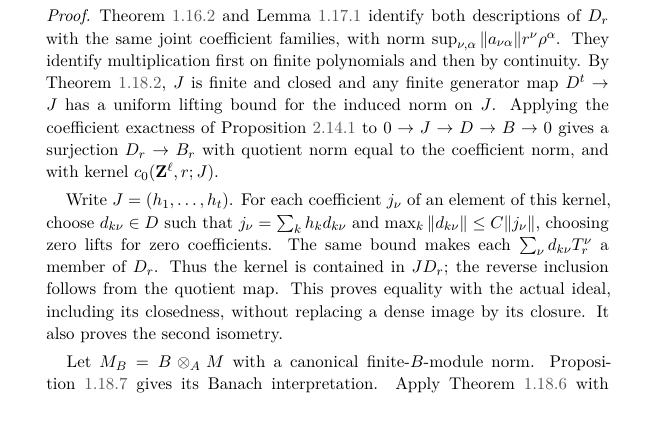
The ledger retains this scope. Its exact text or reader anchor is unavailable in this edition.
AND · joint registered proof inputs
These pointers have no operative linked edge in this map.
APP-STACKS-00D2@NAG-001580:original-proofSTACKS-00D2NAG-001580 · Actual quotient and finite-module base change · Chapter argument