NAG-001646 · Accepted whole
The conormal descriptions
2 Analytic spaces, morphisms and fibres
Open in the English reader · PDF page 397
Statement · exact TeX
\begin{proposition}[\bi{The conormal descriptions}{余法模描述}]
\label{fnd:analyticconormaldescriptions}
\bi{For an affinoid morphism $A\to B$, let $J$ be the kernel of multiplication $B\widehat\otimes_A B\to B$. Then $J/J^2$ is canonically isomorphic to $\Omega^{\mathrm{an}}_{B/A}$, with $db$ corresponding to $1\otimes b-b\otimes1$. If $W\hookrightarrow V$ is a closed immersion over an analytic space $X$, with coherent ideal $\mathcal I$, there is an exact sequence}
{对 affinoid 态射 $A\to B$,令 $J$ 为乘法 $B\widehat\otimes_A B\to B$ 的核。则 $J/J^2$ 与 $\Omega^{\mathrm{an}}_{B/A}$ 典范同构,其中 $db$ 对应于 $1\otimes b-b\otimes1$。若 $W\hookrightarrow V$ 为某个解析空间 $X$ 上的闭浸入,凝聚理想为 $\mathcal I$,则存在正合序列}
\[
 \mathcal I/\mathcal I^2\xrightarrow{\ d\ }
          \Omega_{V/X}|_W\longrightarrow\Omega_{W/X}
          \longrightarrow0.
\]
\bi{In particular $\Omega_{\mathbb A_X^{n,\mathrm{an}}/X}$ is free with basis $dT_1,\ldots,dT_n$, and the same basis restricts to every analytic domain of this relative affine space.}
{特别地,$\Omega_{\mathbb A_X^{n,\mathrm{an}}/X}$ 为以 $dT_1,\ldots,dT_n$ 为基的自由模,且该基限制到此相对仿射空间的每个解析域后仍为基。}
\end{proposition}
Full selected proof · exact TeX
\begin{proof}
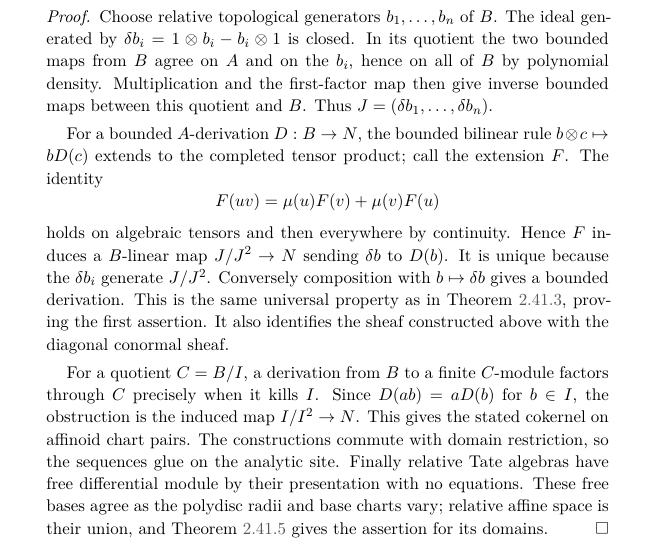
\bi{Choose relative topological generators $b_1,\ldots,b_n$ of $B$. The ideal generated by $\delta b_i=1\otimes b_i-b_i\otimes1$ is closed. In its quotient the two bounded maps from $B$ agree on $A$ and on the $b_i$, hence on all of $B$ by polynomial density. Multiplication and the first-factor map then give inverse bounded maps between this quotient and $B$. Thus $J=(\delta b_1,\ldots,\delta b_n)$.}
{选择 $B$ 的相对拓扑生成元 $b_1,\ldots,b_n$。由 $\delta b_i=1\otimes b_i-b_i\otimes1$ 生成的理想闭。在其商中,来自 $B$ 的两个有界映射在 $A$ 及所有 $b_i$ 上一致,由多项式稠密性,在整个 $B$ 上一致。于是乘法与第一因子映射给出该商与 $B$ 之间互逆的有界映射。因此 $J=(\delta b_1,\ldots,\delta b_n)$。}

\bi{For a bounded $A$-derivation $D:B\to N$, the bounded bilinear rule $b\otimes c\mapsto bD(c)$ extends to the completed tensor product; call the extension $F$. The identity}
{对有界 $A$-导子 $D:B\to N$,有界双线性规则 $b\otimes c\mapsto bD(c)$ 延拓到完备张量积,记此延拓为 $F$。恒等式}
\[
 F(uv)=\mu(u)F(v)+\mu(v)F(u)
\]
\bi{holds on algebraic tensors and then everywhere by continuity. Hence $F$ induces a $B$-linear map $J/J^2\to N$ sending $\delta b$ to $D(b)$. It is unique because the $\delta b_i$ generate $J/J^2$. Conversely composition with $b\mapsto\delta b$ gives a bounded derivation. This is the same universal property as in Theorem~\ref{fnd:boundeduniversaldifferentials}, proving the first assertion. It also identifies the sheaf constructed above with the diagonal conormal sheaf.}
{先在代数张量积上成立,再由连续性在完备张量积上成立。因此 $F$ 诱导 $B$-线性映射 $J/J^2\to N$,将 $\delta b$ 送到 $D(b)$。由于 $\delta b_i$ 生成 $J/J^2$,此映射唯一。反之,与 $b\mapsto\delta b$ 复合给出有界导子。这正是 Theorem~\ref{fnd:boundeduniversaldifferentials} 中的泛性质,故第一项得证,并将上面构造的层识别为对角线的余法层。}

\bi{For a quotient $C=B/I$, a derivation from $B$ to a finite $C$-module factors through $C$ precisely when it kills $I$. Since $D(ab)=aD(b)$ for $b\in I$, the obstruction is the induced map $I/I^2\to N$. This gives the stated cokernel on affinoid chart pairs. The constructions commute with domain restriction, so the sequences glue on the analytic site. Finally relative Tate algebras have free differential module by their presentation with no equations. These free bases agree as the polydisc radii and base charts vary; relative affine space is their union, and Theorem~\ref{fnd:analyticdifferentialdomains} gives the assertion for its domains.}
{对商 $C=B/I$,一个从 $B$ 到有限 $C$-模的导子经 $C$ 分解,当且仅当它消灭 $I$。因为对 $b\in I$ 有 $D(ab)=aD(b)$,其障碍正是诱导映射 $I/I^2\to N$。这在每个 affinoid chart 对上给出所列余核。构造与域限制相容,故这些序列在解析 site 上粘合。最后,相对 Tate 代数的无方程表示给出自由微分模。改变多圆盘半径及基底 chart 时,这些自由基彼此相容;相对仿射空间为这些分片之并,再由 Theorem~\ref{fnd:analyticdifferentialdomains} 得到其解析域上的结论。}
\end{proof}
Typeset reader excerpt
Typed proof inputs
- NAG-001560 · selected whole (sealed native whole)
- NAG-001562 · selected whole (sealed native whole)
- NAG-001643 · selected whole (sealed native whole)
- NAG-001645 · selected whole (earlier reviewed original candidate in this packet)
- NAG-001653 · selected whole (sealed native whole)
- NAG-001688 · selected whole (sealed native whole)
- NAG-001707 · selected whole (earlier reviewed original candidate in this packet)
- NAG-001560 · selected whole
- NAG-001560 · selected whole (requires)
- NAG-001562 · selected whole
- NAG-001562 · selected whole (requires)
- NAG-001643 · selected whole
- NAG-001643 · selected whole (requires)
- NAG-001645 · selected whole
- NAG-001645 · selected whole (requires)
- NAG-001653 · selected whole
- NAG-001653 · selected whole (requires)
- NAG-001688 · selected whole
- NAG-001688 · selected whole (requires)
- NAG-001707 · selected whole
- NAG-001707 · selected whole (requires)
Reader cross-references
Proof map
Verified map inputs · NAG-001646
AND · joint registered proof inputs
- NAG-001560 · Closed submodules and controlled matrix images · accepted whole
- NAG-001562 · Actual quotients by arbitrary ideals · accepted whole
- NAG-001643 · Bounded universal differentials · accepted whole
- NAG-001645 · Differentials on analytic domains · accepted whole
- NAG-001653 · Result 2.53.2 · accepted whole
- NAG-001688 · Pushouts with complete-extension affinoids · accepted whole
- NAG-001707 · Affine analytification and its mapping property · accepted whole