NAG-001778 · Accepted whole
A uniform regular open in positive characteristic
2 Analytic spaces, morphisms and fibres
Open in the English reader · PDF page 344
Statement · exact TeX
\begin{theorem}[\bi{A uniform regular open in positive characteristic}{正特征中的统一正则开集}]
\label{fnd:positivecharacteristicgenericgerms}
\bi{Let $K$ be complete of characteristic $p>0$, let $r$ be a finite $K$-free polyradius, and let $D=K_r\{T_1,\ldots,T_l\}\subset A$ be a finite extension of integral domains. Equip $A$ with its finite affinoid norm. There exists $0\ne d\in D$ such that, for every analytically separable complete extension $L/K$ and every $x\in X_L=\mathcal M(A_L)$,}
{设 $K$ 为特征 $p>0$ 的完备域,$r$ 为有限的 $K$-自由多半径,且 $D=K_r\{T_1,\ldots,T_l\}\subset A$ 为整环的有限扩张;赋予 $A$ 有限 affinoid 范数。则存在 $0\ne d\in D$,使对每个解析可分完备扩张 $L/K$ 及每个 $x\in X_L=\mathcal M(A_L)$,}
\[
       \mathcal O_{X_L,x}[1/d],\qquad
       \widehat{\mathcal O_{X_L,x}}[1/d],\qquad
       A_L[1/d]
\]
\bi{are regular rings.}
{均为正则环。}
\end{theorem}
Full selected proof · exact TeX
\begin{proof}
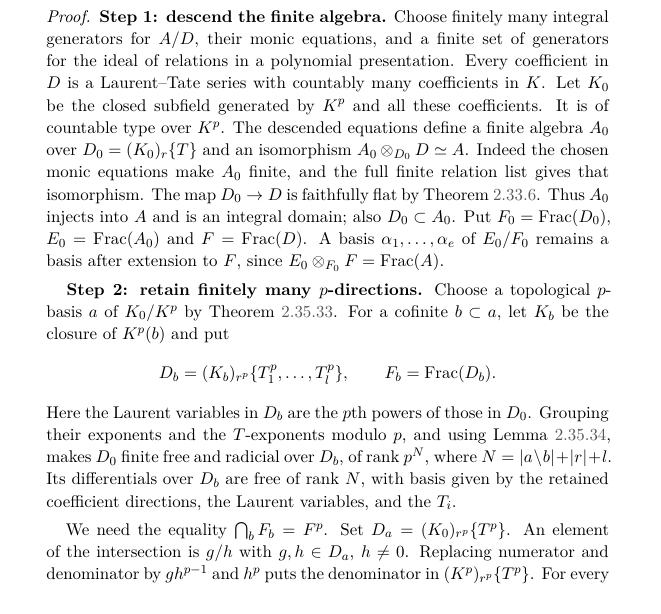
\bi{\textbf{Step 1: descend the finite algebra.}
Choose finitely many integral generators for $A/D$, their monic equations, and a finite set of generators for the ideal of relations in a polynomial presentation. Every coefficient in $D$ is a Laurent--Tate series with countably many coefficients in $K$. Let $K_0$ be the closed subfield generated by $K^p$ and all these coefficients. It is of countable type over $K^p$. The descended equations define a finite algebra $A_0$ over $D_0=(K_0)_r\{T\}$ and an isomorphism $A_0\otimes_{D_0}D\simeq A$. Indeed the chosen monic equations make $A_0$ finite, and the full finite relation list gives that isomorphism. The map $D_0\to D$ is faithfully flat by Theorem~\ref{fnd:generalscalarfaithful}. Thus $A_0$ injects into $A$ and is an integral domain; also $D_0\subset A_0$. Put $F_0=\operatorname{Frac}(D_0)$, $E_0=\operatorname{Frac}(A_0)$ and $F=\operatorname{Frac}(D)$. A basis $\alpha_1,\ldots,\alpha_e$ of $E_0/F_0$ remains a basis after extension to $F$, since $E_0\otimes_{F_0}F=\operatorname{Frac}(A)$.}
{\textbf{第一步:下降有限代数。}
选择 $A/D$ 的有限个整生成元、其首一方程,以及多项式表示中关系理想的有限生成组。$D$ 的每个系数为 Laurent--Tate 级数,只涉及 $K$ 中可数多个系数。令 $K_0$ 为 $K^p$ 与所有这些系数生成的闭子域;它在 $K^p$ 上为可数型。下降后的方程在 $D_0=(K_0)_r\{T\}$ 上定义有限代数 $A_0$,并给出同构 $A_0\otimes_{D_0}D\simeq A$:所选首一方程保证有限性,完整的有限关系组给出该同构。由 Theorem~\ref{fnd:generalscalarfaithful},$D_0\to D$ 忠实平坦,所以 $A_0$ 嵌入 $A$,从而为整环,且 $D_0\subset A_0$。记 $F_0=\operatorname{Frac}(D_0)$、$E_0=\operatorname{Frac}(A_0)$、$F=\operatorname{Frac}(D)$。$E_0/F_0$ 的基 $\alpha_1,\ldots,\alpha_e$ 在扩张到 $F$ 后仍为基,因为 $E_0\otimes_{F_0}F=\operatorname{Frac}(A)$。}

\bi{\textbf{Step 2: retain finitely many \(p\)-directions.}
Choose a topological $p$-basis $a$ of $K_0/K^p$ by Theorem~\ref{fnd:topologicalpbasis}. For a cofinite $b\subset a$, let $K_b$ be the closure of $K^p(b)$ and put}
{\textbf{第二步:保留有限多个 \(p\)-方向。}
由 Theorem~\ref{fnd:topologicalpbasis} 选择 $K_0/K^p$ 的拓扑 $p$-基 $a$。对余有限子集 $b\subset a$,令 $K_b$ 为 $K^p(b)$ 的闭包,并置}
\[
 D_b=(K_b)_{r^p}\{T_1^p,\ldots,T_l^p\},\qquad F_b=\operatorname{Frac}(D_b).
\]
\bi{Here the Laurent variables in $D_b$ are the $p$th powers of those in $D_0$. Grouping their exponents and the $T$-exponents modulo $p$, and using Lemma~\ref{fnd:cofinitepbasisfields}, makes $D_0$ finite free and radicial over $D_b$, of rank $p^N$, where $N=|a\setminus b|+|r|+l$. Its differentials over $D_b$ are free of rank $N$, with basis given by the retained coefficient directions, the Laurent variables, and the $T_i$.}
{这里 $D_b$ 的 Laurent 变量为 $D_0$ 中 Laurent 变量的 $p$ 次幂。把这些变量及 $T$ 的指数按模 $p$ 归组,再用 Lemma~\ref{fnd:cofinitepbasisfields},可知 $D_0$ 在 $D_b$ 上有限自由且根式,秩为 $p^N$,其中 $N=|a\setminus b|+|r|+l$;其相对微分模自由且秩为 $N$,基由保留的系数方向、Laurent 变量及 $T_i$ 的微分给出。}

\bi{We need the equality $\bigcap_b F_b=F^p$. Set $D_a=(K_0)_{r^p}\{T^p\}$. An element of the intersection is $g/h$ with $g,h\in D_a$, $h\ne0$. Replacing numerator and denominator by $gh^{p-1}$ and $h^p$ puts the denominator in $(K^p)_{r^p}\{T^p\}$. For every cofinite $b$, the new numerator belongs both to $D_a$ and to $F_b$. Since $D_b\to D_a$ is faithfully flat, $D_a\cap F_b=D_b$: a relation $v g=u$ with $u,v\in D_b$, $v\ne0$, contracts the principal ideal $vD_a$ to $vD_b$. Hence the numerator belongs to every $D_b$. Uniqueness of Laurent--Tate coefficients and $\bigcap_b K_b=K^p$ identify their intersection with $(K^p)_{r^p}\{T^p\}$. Taking fractions proves the required equality.}
{需要核验 $\bigcap_bF_b=F^p$。置 $D_a=(K_0)_{r^p}\{T^p\}$。交中的元素可写作 $g/h$,其中 $g,h\in D_a$、$h\ne0$;将分子、分母改写为 $gh^{p-1}$、$h^p$,便使分母属于 $(K^p)_{r^p}\{T^p\}$。对每个余有限 $b$,新分子同时属于 $D_a$ 与 $F_b$。由于 $D_b\to D_a$ 忠实平坦,故 $D_a\cap F_b=D_b$:若 $vg=u$,其中 $u,v\in D_b$、$v\ne0$,则主理想 $vD_a$ 收缩为 $vD_b$。所以新分子属于所有 $D_b$。Laurent--Tate 系数的唯一性及 $\bigcap_bK_b=K^p$ 将其交识别为 $(K^p)_{r^p}\{T^p\}$,取分式即得所需等式。}

\bi{The elements $\alpha_i^p$ are independent over $F^p$, by taking $p$th roots of a putative relation and using the $F$-independence of the $\alpha_i$. Lemma~\ref{fnd:descendingfieldrank} therefore supplies a cofinite $b$ for which they are independent over $F_b$. Since they form a basis of $E_0^p/F_0^p$ and $F_0^p\subset F_b$, this implies}
{若 $\alpha_i^p$ 在 $F^p$ 上有关系,则对系数取 $p$ 次根便违反 $\alpha_i$ 的 $F$-线性无关性,故 $\alpha_i^p$ 在 $F^p$ 上线性无关。Lemma~\ref{fnd:descendingfieldrank} 因而给出余有限 $b$,使它们在 $F_b$ 上已线性无关。因为它们组成 $E_0^p/F_0^p$ 的基,且 $F_0^p\subset F_b$,故}
\[
 [E_0^pF_b:F_b]=e,\qquad
 [E_0:E_0^pF_b]=[F_0:F_b]=p^N.
\]
\bi{The universal derivation over $F_b$ annihilates $E_0^pF_b$. An algebraic $p$-basis of the finite exponent-one extension $E_0/E_0^pF_b$ computes its differentials by the equations $U_i^p-c_i$; thus $\dim_{E_0}\Omega_{E_0/F_b}=N$.}
{$F_b$ 上的泛导子消灭 $E_0^pF_b$。有限指数一扩张 $E_0/E_0^pF_b$ 的代数 $p$-基通过方程 $U_i^p-c_i$ 计算其微分模,因此 $\dim_{E_0}\Omega_{E_0/F_b}=N$。}

\bi{\textbf{Step 3: choose one denominator.}
The finite $A_0$-module $\Omega_{A_0/D_b}$ consequently becomes free of rank $N$ after inverting a nonzero element of $A_0$: choose lifts of a generic basis, then kill the finite torsion kernel and cokernel. Any nonzero element of $A_0$ becomes a unit after inverting a nonzero element of $D_0$, since $A_0\otimes_{D_0}F_0$ is a field. Raising that latter element to its $p$th power puts it in $D_b$. Combine this denominator with the one in Lemma~\ref{fnd:finitegenerictriangularpresentation}, again taking a $p$th power. We obtain $0\ne d\in D_b$ for which $A_0[1/d]$ has a triangular monic presentation over $D_0[1/d]$ and $\Omega_{A_0[1/d]/D_b[1/d]}$ is free of rank $N$.}
{\textbf{第三步:选择一个分母。}
因此,有限 $A_0$-模 $\Omega_{A_0/D_b}$ 在可逆化 $A_0$ 的某个非零元素后自由且秩为 $N$:提升泛基,再消灭有限的挠核与挠余核即可。由于 $A_0\otimes_{D_0}F_0$ 为域,$A_0$ 的每个非零元素在可逆化 $D_0$ 的某个非零元素后成为单位;将后者取 $p$ 次幂即使其属于 $D_b$。将这个分母与 Lemma~\ref{fnd:finitegenerictriangularpresentation} 中的分母合并,再取 $p$ 次幂,得到 $0\ne d\in D_b$,使 $A_0[1/d]$ 在 $D_0[1/d]$ 上具有三角首一表示,且 $\Omega_{A_0[1/d]/D_b[1/d]}$ 自由、秩为 $N$。}

\bi{\textbf{Step 4: completed germs over countable scalar fields.}
Fix an analytically separable complete extension $L/K$. Let $F_*$ be the closure of $L^pK_0$ in $L$, and let $H$ range over the complete fields between $F_*$ and $L$ of countable type over $F_*$. Lemma~\ref{fnd:gaussanalyticseparable} gives $H^\sharp$ with $H=K_0\otimes_{K_b}H^\sharp$. Write}
{\textbf{第四步:可数标量域上的完成芽。}
固定解析可分完备扩张 $L/K$。令 $F_*$ 为 $L^pK_0$ 在 $L$ 中的闭包,并让 $H$ 遍历 $F_*$ 与 $L$ 之间在 $F_*$ 上为可数型的完备域。由 Lemma~\ref{fnd:gaussanalyticseparable},存在 $H^\sharp$ 使 $H=K_0\otimes_{K_b}H^\sharp$。记}
\[
 D_H=D_0\widehat\otimes_{K_0}H,\quad
 B_H=D_b\widehat\otimes_{K_b}H^\sharp,\quad
 A_H=A_0\otimes_{D_0}D_H .
\]
\bi{The finite monomial bases prove the actual algebra identity $D_H=D_0\otimes_{D_b}B_H$. Both $D_H$ and $B_H$ are algebras of affinoid domains in affine space: a product of a polydisc with polyannuli of exact radii $r$ and $r^p$, respectively. Here the Laurent construction remains a polyannulus even when a radius ceases to be free over $H$.}
{有限单项式基证明实际代数恒等式 $D_H=D_0\otimes_{D_b}B_H$。$D_H$ 与 $B_H$ 都是仿射空间中 affinoid 域的代数:分别为多圆盘与精确半径 $r$、$r^p$ 的多圆环之积。即使某个半径在 $H$ 上不再自由,这个 Laurent 构造仍是多圆环。}

\bi{Fix the image $x_H$ of $x$ in $\mathcal M(A_H)$, and let $y$ and $z$ be its images in $\mathcal M(D_H)$ and $\mathcal M(B_H)$. The finite radicial map $\mathcal M(D_H)\to\mathcal M(B_H)$ has a unique point over $z$: in a radicial finite fibre there is one residue field, purely inseparable over $\mathcal H(z)$, and its absolute value is forced by $|u|^{p^m}=|u^{p^m}|$. The finite branch and completion formulas of Lemma~\ref{fnd:finiteanalyticbranchseparation} therefore give, with $S=\widehat{\mathcal O_{\mathcal M(B_H),z}}$ and $B=\widehat{\mathcal O_{\mathcal M(D_H),y}}$,}
{固定 $x$ 在 $\mathcal M(A_H)$ 中的像 $x_H$,记其在 $\mathcal M(D_H)$、$\mathcal M(B_H)$ 中的像为 $y,z$。有限根式映射 $\mathcal M(D_H)\to\mathcal M(B_H)$ 在 $z$ 上方只有一个点:根式有限纤维只有一个剩余域,它在 $\mathcal H(z)$ 上纯不可分,且绝对值由 $|u|^{p^m}=|u^{p^m}|$ 唯一决定。于是 Lemma~\ref{fnd:finiteanalyticbranchseparation} 的有限分支及完备化公式给出:若 $S=\widehat{\mathcal O_{\mathcal M(B_H),z}}$、$B=\widehat{\mathcal O_{\mathcal M(D_H),y}}$,则}
\[
 B=D_0\otimes_{D_b}S,\qquad
 A_0\otimes_{D_0}B
       =\prod_{t\mapsto y}\widehat{\mathcal O_{\mathcal M(A_H),t}} .
\]
\bi{The ring $B$ is regular by Theorem~\ref{fnd:affinespacedomainregular} and Tag 07NY. After inverting $d$, its differentials over $S[1/d]$ are free of rank $N$, and those of $(A_0\otimes_{D_0}B)[1/d]$ have the same rank, by finite algebraic base change of the differential presentations in Steps 2 and 3. The latter algebra also retains its triangular monic presentation over $B[1/d]$. Lemma~\ref{fnd:equaldifferentialrankregular} thus proves that it is regular. Each factor, in particular $\widehat{\mathcal O_{\mathcal M(A_H),x_H}}[1/d]$, is regular.}
{由 Theorem~\ref{fnd:affinespacedomainregular} 及 Tag 07NY,$B$ 正则。可逆化 $d$ 后,它在 $S[1/d]$ 上的微分模自由、秩为 $N$;由第二、三步微分表示的有限代数基变换,$(A_0\otimes_{D_0}B)[1/d]$ 的微分模具有相同的秩。后者还保留其在 $B[1/d]$ 上的三角首一表示,因此 Lemma~\ref{fnd:equaldifferentialrankregular} 说明它正则。每个因子,特别是 $\widehat{\mathcal O_{\mathcal M(A_H),x_H}}[1/d]$,也正则。}

\bi{\textbf{Step 5: pass to \(L\).}
Lemma~\ref{fnd:countablecompletedgermdescent} identifies $\widehat{\mathcal O_{X_L,x}}[1/d]$ with the filtered colimit of the regular rings in Step 4. Localize at any prime and its contractions. The resulting system consists of regular local rings with local transition maps and has a Noetherian colimit. By \cite[Tag 07DX]{StacksAlg}, that colimit is regular local. This proves regularity of the completed localized germ. Completion is faithfully flat, also after inverting $d$, so Tags 00HQ and 00OF descend regularity to $\mathcal O_{X_L,x}[1/d]$. Finally, every prime of $A_L$ avoiding $d$ is the kernel of an analytic point by Lemma~\ref{fnd:genericanalyticpointdensity}. Its faithfully flat local map into the ordinary germ at that point descends regularity once more, proving that $A_L[1/d]$ is regular.}
{\textbf{第五步:传至 \(L\)。}
Lemma~\ref{fnd:countablecompletedgermdescent} 将 $\widehat{\mathcal O_{X_L,x}}[1/d]$ 识别为第四步各正则环的滤过直极限。在任意素理想及其收缩处局部化,所得系统由正则局部环及局部转移映射组成,且其直极限为 Noetherian 环。由 \cite[Tag 07DX]{StacksAlg},该直极限为正则局部环,故完成的局部化芽正则。完备化忠实平坦,可逆化 $d$ 后仍然如此,故 Tags 00HQ 与 00OF 将正则性下降到 $\mathcal O_{X_L,x}[1/d]$。最后,Lemma~\ref{fnd:genericanalyticpointdensity} 说明 $A_L$ 中每个避开 $d$ 的素理想都是某个解析点的核;从该处的代数局部环到通常芽的忠实平坦局部映射再一次下降正则性,得到 $A_L[1/d]$ 正则。}
\end{proof}
Typeset reader excerpt
Typed proof inputs
- NAG-001415 · selected whole (selected native whole)
- NAG-001561 · selected whole (selected native whole)
- NAG-001686 · selected whole (selected native whole)
- NAG-001698 · selected whole (selected native whole)
- NAG-001735 · selected whole (selected native whole)
- NAG-001747 · selected whole (selected native whole)
- NAG-001752 · selected whole (selected native whole)
- NAG-001760 · selected whole (selected native whole)
- NAG-001770 · selected whole (selected native whole)
- NAG-001771 · selected whole (selected native whole)
- NAG-001772 · selected whole (selected native whole)
- NAG-001773 · selected whole (selected native whole)
- NAG-001774 · selected whole (selected native whole)
- NAG-001776 · selected whole (selected native whole)
- NAG-001777 · selected whole (earlier same packet whole pending review)
- NAG-001832 · selected whole, export unavailable (selected native whole)
- NAG-001860 · selected whole (selected native whole)
Reader cross-references
- fnd:affinespacedomainregular
- fnd:cofinitepbasisfields
- fnd:countablecompletedgermdescent
- fnd:descendingfieldrank
- fnd:equaldifferentialrankregular
- fnd:finiteanalyticbranchseparation
- fnd:finitegenerictriangularpresentation
- fnd:gaussanalyticseparable
- fnd:generalscalarfaithful
- fnd:genericanalyticpointdensity
- fnd:topologicalpbasis
Proof map
Verified map inputs · NAG-001778
AND · joint registered proof inputs
- NAG-001415 · The Laurent coefficient normal form · accepted whole Exact source window 2949–2969
- Use the actual topological p-basis and cofinite-field lemmas. Group Laurent and polynomial exponents modulo p; principal-ideal contraction and uniqueness of Laurent coefficients identify the intersection of the actual fraction fields. The descending-rank lemma gives one finite set of surviving coefficient directions and the stated differential dimension.
- NAG-001561 · Canonical norms and exactness for finite modules · accepted whole Exact source windows 2944–2947, 2971–2974
- Descend all monic equations and finitely many relations using countable coefficients. Faithful scalar flatness gives the embedded integral model, so the fraction-field basis remains a basis after localization and base change to the given domain.
- Choose one common denominator in the p-power base for the actual triangular presentation and the generic differential rank; use finite kernel/cokernel over the domain.
- NAG-001686 · Finite modules and faithful scalar extension · accepted whole Exact source windows 2944–2947, 2949–2969
- Descend all monic equations and finitely many relations using countable coefficients. Faithful scalar flatness gives the embedded integral model, so the fraction-field basis remains a basis after localization and base change to the given domain.
- Use the actual topological p-basis and cofinite-field lemmas. Group Laurent and polynomial exponents modulo p; principal-ideal contraction and uniqueness of Laurent coefficients identify the intersection of the actual fraction fields. The descending-rank lemma gives one finite set of surviving coefficient directions and the stated differential dimension.
- NAG-001698 · Ordinary affinoid stalks · accepted whole Exact source window 2998–3001
- For each algebraic prime use the completed countable colimit localized at its contractions, which is Noetherian with regular local stages and local transition maps. Descend regularity of localizations by faithful flatness of completion. Realize each remaining prime in the algebra by an analytic point with that exact kernel; descend from its regular ordinary stalk.
- NAG-001735 · Separating the branches of a finite morphism · accepted whole Exact source window 2976–2996
- Use the actual analytically separable scalar decomposition. The radicial finite chart has exactly one analytic point in the relevant branch and the other finite map gives the actual completed branch product. Apply completion regularity to the affine-space-domain ordinary base. Keep the two equal differential ranks and triangular presentation after inverting d; then apply the native equal-rank regularity criterion.
- NAG-001747 · Noetherian ordinary local rings · accepted whole Exact source window 2998–3001
- For each algebraic prime use the completed countable colimit localized at its contractions, which is Noetherian with regular local stages and local transition maps. Descend regularity of localizations by faithful flatness of completion. Realize each remaining prime in the algebra by an analytic point with that exact kernel; descend from its regular ordinary stalk.
- NAG-001752 · Coherent direct image under a finite morphism · accepted whole Exact source window 2976–2996
- Use the actual analytically separable scalar decomposition. The radicial finite chart has exactly one analytic point in the relevant branch and the other finite map gives the actual completed branch product. Apply completion regularity to the affine-space-domain ordinary base. Keep the two equal differential ranks and triangular presentation after inverting d; then apply the native equal-rank regularity criterion.
- NAG-001760 · Regular affine-space domains · accepted whole Exact source window 2976–2996
- Use the actual analytically separable scalar decomposition. The radicial finite chart has exactly one analytic point in the relevant branch and the other finite map gives the actual completed branch product. Apply completion regularity to the affine-space-domain ordinary base. Keep the two equal differential ranks and triangular presentation after inverting d; then apply the native equal-rank regularity criterion.
- NAG-001770 · Countable exponent-one extensions · accepted whole Exact source window 2949–2969
- Use the actual topological p-basis and cofinite-field lemmas. Group Laurent and polynomial exponents modulo p; principal-ideal contraction and uniqueness of Laurent coefficients identify the intersection of the actual fraction fields. The descending-rank lemma gives one finite set of surviving coefficient directions and the stated differential dimension.
- NAG-001771 · Result 2.35.34 · accepted whole Exact source window 2949–2969
- Use the actual topological p-basis and cofinite-field lemmas. Group Laurent and polynomial exponents modulo p; principal-ideal contraction and uniqueness of Laurent coefficients identify the intersection of the actual fraction fields. The descending-rank lemma gives one finite set of surviving coefficient directions and the stated differential dimension.
- NAG-001772 · Finite rank stabilization over descending fields · accepted whole Exact source window 2949–2969
- Use the actual topological p-basis and cofinite-field lemmas. Group Laurent and polynomial exponents modulo p; principal-ideal contraction and uniqueness of Laurent coefficients identify the intersection of the actual fraction fields. The descending-rank lemma gives one finite set of surviving coefficient directions and the stated differential dimension.
- NAG-001773 · A triangular presentation on a finite generic open · accepted whole Exact source window 2971–2974
- Choose one common denominator in the p-power base for the actual triangular presentation and the generic differential rank; use finite kernel/cokernel over the domain.
- NAG-001774 · Equal differential ranks and regularity · accepted whole Exact source window 2976–2996
- Use the actual analytically separable scalar decomposition. The radicial finite chart has exactly one analytic point in the relevant branch and the other finite map gives the actual completed branch product. Apply completion regularity to the affine-space-domain ordinary base. Keep the two equal differential ranks and triangular presentation after inverting d; then apply the native equal-rank regularity criterion.
- NAG-001776 · Result 2.35.39 · accepted whole Exact source window 2976–2996
- Use the actual analytically separable scalar decomposition. The radicial finite chart has exactly one analytic point in the relevant branch and the other finite map gives the actual completed branch product. Apply completion regularity to the affine-space-domain ordinary base. Keep the two equal differential ranks and triangular presentation after inverting d; then apply the native equal-rank regularity criterion.
- NAG-001777 · Countable descent of completed ordinary germs · accepted whole Exact source window 2998–3001
- For each algebraic prime use the completed countable colimit localized at its contractions, which is Noetherian with regular local stages and local transition maps. Descend regularity of localizations by faithful flatness of completion. Realize each remaining prime in the algebra by an analytic point with that exact kernel; descend from its regular ordinary stalk.
- NAG-001832 · Result 2.38.2 · accepted whole; PDF destination Exact source window 2998–3001
- For each algebraic prime use the completed countable colimit localized at its contractions, which is Noetherian with regular local stages and local transition maps. Descend regularity of localizations by faithful flatness of completion. Realize each remaining prime in the algebra by an analytic point with that exact kernel; descend from its regular ordinary stalk.
- NAG-001860 · Generic analytic points in ordinary open sets · accepted whole Exact source window 2998–3001
- For each algebraic prime use the completed countable colimit localized at its contractions, which is Noetherian with regular local stages and local transition maps. Descend regularity of localizations by faithful flatness of completion. Realize each remaining prime in the algebra by an analytic point with that exact kernel; descend from its regular ordinary stalk.
NAG-001778 · A uniform regular open in positive characteristic · Chapter argument