NAG-001979 · Accepted whole
Separation of analytic germs
3 Reduction, formal models and residual geometry
Open in the English reader · PDF page 573
Statement · exact TeX
\begin{proposition}[\bi{Separation of analytic germs}
{解析芽的分离性}]
\label{fnd:gradedgermseparation}
\bi{A morphism of analytic germs is separated if and only if
its reduction is separated. In particular, an analytic germ
whose reduction is affine admits a compact separated
neighbourhood representative.}
{解析芽态射分离,当且仅当其约化分离。特别地,约化仿射的
解析芽具有紧分离邻域代表。}
\end{proposition}
Full selected proof · exact TeX
\begin{proof}
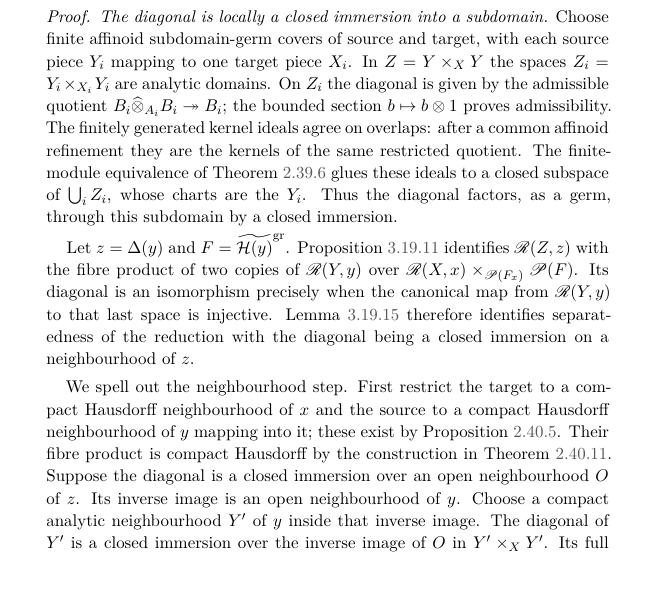
\bi{\emph{The diagonal is locally a closed immersion into a
subdomain.} Choose finite affinoid subdomain-germ covers of
source and target, with each source piece $Y_i$ mapping to
one target piece $X_i$. In $Z=Y\times_XY$ the spaces
$Z_i=Y_i\times_{X_i}Y_i$ are analytic domains.
On $Z_i$ the diagonal is given by the admissible quotient
$B_i\widehat\otimes_{A_i}B_i\twoheadrightarrow B_i$;
the bounded section $b\mapsto b\otimes1$ proves admissibility.
The finitely generated kernel ideals agree on overlaps:
after a common affinoid refinement they are the kernels
of the same restricted quotient. The finite-module
equivalence of Theorem~\ref{fnd:fullgkiehltheoremb} glues
these ideals to a closed subspace of $\bigcup_i Z_i$,
whose charts are the $Y_i$. Thus the diagonal factors,
as a germ, through this subdomain by a closed immersion.}
{\emph{对角线局部为到一个子域的闭浸入。}
选取源与目标的有限 affinoid 子域芽覆盖,使每个源片
$Y_i$ 映入某个目标片 $X_i$。在 $Z=Y\times_XY$ 中,
$Z_i=Y_i\times_{X_i}Y_i$ 是解析域。
在 $Z_i$ 上,对角线由 admissible 商
$B_i\widehat\otimes_{A_i}B_i\twoheadrightarrow B_i$ 给出;
有界截面 $b\mapsto b\otimes1$ 保证 admissibility。
有限生成的核理想在重叠上相等,因为在共同 affinoid 加细上,
它们都是同一个限制商的核。由
Theorem~\ref{fnd:fullgkiehltheoremb} 的有限模等价,
这些理想粘合为 $\bigcup_i Z_i$ 的闭子空间,其各局部图
恰为 $Y_i$。因此对角线作为芽,经该子域分解为闭浸入。}

\bi{Let $z=\Delta(y)$ and $F=\widetilde{\mathcal H(y)}^{\rm gr}$.
Proposition~\ref{fnd:gradedgermproducts} identifies
$\mathscr R(Z,z)$ with the fibre product of two copies of
$\mathscr R(Y,y)$ over
$\mathscr R(X,x)\times_{\mathscr P(F_x)}\mathscr P(F)$.
Its diagonal is an isomorphism precisely when the canonical
map from $\mathscr R(Y,y)$ to that last space is injective.
Lemma~\ref{fnd:gradedgermclosedimmersion} therefore identifies
separatedness of the reduction with the diagonal being a
closed immersion on a neighbourhood of $z$.}
{令 $z=\Delta(y)$、$F=\widetilde{\mathcal H(y)}^{\rm gr}$。
Proposition~\ref{fnd:gradedgermproducts} 将
$\mathscr R(Z,z)$ 识别为两份 $\mathscr R(Y,y)$ 在
$\mathscr R(X,x)\times_{\mathscr P(F_x)}\mathscr P(F)$ 上的
纤维积。其对角线为同构,当且仅当
$\mathscr R(Y,y)$ 到后一个空间的典范映射单射。
由 Lemma~\ref{fnd:gradedgermclosedimmersion},约化的分离性
于是等价于对角线在 $z$ 的一个邻域上为闭浸入。}

\bi{We spell out the neighbourhood step. First restrict the
target to a compact Hausdorff neighbourhood of $x$ and
the source to a compact Hausdorff neighbourhood of $y$
mapping into it; these exist by
Proposition~\ref{fnd:generalnetdomaincalculus}.
Their fibre product is compact Hausdorff by the construction
in Theorem~\ref{fnd:generalanalyticproducts}.
Suppose the diagonal is a closed immersion over an open
neighbourhood $O$ of $z$. Its inverse image is an open
neighbourhood of $y$. Choose a compact analytic neighbourhood
$Y'$ of $y$ inside that inverse image.
The diagonal of $Y'$ is a closed immersion over the inverse
image of $O$ in $Y'\times_XY'$. Its full image is closed,
because $Y'$ is compact and this product is Hausdorff.
The open complement of that image, together with the inverse
image of $O$, covers the product; on the complement the
closed subspace is empty. Thus the diagonal of $Y'$ is a
closed immersion everywhere. This proves separatedness
of a representative, rather than merely a condition at
one point of its diagonal. Conversely a separated
representative has a closed diagonal, giving the reduction
condition above. The last assertion follows since an
affine birational space embeds into its valuation space.}
{明确说明邻域步骤。先将目标限制到 $x$ 的一个紧 Hausdorff
邻域,再将源限制到映入它的 $y$ 的紧 Hausdorff 邻域;
这些邻域由 Proposition~\ref{fnd:generalnetdomaincalculus}
存在。根据 Theorem~\ref{fnd:generalanalyticproducts} 的构造,
其纤维积紧且 Hausdorff。假设对角线在 $z$ 的开邻域 $O$ 上
为闭浸入。$O$ 的逆像是 $y$ 的开邻域,在其中选取紧解析
邻域 $Y'$。$Y'$ 的对角线在 $O$ 于 $Y'\times_XY'$ 中的
逆像上为闭浸入。其完整像是闭集,因为 $Y'$ 紧而该乘积
Hausdorff。此像的开补集与 $O$ 的逆像覆盖乘积;在补集上,
闭子空间为空。因此 $Y'$ 的对角线处处为闭浸入。
这证明了一个代表的分离性,而不只是对角线上一点的性质。
反之,分离代表具有闭对角线,故满足上面的约化条件。
最后一项来自仿射 birational 空间嵌入其赋值空间。}
\end{proof}
Typeset reader excerpt
Typed proof inputs
- NAG-001561 · selected whole (sealed native whole)
- NAG-001609 · selected whole (sealed native whole)
- NAG-001610 · selected whole (sealed native whole)
- NAG-001615 · selected whole (sealed native whole)
- NAG-001624 · selected whole (sealed native whole)
- NAG-001688 · selected whole (sealed native whole)
- NAG-001974 · selected whole (earlier candidate if selected)
- NAG-001978 · selected whole (earlier candidate if selected)
Reader cross-references
Proof map
Verified map inputs · NAG-001979
AND · joint registered proof inputs
- NAG-001561 · Canonical norms and exactness for finite modules · accepted whole
- Use the actual product-domain charts. The diagonal quotient has its bounded section, and each kernel is finitely generated. The overlap ideals are kernels of the same actual morphism after restriction, so the selected finite module restriction and equivalence glue precisely this closed subspace.
- NAG-001609 · Local calculus of analytic domains · accepted whole
- Use the actual product-domain charts. The diagonal quotient has its bounded section, and each kernel is finitely generated. The overlap ideals are kernels of the same actual morphism after restriction, so the selected finite module restriction and equivalence glue precisely this closed subspace.
- Choose the actual compact Hausdorff source and target representatives. Shrink inside the inverse image of the open product neighbourhood in which the diagonal is closed. Its image in the actual Hausdorff compact product is closed; the open complement has empty diagonal. Chart restriction and gluing give the required separated representative.
- NAG-001610 · The structure sheaf of an atlas · accepted whole
- Choose the actual compact Hausdorff source and target representatives. Shrink inside the inverse image of the open product neighbourhood in which the diagonal is closed. Its image in the actual Hausdorff compact product is closed; the open complement has empty diagonal. Chart restriction and gluing give the required separated representative.
- NAG-001615 · Fibre products of analytic spaces · accepted whole
- Use the actual product-domain charts. The diagonal quotient has its bounded section, and each kernel is finitely generated. The overlap ideals are kernels of the same actual morphism after restriction, so the selected finite module restriction and equivalence glue precisely this closed subspace.
- Choose the actual compact Hausdorff source and target representatives. Shrink inside the inverse image of the open product neighbourhood in which the diagonal is closed. Its image in the actual Hausdorff compact product is closed; the open complement has empty diagonal. Chart restriction and gluing give the required separated representative.
- NAG-001624 · Kiehl and Theorem B on the analytic G-site · accepted whole
- Use the actual product-domain charts. The diagonal quotient has its bounded section, and each kernel is finitely generated. The overlap ideals are kernels of the same actual morphism after restriction, so the selected finite module restriction and equivalence glue precisely this closed subspace.
- NAG-001688 · Pushouts with complete-extension affinoids · accepted whole
- Use the actual product-domain charts. The diagonal quotient has its bounded section, and each kernel is finitely generated. The overlap ideals are kernels of the same actual morphism after restriction, so the selected finite module restriction and equivalence glue precisely this closed subspace.
- NAG-001974 · Reduction of a fibre-product germ · accepted whole
- The diagonal product reduction at the matched point is computed in the same completed residue field. The diagonal is an isomorphism exactly when the separatedness map is injective, and the actual closed-into-subdomain factorization lets the closed-immersion test transport that equivalence.
- NAG-001978 · Closed immersions and reductions · accepted whole
- The diagonal product reduction at the matched point is computed in the same completed residue field. The diagonal is an isomorphism exactly when the separatedness map is injective, and the actual closed-into-subdomain factorization lets the closed-immersion test transport that equivalence.
NAG-001979 · Separation of analytic germs · Chapter argument