NAG-002027 · Accepted whole
Annular units
Open in the English reader · PDF page 645
Statement · exact TeX
\begin{proposition}[\bi{Annular units}{圆环上的可逆函数}]
\label{cand:annulusunitnormalform}
\bi{An element $f\in A_{r,R}$ is a unit if and only if}
{$f\in A_{r,R}$ 可逆,当且仅当存在下述表示:}
\[
 f=cT^m(1+h),\qquad
 c\in K^\times,\quad m\in\Z,\quad h\in A_{r,R},\quad
 \|h\|_{r,R}<1.
\]
\bi{The exponent $m$ is unique, and $c$ may be taken to be the coefficient $a_m$ of $f$. At every analytic point $x$ of the annulus,}
{指数 $m$ 唯一,且 $c$ 可取为 $f$ 的系数 $a_m$。在圆环的每个解析点 $x$,均有}
\[
 |f(x)|=|c|\,|T(x)|^m.
\]
\end{proposition}
Full selected proof · exact TeX
\begin{proof}
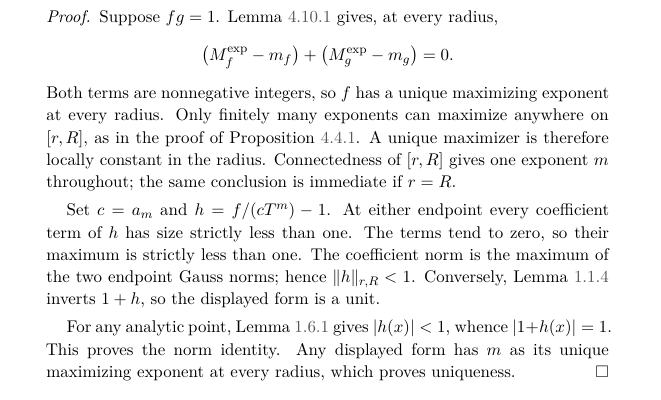
\bi{Suppose $fg=1$. Lemma~\ref{cand:annulusdominantexponents} gives, at every radius,}
{设 $fg=1$。由 Lemma~\ref{cand:annulusdominantexponents},在每个半径都有}
\[
 \bigl(M_f^{\mathrm{exp}}-m_f\bigr)
 +\bigl(M_g^{\mathrm{exp}}-m_g\bigr)=0.
\]
\bi{Both terms are nonnegative integers, so $f$ has a unique maximizing exponent at every radius. Only finitely many exponents can maximize anywhere on $[r,R]$, as in the proof of Proposition~\ref{fnd:annulusunitaffine}. A unique maximizer is therefore locally constant in the radius. Connectedness of $[r,R]$ gives one exponent $m$ throughout; the same conclusion is immediate if $r=R$.}
{两项均为非负整数,所以 $f$ 在每个半径只有一个达到最大值的指数。由 Proposition~\ref{fnd:annulusunitaffine} 证明中的论证,在整个 $[r,R]$ 上可能达到最大值的指数总共只有有限个。因此唯一的最大值指数随半径局部常值。由 $[r,R]$ 的连通性,得到统一的指数 $m$;当 $r=R$ 时结论也直接成立。}

\bi{Set $c=a_m$ and $h=f/(cT^m)-1$. At either endpoint every coefficient term of $h$ has size strictly less than one. The terms tend to zero, so their maximum is strictly less than one. The coefficient norm is the maximum of the two endpoint Gauss norms; hence $\|h\|_{r,R}<1$. Conversely, Lemma~\ref{fnd:geometricinverse} inverts $1+h$, so the displayed form is a unit.}
{令 $c=a_m$、$h=f/(cT^m)-1$。在两个端点,$h$ 的每个系数项的大小均严格小于一。这些项趋于零,因此其最大值也严格小于一。系数范数是两个端点 Gauss 范数的最大值,故 $\|h\|_{r,R}<1$。反之,由 Lemma~\ref{fnd:geometricinverse},$1+h$ 可逆,所以所列形式可逆。}

\bi{For any analytic point, Lemma~\ref{new:seminormcontractive} gives $|h(x)|<1$, whence $|1+h(x)|=1$. This proves the norm identity. Any displayed form has $m$ as its unique maximizing exponent at every radius, which proves uniqueness.}
{对任意解析点,Lemma~\ref{new:seminormcontractive} 给出 $|h(x)|<1$,所以 $|1+h(x)|=1$,从而得到范数恒等式。任何所列表示都以 $m$ 为每个半径处唯一达到最大值的指数,故 $m$ 唯一。}
\end{proof}
Typeset reader excerpt
Typed proof inputs
- BASE-RINGS · standing context or base
- BASE-RINGS · standing context or base (requires)
- NAG-000152 · selected whole
- NAG-000152 · selected whole (requires)
- NAG-000184 · selected whole
- NAG-000184 · selected whole (requires)
- NAG-000655 · selected whole
- NAG-000655 · selected whole (requires)
- NAG-001415 · selected whole
- NAG-001415 · selected whole (requires)
- NAG-001416 · selected whole
- NAG-001416 · selected whole (requires)
- NAG-002026 · selected whole
- NAG-002026 · selected whole (requires)
Reader cross-references
Proof map
Verified map inputs · NAG-002027
AND · joint registered proof inputs
- NAG-000152 · Result 4.4.1 · accepted whole
- NAG-000184 · Geometric inversion · accepted whole
- NAG-000655 · Result 1.6.1 · accepted whole
- NAG-001415 · The Laurent coefficient normal form · accepted whole
- NAG-001416 · Multiplication, module actions and naturality · accepted whole
- NAG-002026 · Extreme Laurent exponents · accepted whole
Standing context and base inputs
BASE-RINGS