NAG-002029 · Accepted whole
Residual orders along Gauss-circle paths
Open in the English reader · PDF page 646
Statement · exact TeX
\begin{proposition}[\bi{Residual orders along Gauss-circle paths}{Gauss 圆周路径上的剩余阶数}]
\label{cand:gausscircleresidualslopes}
\bi{Let $f=\sum a_nT^n\in A_{r,R}\setminus\{0\}$, let $r<\rho<R$ with $\rho\in|K^\times|$, and choose $b,c\in K^\times$ with $|b|=\rho$ and $|c|=M_f(\rho)$. Put $k=\widetilde K$ and}
{设 $f=\sum a_nT^n\in A_{r,R}\setminus\{0\}$,并设 $r<\rho<R$、$\rho\in|K^\times|$。选择 $b,c\in K^\times$,使 $|b|=\rho$、$|c|=M_f(\rho)$。令 $k=\widetilde K$,并定义}
\[
 d_n=c^{-1}a_nb^n,
 \qquad P_f(Z)=\sum_n\widetilde{d_n}Z^n\in k[Z,Z^{-1}].
\]
\bi{Then $P_f$ is a nonzero Laurent polynomial representing the residue of $c^{-1}f$ in $\widetilde{\mathcal H(\eta_\rho)}=k(\widetilde{T/b})$. For sufficiently small $s\geq0$, consider the paths}
{则 $P_f$ 是非零 Laurent 多项式,表示 $c^{-1}f$ 在 $\widetilde{\mathcal H(\eta_\rho)}=k(\widetilde{T/b})$ 中的剩余类。对充分小的 $s\geq0$,考虑下列路径:}
\[
 \begin{gathered}
 \gamma_0(s)=\zeta_{0,\rho e^{-s}},\qquad
 \gamma_\infty(s)=\zeta_{0,\rho e^s},\\
 \gamma_\alpha(s)=\zeta_{bu,\rho e^{-s}}
 \quad\left(\alpha\in k^\times,\ u\in K^\circ,\
              \widetilde u=\alpha\right).
 \end{gathered}
\]
\bi{They start at $\eta_\rho$, and}
{这些路径均从 $\eta_\rho$ 出发,且满足}
\[
 \left.\frac{d}{ds}\right|_{0+}
 \bigl(-\log|f(\gamma_\alpha(s))|\bigr)
 =\operatorname{ord}_\alpha(P_f)
 \qquad\left(\alpha\in k\cup\{\infty\}\right).
\]
\bi{For $\alpha\in k^\times$ and $d=\operatorname{ord}_\alpha(P_f)$, the stronger identity}
{对 $\alpha\in k^\times$ 及 $d=\operatorname{ord}_\alpha(P_f)$,更有恒等式}
\[
 |f(\gamma_\alpha(s))|=|c|e^{-ds}
\]
\bi{holds for all sufficiently small $s\geq0$. The path germ is independent of the lift $u$. These statements also apply to a quotient of two nonzero elements of $A_{r,R}$ by subtracting their formulas. If $k$ is algebraically closed, the sum of the displayed outgoing slopes is zero.}
{对所有充分小的 $s\geq0$ 均成立。路径芽与 $u$ 的提升选择无关。对 $A_{r,R}$ 中两个非零元素的商,两式相减即给出相应结论。若 $k$ 代数闭,则所列出射斜率之和为零。}
\end{proposition}
Full selected proof · exact TeX
\begin{proof}
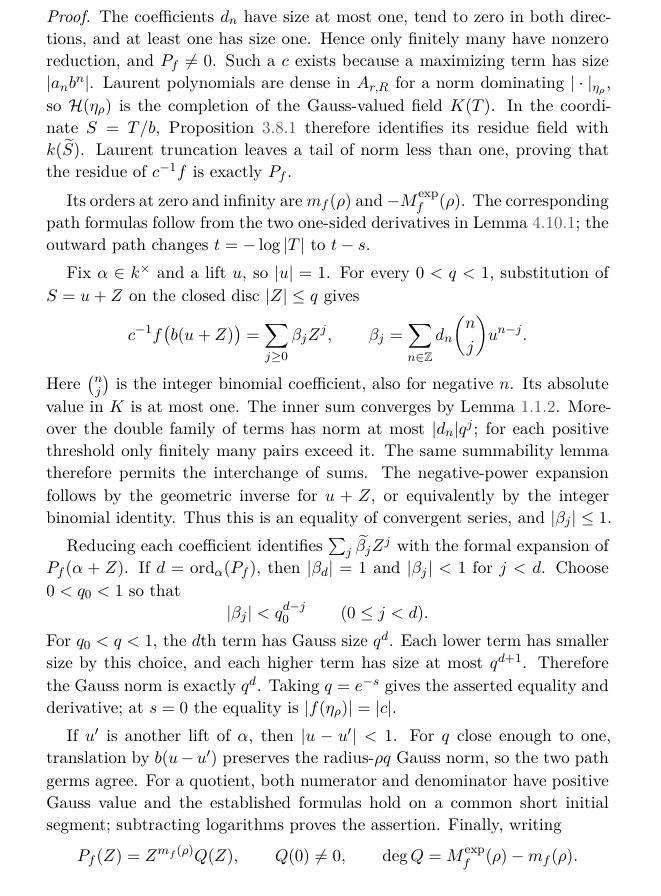
\bi{The coefficients $d_n$ have size at most one, tend to zero in both directions, and at least one has size one. Hence only finitely many have nonzero reduction, and $P_f\ne0$. Such a $c$ exists because a maximizing term has size $|a_nb^n|$. Laurent polynomials are dense in $A_{r,R}$ for a norm dominating $|\cdot|_{\eta_\rho}$, so $\mathcal H(\eta_\rho)$ is the completion of the Gauss-valued field $K(T)$. In the coordinate $S=T/b$, Proposition~\ref{new:gauss_residue_formula} therefore identifies its residue field with $k(\widetilde S)$. Laurent truncation leaves a tail of norm less than one, proving that the residue of $c^{-1}f$ is exactly $P_f$.}
{系数 $d_n$ 的大小不超过一,在正、负两个方向均趋于零,且至少有一个大小为一。因此只有有限个具有非零 reduction,且 $P_f\ne0$。所需 $c$ 存在,因为任一达到最大值的项的大小为 $|a_nb^n|$。Laurent 多项式对一个控制 $|\cdot|_{\eta_\rho}$ 的范数在 $A_{r,R}$ 中稠密,因此 $\mathcal H(\eta_\rho)$ 是 Gauss 赋值域 $K(T)$ 的完备化。在坐标 $S=T/b$ 中,Proposition~\ref{new:gauss_residue_formula} 因而将其剩余域识别为 $k(\widetilde S)$。Laurent 截断后的尾项范数小于一,因此 $c^{-1}f$ 的剩余类正是 $P_f$。}

\bi{Its orders at zero and infinity are $m_f(\rho)$ and $-M_f^{\mathrm{exp}}(\rho)$. The corresponding path formulas follow from the two one-sided derivatives in Lemma~\ref{cand:annulusdominantexponents}; the outward path changes $t=-\log|T|$ to $t-s$.}
{其在零与无穷远处的阶数分别为 $m_f(\rho)$ 和 $-M_f^{\mathrm{exp}}(\rho)$。相应的路径公式来自 Lemma~\ref{cand:annulusdominantexponents} 的两个单侧导数;向外的路径将 $t=-\log|T|$ 变为 $t-s$。}

\bi{Fix $\alpha\in k^\times$ and a lift $u$, so $|u|=1$. For every $0<q<1$, substitution of $S=u+Z$ on the closed disc $|Z|\leq q$ gives}
{固定 $\alpha\in k^\times$ 及其提升 $u$,则 $|u|=1$。对每个 $0<q<1$,在闭圆盘 $|Z|\leq q$ 上代入 $S=u+Z$,得到}
\[
 c^{-1}f\bigl(b(u+Z)\bigr)=\sum_{j\geq0}\beta_jZ^j,
 \qquad
 \beta_j=\sum_{n\in\Z}d_n\binom nj u^{n-j}.
\]
\bi{Here $\binom nj$ is the integer binomial coefficient, also for negative $n$. Its absolute value in $K$ is at most one. The inner sum converges by Lemma~\ref{fnd:seriescriterion}. Moreover the double family of terms has norm at most $|d_n|q^j$; for each positive threshold only finitely many pairs exceed it. The same summability lemma therefore permits the interchange of sums. The negative-power expansion follows by the geometric inverse for $u+Z$, or equivalently by the integer binomial identity. Thus this is an equality of convergent series, and $|\beta_j|\leq1$.}
{这里 $\binom nj$ 表示整数二项式系数,对负整数 $n$ 也采用此定义。它在 $K$ 中的绝对值不超过一。由 Lemma~\ref{fnd:seriescriterion},内层求和收敛。并且双重项族的范数不超过 $|d_n|q^j$;对每个正阈值,只有有限个指标对超过该阈值。同一可求和性引理因此允许交换求和次序。负次幂展开来自 $u+Z$ 的 geometric inverse,亦即整数二项式恒等式。因此上式为收敛级数的恒等式,且 $|\beta_j|\leq1$。}

\bi{Reducing each coefficient identifies $\sum_j\widetilde{\beta_j}Z^j$ with the formal expansion of $P_f(\alpha+Z)$. If $d=\operatorname{ord}_\alpha(P_f)$, then $|\beta_d|=1$ and $|\beta_j|<1$ for $j<d$. Choose $0<q_0<1$ so that}
{逐系数 reduction 将 $\sum_j\widetilde{\beta_j}Z^j$ 识别为 $P_f(\alpha+Z)$ 的形式展开。若 $d=\operatorname{ord}_\alpha(P_f)$,则 $|\beta_d|=1$,而对 $j<d$ 有 $|\beta_j|<1$。选择 $0<q_0<1$,使}
\[
 |\beta_j|<q_0^{d-j}\qquad(0\leq j<d).
\]
\bi{For $q_0<q<1$, the $d$th term has Gauss size $q^d$. Each lower term has smaller size by this choice, and each higher term has size at most $q^{d+1}$. Therefore the Gauss norm is exactly $q^d$. Taking $q=e^{-s}$ gives the asserted equality and derivative; at $s=0$ the equality is $|f(\eta_\rho)|=|c|$.}
{当 $q_0<q<1$ 时,第 $d$ 项的 Gauss 大小为 $q^d$。上述选择保证每个低次项更小,每个高次项的大小则不超过 $q^{d+1}$。所以 Gauss 范数恰为 $q^d$。取 $q=e^{-s}$,得到所需恒等式与导数;$s=0$ 时的恒等式为 $|f(\eta_\rho)|=|c|$。}

\bi{If $u'$ is another lift of $\alpha$, then $|u-u'|<1$. For $q$ close enough to one, translation by $b(u-u')$ preserves the radius-$\rho q$ Gauss norm, so the two path germs agree. For a quotient, both numerator and denominator have positive Gauss value and the established formulas hold on a common short initial segment; subtracting logarithms proves the assertion. Finally, writing}
{若 $u'$ 是 $\alpha$ 的另一个提升,则 $|u-u'|<1$。当 $q$ 充分接近一时,按 $b(u-u')$ 平移保持半径为 $\rho q$ 的 Gauss 范数,因此两个路径芽相同。对商,分子、分母均有正 Gauss 值,且所证公式在共同的一个短初始区间上成立;将对数相减即可。最后写成}
\[
 P_f(Z)=Z^{m_f(\rho)}Q(Z),\qquad Q(0)\ne0,
 \qquad\deg Q=M_f^{\mathrm{exp}}(\rho)-m_f(\rho).
\]
\bi{If $k$ is algebraically closed, the orders of $Q$ at its nonzero roots sum to its degree. Adding the orders at zero and infinity gives zero. This proves the slope sum, and subtraction gives the same conclusion for quotients.}
{若 $k$ 代数闭,则 $Q$ 在其非零根处的阶数之和等于其次数。再加上零与无穷远处的阶数,总和为零。这证明斜率和的断言;相减也给出商的同一结论。}
\end{proof}
Typeset reader excerpt
Typed proof inputs
- BASE-RINGS · standing context or base
- BASE-RINGS · standing context or base (requires)
- NAG-000182 · selected whole
- NAG-000182 · selected whole (requires)
- NAG-000221 · selected whole
- NAG-000221 · selected whole (requires)
- NAG-000464 · selected whole
- NAG-000464 · selected whole (requires)
- NAG-001415 · selected whole
- NAG-001415 · selected whole (requires)
- NAG-001416 · selected whole
- NAG-001416 · selected whole (requires)
- NAG-002026 · selected whole
- NAG-002026 · selected whole (requires)
Reader cross-references
Proof map
Verified map inputs · NAG-002029
AND · joint registered proof inputs
- NAG-000182 · Multiplicativity of the weighted Gauss norm · accepted whole
- NAG-000221 · Result 1.1.2 · accepted whole
- NAG-000464 · Result 3.8.1 · accepted whole
- NAG-001415 · The Laurent coefficient normal form · accepted whole
- NAG-001416 · Multiplication, module actions and naturality · accepted whole
- NAG-002026 · Extreme Laurent exponents · accepted whole
Standing context and base inputs
BASE-RINGS
NAG-002029 · Residual orders along Gauss-circle paths · Chapter argument