NAG-002241 · Accepted whole
The quotient model of an initial degeneration
5 Tropicalization, multiplicities and balancing
Open in the English reader · PDF page 921
Statement · exact TeX
\begin{lemma}[The quotient model of an initial degeneration]
\label{v035:degreeinitialmodel}
Let $I\subset K[M]$ be an ideal and set
\[
 P=K\langle M\rangle,\qquad P_0=R\langle M\rangle,
 \qquad J=IP.
\]
Then
\[
 B_0=P_0/(J\cap P_0)
\]
is an admissible topologically finitely presented $R$-algebra,
with generic algebra $B=P/J$. Its special algebra is
\[
 B_0/\mathfrak mB_0
   \simeq k[M]/\overline{I\cap R[M]},
\]
where the bar denotes coefficientwise reduction in $k[M]$.
\end{lemma}
Full selected proof · exact TeX
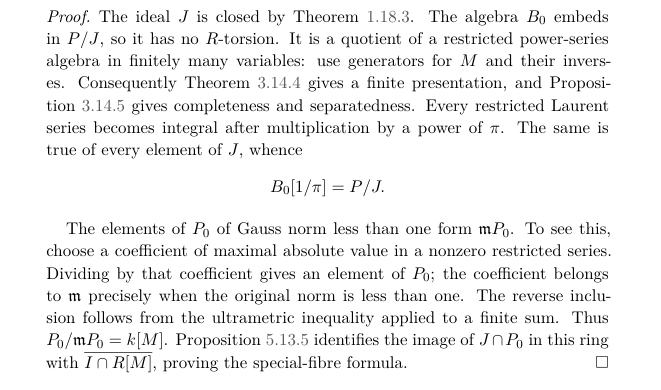
\begin{proof}
The ideal $J$ is closed by
Theorem~\ref{fnd:generalizedfinitemodules}. The algebra $B_0$
embeds in $P/J$, so it has no $R$-torsion. It is a quotient of
a restricted power-series algebra in finitely many variables:
use generators for $M$ and their inverses. Consequently
Theorem~\ref{fnd:formaltorsionfreepresentation} gives a finite
presentation, and Proposition~\ref{fnd:formalmoduletopology}
gives completeness and separatedness. Every restricted Laurent
series becomes integral after multiplication by a power of
$\pi$. The same is true of every element of $J$, whence
\[
 B_0[1/\pi]=P/J.
\]

The elements of $P_0$ of Gauss norm less than one form
$\mathfrak mP_0$. To see this, choose a coefficient of maximal
absolute value in a nonzero restricted series. Dividing by that
coefficient gives an element of $P_0$; the coefficient belongs
to $\mathfrak m$ precisely when the original norm is less than
one. The reverse inclusion follows from the ultrametric
inequality applied to a finite sum. Thus $P_0/\mathfrak mP_0=k[M]$.
Proposition~\ref{cand:initialcompletionreduction} identifies the
image of $J\cap P_0$ in this ring with
$\overline{I\cap R[M]}$, proving the special-fibre formula.
\end{proof}
Standing context 1 · exact TeX
% v0.35 English revision of the five excluded v0.34 degree candidates.
% Author/reviser: /root/f6_degree. Mathematical status is assigned by the gate.
\section{Geometric degrees and tropical lattice indices}
\label{v035:degreesection}

Write $R=K^\circ$, $\mathfrak m=K^{\circ\circ}$ and
$k=\widetilde K$. In the first two lemmas, $K$ is complete and
nontrivially valued, and $\pi\in R$ satisfies $0<|\pi|<1$.
The formal algebras carry their quotient $\pi$-adic topologies.
For a lattice $M$, the notation $R\langle M\rangle$ denotes
the Gauss unit ball in $K\langle M\rangle$.
Typeset reader excerpt
Typed proof inputs
- NAG-001415 · selected whole
- NAG-001415 · selected whole (requires)
- NAG-001553 · selected whole
- NAG-001553 · selected whole (requires)
- NAG-001561 · selected whole
- NAG-001561 · selected whole (requires)
- NAG-001562 · selected whole
- NAG-001562 · selected whole (requires)
- NAG-001915 · selected whole
- NAG-001915 · selected whole (requires)
- NAG-001916 · selected whole
- NAG-001916 · selected whole (requires)
- NAG-002084 · selected whole
- NAG-002084 · selected whole (requires)
Reader cross-references
Proof map
Verified map inputs · NAG-002241
AND · joint registered proof inputs
- NAG-001415 · The Laurent coefficient normal form · accepted whole
- NAG-001553 · The actual multi-Laurent relation quotient · accepted whole
- NAG-001561 · Canonical norms and exactness for finite modules · accepted whole
- NAG-001562 · Actual quotients by arbitrary ideals · accepted whole
- NAG-001915 · Torsion-free finite modules are finitely presented · accepted whole
- NAG-001916 · Adic topology on finite formal modules · accepted whole
- NAG-002084 · Completion retains the initial relations · accepted whole
NAG-002241 · The quotient model of an initial degeneration · Chapter argument