NAG-002275 · Accepted whole
Necessity of the geometric marked forest condition
Open in the English reader · PDF page 773
Statement · exact TeX
\begin{proposition}[Necessity of the geometric marked forest condition]
\label{v036:f5:forestnecessity}
Let $q:(\mathcal C_0,D)\to(\mathcal C_1,D_1)$ be a
morphism of marked semistable algebraic models inducing
the identity on $C$ and on the generic marking. Then
$V(\mathcal C_1)\subset V(\mathcal C_0)$, and this subset
satisfies the marked forest condition in $\mathcal C_0$.
\end{proposition}
Full selected proof · exact TeX
\begin{proof}
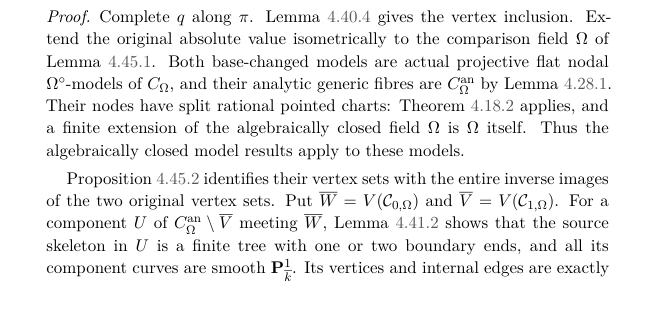
Complete $q$ along $\pi$. Lemma~\ref{v035:f5:dominationvertices}
gives the vertex inclusion. Extend the original absolute
value isometrically to the comparison field $\Omega$ of
Lemma~\ref{v036:f5:comparisonfield}. Both base-changed
models are actual projective flat nodal $\Omega^\circ$-models
of $C_\Omega$, and their analytic generic fibres are
$C_\Omega^{\an}$ by Lemma~\ref{cand:algebraicmodelscalar}.
Their nodes have split rational pointed charts:
Theorem~\ref{cand:simultaneousnodalsplitting} applies,
and a finite extension of the algebraically closed field
$\Omega$ is $\Omega$ itself. Thus the algebraically closed
model results apply to these models.

Proposition~\ref{v036:f5:vertexarithmetic} identifies their
vertex sets with the entire inverse images of the two
original vertex sets. Put $\overline W=V(\mathcal C_{0,\Omega})$
and $\overline V=V(\mathcal C_{1,\Omega})$.
For a component $U$ of $C_\Omega^{\an}\setminus\overline V$
meeting $\overline W$, Lemma~\ref{v035:f5:finiteforest}
shows that the source skeleton in $U$ is a finite tree
with one or two boundary ends, and all its component
curves are smooth $\mathbf P^1_{\overline k}$. Its vertices
and internal edges are exactly one connected component
$T$ of the induced removed graph. Its boundary ends are
exactly the $b(T)$ attaching branches, counted separately
even when they end at the same protected component.

The set $U$ is the actual tube of a closed point $p$ of
the target. For every removed component with generic
point $\eta$, functorial specialization gives
$q_s(\eta)=p$. Since $p$ is closed, every point of that
component, including all its marked specializations,
also maps to $p$. If $b(T)=1$, the target point $p$ is
smooth, and the closed immersion $D_{1,\overline k}$ has
at most one geometric point over it. Thus $m(T)\leq1$.
If $b(T)=2$, then $p$ is nodal and the marking avoids it,
so $m(T)=0$. This proves the stated condition on every
removed geometric tree.
\end{proof}
Standing context 1 · exact TeX
\begin{definition}[Marked semistable models over the original field]
\label{v036:f5:modelclass}
Let $C/K$ be smooth, projective and geometrically connected.
A \emph{semistable algebraic model} of $C$
means a projective flat finitely presented nodal $O$-curve
with generic fibre identified with $C$ and geometrically
connected special fibre. Its special fibre is geometrically
reduced. A \emph{marking} is a finite \textup{\'etale}
$O$-scheme $D$ embedded as a closed subscheme of the relative
smooth locus. An empty marking is allowed. Write $W$ for
the component vertex set of the model. A morphism of marked
models carries a specified isomorphism of its marking with
the target marking, compatible with the curve morphism
and with the specified generic identifications.

The \emph{geometric marked dual graph} has one vertex for
each component over $\overline k$, one edge for each
geometric node, and one labelled leg for each point of
$D_{\overline k}$. The two branches of a self-node give the
two ends of its loop.
\end{definition}
Standing context 2 · exact TeX
Fix a nonempty subset $V\subset W$,
and let $\overline V$ denote all geometric vertices over
its special components. For a connected component $T$ of
the subgraph induced by the vertices outside $\overline V$,
let $b(T)$ count its incident edges leading to
$\overline V$, with multiplicity, and let $m(T)$ count
its marked legs.

\begin{definition}[The marked forest condition]
\label{v036:f5:forestcondition}
The subset $V$ satisfies the marked forest condition if
every such $T$ is a tree, all the geometric special
components at its vertices are smooth $\mathbf P^1_{\overline k}$,
and
\[
                         b(T)+m(T)\leq2.
\]
Connectedness and $V\ne\varnothing$ give $b(T)\geq1$.
Thus a tree with one attaching branch carries at most one
mark, and a tree with two attaching branches carries none.
The two attaching branches may end on the same protected
component.
\end{definition}
Standing context 3 · exact TeX
\begin{definition}[Semistable formal curve models with pointed charts]
\label{v035:formal:modelclass}
Suppose $K$ is algebraically closed and $C/K$ is a smooth
connected projective curve. A point of $C^{\an}$ is of
\emph{type II} when its completed residue field has residual
transcendence degree one and relative rational value-group
rank zero. A \emph{pointedly semistable
formal model} of $C^{\an}$ is a quasi-compact admissible
formal $O$-scheme with an identification of its generic
fibre with $C^{\an}$, reduced pure one-dimensional special
fibre, and a diagram as in
Proposition~\ref{v035:formal:tubeends} at each closed
special-fibre point. Morphisms induce the identity on
$C^{\an}$. Its vertex set consists of its component
points $v_\eta$.
\end{definition}
Typeset reader excerpt
Typed proof inputs
- NAG-002053 · selected whole (exact native application)
- NAG-002094 · selected whole (exact native application)
- NAG-002222 · selected whole (exact native application)
- NAG-002229 · selected whole (exact native application)
- NAG-002232 · selected whole (exact native application)
- NAG-002270 · selected whole (exact native application)
- NAG-002271 · selected whole (exact native application)
- SUPPORT:NAG-001944:given_atlas_open_preimages_and_contraction · typed target unresolved in this export (exact native application)
Reader cross-references
Proof map
Verified map inputs · NAG-002275
AND · joint registered proof inputs
- NAG-002053 · All lifts of a finite set of nodes · accepted whole Exact source window 738–742
- The finite node set has rational split pointed charts over the already algebraically closed comparison field.
- NAG-002094 · Scalar extension of algebraic formal models · accepted whole Exact source window 734–741
- Actual projective model coefficient change and completed generic fibre identification.
- NAG-002222 · Formal smooth and nodal tube closures · accepted whole Exact source window 758–768
- The actual target tube and its exact smooth or nodal incidence after the geometric coefficient change.
- NAG-002229 · Vertices under a formal domination · accepted whole Exact source window 731–732
- Vertex inclusion for the actual completed marked-model arrow.
- NAG-002232 · Finite forests outside a semistable vertex set · accepted whole Exact source window 748–756
- Finite removed tree inside an actual smooth disc or nodal annulus with one or two distinguished boundary branches.
- NAG-002270 · An algebraically closed comparison field · accepted whole Exact source window 733–735
- Isometric algebraically closed comparison field.
- NAG-002271 · The arithmetic of a model vertex · accepted whole Exact source window 744–747
- Whole inverse image of the original component vertex sets, including all components after scalar change.
Unlinked source pointers
These pointers have no operative linked edge in this map.
SUPPORT:NAG-001944:given_atlas_open_preimages_and_contraction
NAG-002275 · Necessity of the geometric marked forest condition · Chapter argument