NAG-002278 · Accepted whole
Semilinear group actions on exact contractions
Open in the English reader · PDF page 776
Statement · exact TeX
\begin{corollary}[Semilinear group actions on exact contractions]
\label{v036:f5:equivariantcontraction}
Let a group $G$ act on $(\mathcal C_0,D)$ by semilinear
isometric automorphisms, and let $V$ be invariant and
satisfy the marked forest condition. There is a unique
action of $G$ on $(\mathcal C_V,D_V)$ making $q_V$
equivariant. Its generic action is the prescribed action
on $C$. Inclusions between invariant admissible vertex
sets give equivariant contraction morphisms.
\end{corollary}
Full selected proof · exact TeX
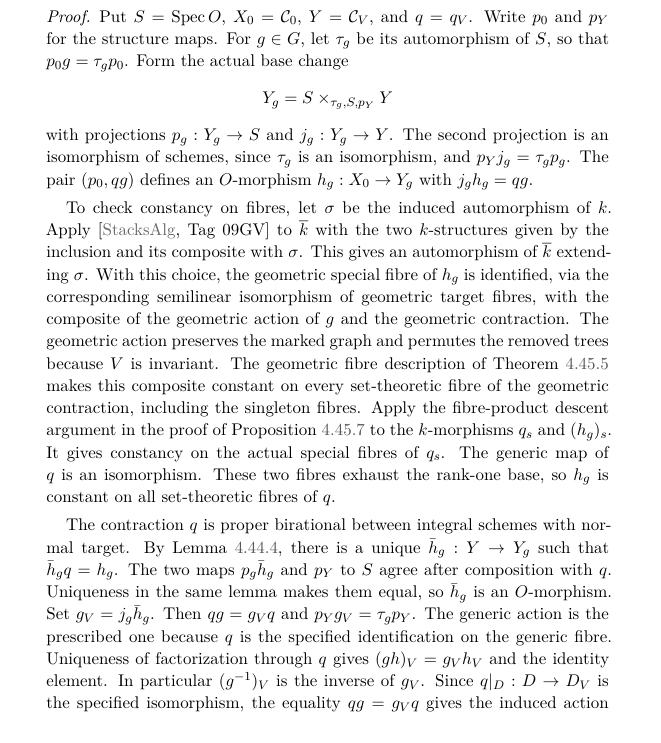
\begin{proof}
Put $S=\operatorname{Spec}O$, $X_0=\mathcal C_0$, $Y=\mathcal C_V$,
and $q=q_V$. Write $p_0$ and $p_Y$ for the structure maps.
For $g\in G$, let $\tau_g$ be its automorphism of $S$, so that
$p_0g=\tau_gp_0$. Form the actual base change
\[
 Y_g=S\times_{\tau_g,S,p_Y}Y
\]
with projections $p_g:Y_g\to S$ and $j_g:Y_g\to Y$.
The second projection is an isomorphism of schemes, since $\tau_g$
is an isomorphism, and $p_Yj_g=\tau_gp_g$.
The pair $(p_0,qg)$ defines an $O$-morphism
$h_g:X_0\to Y_g$ with $j_gh_g=qg$.

To check constancy on fibres, let $\sigma$ be the induced
automorphism of $k$. Apply \cite[Tag 09GV]{StacksAlg} to
$\overline k$ with the two $k$-structures given by the inclusion
and its composite with $\sigma$. This gives an automorphism of
$\overline k$ extending $\sigma$. With this choice, the geometric
special fibre of $h_g$ is identified, via the corresponding
semilinear isomorphism of geometric target fibres, with the
composite of the geometric action of $g$ and the geometric
contraction. The geometric action preserves the marked graph
and permutes the removed trees because $V$ is invariant.
The geometric fibre description of
Theorem~\ref{v036:f5:markedcontraction} makes this composite
constant on every set-theoretic fibre of the geometric
contraction, including the singleton fibres. Apply the
fibre-product descent argument in the proof of
Proposition~\ref{v036:f5:contractionuniqueness} to the
$k$-morphisms $q_s$ and $(h_g)_s$. It gives constancy on the
actual special fibres of $q_s$. The generic map of $q$ is an
isomorphism. These two fibres exhaust the rank-one base, so
$h_g$ is constant on all set-theoretic fibres of $q$.

The contraction $q$ is proper birational between integral
schemes with normal target. By
Lemma~\ref{v036:f5:properquotient}, there is a unique
$\bar h_g:Y\to Y_g$ such that $\bar h_gq=h_g$.
The two maps $p_g\bar h_g$ and $p_Y$ to $S$ agree after
composition with $q$. Uniqueness in the same lemma makes
them equal, so $\bar h_g$ is an $O$-morphism.
Set $g_V=j_g\bar h_g$. Then $qg=g_Vq$ and $p_Yg_V=\tau_gp_Y$.
The generic action is the prescribed one because $q$ is the
specified identification on the generic fibre. Uniqueness of
factorization through $q$ gives $(gh)_V=g_Vh_V$ and the identity
element. In particular $(g^{-1})_V$ is the inverse of $g_V$.
Since $q|_D:D\to D_V$ is the specified isomorphism, the equality
$qg=g_Vq$ gives the induced action on the marking as a scheme.
Finally, for an arrow of Theorem~\ref{v036:f5:contractioncategory}
from $Y'=\mathcal C_{V'}$ to $Y$, the two equivariance composites
agree after precomposition with $q_{V'}:X_0\to Y'$.
Uniqueness of factorization through $q_{V'}$ makes them equal.
\end{proof}
Typeset reader excerpt
Typed proof inputs
- NAG-002267 · selected whole (exact native application)
- NAG-002268 · selected whole (exact native application)
- NAG-002274 · selected whole (exact native application)
- NAG-002276 · selected whole (exact native application)
- NAG-002277 · selected whole (exact native application)
Reader cross-references
Proof map
Verified map inputs · NAG-002278
AND · joint registered proof inputs
- NAG-002267 · Generic normalization of a nodal family · accepted whole Exact source window 925–926
- Actual integral normal source and target with smooth integral generic fibre, as in the marked-contraction input. No new normalization construction.
- NAG-002268 · Proper contractions as ringed-space quotients · accepted whole Exact source windows 927–932, 941–942
- Use the actual proper birational map with integral source and normal integral target. Factor the O-linear h_g, then enforce its structure morphism and use uniqueness after composition with q.
- Its same uniqueness clause for q_{V'} gives equality of the two equivariance composites as scheme maps.
- NAG-002274 · Exact marked contraction over the original field · accepted whole Exact source window 915–917
- The geometric fibre description for this actual q and the specified isomorphism of markings.
- NAG-002276 · Algebraic uniqueness of an exact contraction · accepted whole Exact source window 919–921
- Only the fibre-product descent proof clause for q_s and the already O-linear twisted map, hence both special maps are k-linear.
- NAG-002277 · The ordered category of marked contractions · accepted whole Exact source window 939–941
- Use the actually constructed arrow for nested invariant admissible subsets under this same source.
NAG-002278 · Semilinear group actions on exact contractions · Chapter argument