NAG-002276 · Accepted whole
Algebraic uniqueness of an exact contraction
Open in the English reader · PDF page 774
Statement · exact TeX
\begin{proposition}[Algebraic uniqueness of an exact contraction]
\label{v036:f5:contractionuniqueness}
Let $q_i:\mathcal C_0\to\mathcal C_i$, $i=1,2$, be
morphisms of semistable algebraic models inducing the
identity on $C$. If the targets have the same component
vertices in $C^{\an}$, there is a unique algebraic
isomorphism $h:\mathcal C_1\to\mathcal C_2$ with
$q_2=h\circ q_1$. It induces the identity on $C$.
\end{proposition}
Full selected proof · exact TeX
\begin{proof}
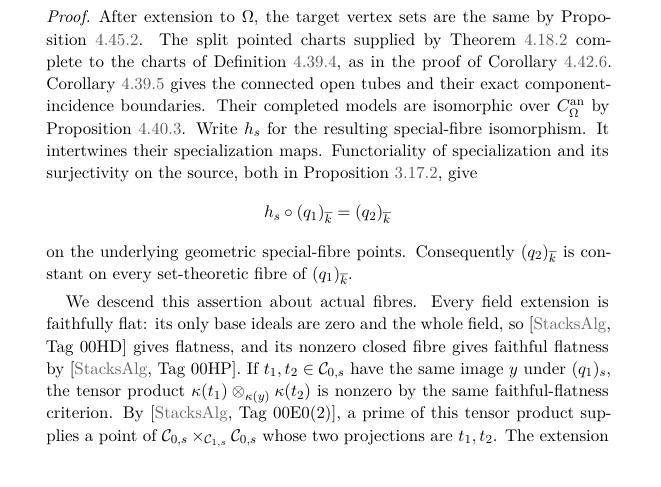
After extension to $\Omega$, the target vertex sets are
the same by Proposition~\ref{v036:f5:vertexarithmetic}.
The split pointed charts supplied by
Theorem~\ref{cand:simultaneousnodalsplitting} complete to
the charts of Definition~\ref{v035:formal:modelclass}, as
in the proof of Corollary~\ref{v035:f5:formalcorrespondence}.
Corollary~\ref{v035:formal:partition} gives the connected
open tubes and their exact component-incidence boundaries.
Their completed models are isomorphic over $C_\Omega^{\an}$
by Proposition~\ref{v035:f5:vertexuniqueness}. Write $h_s$
for the resulting special-fibre isomorphism. It intertwines
their specialization maps. Functoriality of specialization
and its surjectivity on the source, both in
Proposition~\ref{fnd:formalglobalgenericfaithful}, give
\[
                 h_s\circ(q_1)_{\overline k}
                        =(q_2)_{\overline k}
\]
on the underlying geometric special-fibre points.
Consequently $(q_2)_{\overline k}$ is constant on every
set-theoretic fibre of $(q_1)_{\overline k}$.

We descend this assertion about actual fibres. Every field
extension is faithfully flat: its only base ideals are zero
and the whole field, so \cite[Tag 00HD]{StacksAlg} gives
flatness, and its nonzero closed fibre gives faithful
flatness by \cite[Tag 00HP]{StacksAlg}. If
$t_1,t_2\in\mathcal C_{0,s}$ have the same image $y$
under $(q_1)_s$, the tensor product
$\kappa(t_1)\otimes_{\kappa(y)}\kappa(t_2)$ is nonzero
by the same faithful-flatness criterion.
By \cite[Tag 00E0(2)]{StacksAlg}, a prime of this tensor
product supplies a point of
$\mathcal C_{0,s}\times_{\mathcal C_{1,s}}\mathcal C_{0,s}$
whose two projections are $t_1,t_2$. The extension
$\overline k/k$ is faithfully flat by the preceding
argument. On an affine base change, its tensor functor
on modules is the original coefficient tensor functor,
so remains faithfully flat. Surjectivity on spectra,
\cite[Tag 00HQ]{StacksAlg}, lifts the chosen point to the
base-changed fibre product. The lifted projections have the same
$(q_1)_{\overline k}$-image, hence the same
$(q_2)_{\overline k}$-image. Projecting back gives
$(q_2)_s(t_1)=(q_2)_s(t_2)$. On the generic fibre $q_1$
and $q_2$ are identities. These two fibres exhaust the
rank-one base, and their images cannot meet. Thus $q_2$
is constant on every fibre of $q_1$.

The morphisms $q_i$ are proper: their graphs are closed
in the products over $O$, and projection from those
products is proper. Their targets are normal and integral
by Proposition~\ref{v036:f5:genericnormalization}.
Lemma~\ref{v036:f5:properquotient} gives an actual
algebraic factorization $h$. Interchanging the indices
gives its inverse; uniqueness of factorization shows that
the composites are the identity. This proves both the
assertion and its uniqueness.
\end{proof}
Standing context 1 · exact TeX
\begin{definition}[Marked semistable models over the original field]
\label{v036:f5:modelclass}
Let $C/K$ be smooth, projective and geometrically connected.
A \emph{semistable algebraic model} of $C$
means a projective flat finitely presented nodal $O$-curve
with generic fibre identified with $C$ and geometrically
connected special fibre. Its special fibre is geometrically
reduced. A \emph{marking} is a finite \textup{\'etale}
$O$-scheme $D$ embedded as a closed subscheme of the relative
smooth locus. An empty marking is allowed. Write $W$ for
the component vertex set of the model. A morphism of marked
models carries a specified isomorphism of its marking with
the target marking, compatible with the curve morphism
and with the specified generic identifications.

The \emph{geometric marked dual graph} has one vertex for
each component over $\overline k$, one edge for each
geometric node, and one labelled leg for each point of
$D_{\overline k}$. The two branches of a self-node give the
two ends of its loop.
\end{definition}
Standing context 2 · exact TeX
Fix a nonempty subset $V\subset W$,
and let $\overline V$ denote all geometric vertices over
its special components. For a connected component $T$ of
the subgraph induced by the vertices outside $\overline V$,
let $b(T)$ count its incident edges leading to
$\overline V$, with multiplicity, and let $m(T)$ count
its marked legs.

\begin{definition}[The marked forest condition]
\label{v036:f5:forestcondition}
The subset $V$ satisfies the marked forest condition if
every such $T$ is a tree, all the geometric special
components at its vertices are smooth $\mathbf P^1_{\overline k}$,
and
\[
                         b(T)+m(T)\leq2.
\]
Connectedness and $V\ne\varnothing$ give $b(T)\geq1$.
Thus a tree with one attaching branch carries at most one
mark, and a tree with two attaching branches carries none.
The two attaching branches may end on the same protected
component.
\end{definition}
Standing context 3 · exact TeX
\begin{definition}[Semistable formal curve models with pointed charts]
\label{v035:formal:modelclass}
Suppose $K$ is algebraically closed and $C/K$ is a smooth
connected projective curve. A point of $C^{\an}$ is of
\emph{type II} when its completed residue field has residual
transcendence degree one and relative rational value-group
rank zero. A \emph{pointedly semistable
formal model} of $C^{\an}$ is a quasi-compact admissible
formal $O$-scheme with an identification of its generic
fibre with $C^{\an}$, reduced pure one-dimensional special
fibre, and a diagram as in
Proposition~\ref{v035:formal:tubeends} at each closed
special-fibre point. Morphisms induce the identity on
$C^{\an}$. Its vertex set consists of its component
points $v_\eta$.
\end{definition}
Typeset reader excerpt
Typed proof inputs
- NAG-001939 · selected whole (exact native application)
- NAG-002053 · selected whole (exact native application)
- NAG-002224 · selected whole (exact native application)
- NAG-002228 · selected whole (exact native application)
- NAG-002267 · selected whole (exact native application)
- NAG-002268 · selected whole (exact native application)
- NAG-002270 · selected whole (exact native application)
- NAG-002271 · selected whole (exact native application)
- SUPPORT:NAG-001944:given_atlas_open_preimages_and_contraction · typed target unresolved in this export (exact native application)
- SUPPORT:NAG-002239:pointed_completion_discrete_test_lifting · typed target unresolved in this export (exact native application)
Reader cross-references
Proof map
Verified map inputs · NAG-002276
AND · joint registered proof inputs
- NAG-001939 · Surjectivity of formal specialization · accepted whole Exact source window 792–799
- Affine specialization surjectivity on the actual source chart cover.
- NAG-002053 · All lifts of a finite set of nodes · accepted whole Exact source window 783–785
- Supplied split node charts over the actual comparison field.
- NAG-002224 · The specialization partition of a formal curve · accepted whole Exact source window 787–788
- Actual pointed formal partition and the complete set of tube boundaries.
- NAG-002228 · Uniqueness from vertices and actual tubes · accepted whole Exact source window 789–792
- The two supplied formal completions over the same generic X with same vertices and exact tube boundaries.
- NAG-002267 · Generic normalization of a nodal family · accepted whole Exact source window 829–832
- Normality and integrality for the actual model targets with smooth integral generic fibre.
- NAG-002268 · Proper contractions as ringed-space quotients · accepted whole Exact source window 833–837
- Proper quotient on both actual arrows after descending constancy on actual geometric fibres.
- NAG-002270 · An algebraically closed comparison field · accepted whole Exact source window 781–782
- Isometric comparison field in the standing original-field section.
- NAG-002271 · The arithmetic of a model vertex · accepted whole Exact source window 781–782
- Whole vertex preimages for the two actual targets.
Unlinked source pointers
These pointers have no operative linked edge in this map.
SUPPORT:NAG-001944:given_atlas_open_preimages_and_contractionSUPPORT:NAG-002239:pointed_completion_discrete_test_lifting
NAG-002276 · Algebraic uniqueness of an exact contraction · Chapter argument