NAG-002304 · Accepted whole
Calibration under an isogeny of the target
5 Tropicalization, multiplicities and balancing
Open in the English reader · PDF page 962
Statement · exact TeX
\begin{proposition}[Calibration under an isogeny of the target]
\label{v036:gausscalibration}
Let $A_{K,r}\to D$ be finite with its canonical Banach structure,
and let $C$ and $s$ be as in Proposition~\ref{v036:gaussisogeny}.
Regard $D$ also as an $A_{K,s}$-algebra by composition. It has the
canonical finite-$A_{K,s}$-module Banach structure, and
\[
                         \delta_{K,s}(D)=|\det C|\,\delta_{K,r}(D).
\]

More generally let $D$ be an actual full moment-fibre algebra at
$w\in\mathbb R^n$, and let $Q_0,Q_1:\mathbb Z^n\to\mathbb Z^d$
have rank $d$ and the same rational row space. Suppose the two
monomial maps make $D$ finite with its canonical module norms
over their polytori at $Q_iw$. Let $N\subset\mathbb Z^n$ have
rank $d$ and suppose $Q_i|_N$ is injective. Writing $\delta_{Q_i}$
for the corresponding Gauss degree, one has
\[
 \frac{\delta_{Q_0}}{[\mathbb Z^d:Q_0(N)]}
   =\frac{\delta_{Q_1}}{[\mathbb Z^d:Q_1(N)]}.
\]
\end{proposition}
Full selected proof · exact TeX
\begin{proof}
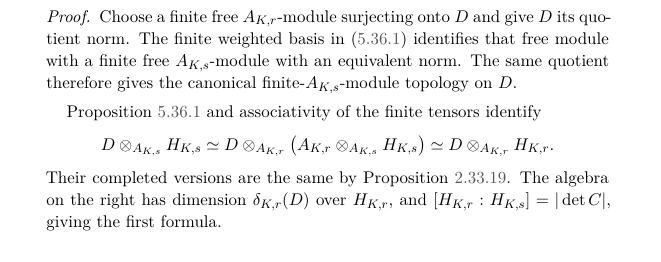
Choose a finite free $A_{K,r}$-module surjecting onto $D$ and
give $D$ its quotient norm. The finite weighted basis in
\eqref{v036:eq:gausscosets} identifies that free module with a
finite free $A_{K,s}$-module with an equivalent norm. The same
quotient therefore gives the canonical finite-$A_{K,s}$-module
topology on $D$.

Proposition~\ref{v036:gaussisogeny} and associativity of the
finite tensors identify
\[
 D\otimes_{A_{K,s}}H_{K,s}
   \simeq
 D\otimes_{A_{K,r}}
       \bigl(A_{K,r}\otimes_{A_{K,s}}H_{K,s}\bigr)
   \simeq D\otimes_{A_{K,r}}H_{K,r}.
\]
Their completed versions are the same by
Proposition~\ref{fnd:generalizedfinitebasechange}. The algebra on
the right has dimension $\delta_{K,r}(D)$ over $H_{K,r}$, and
$[H_{K,r}:H_{K,s}]=|\det C|$, giving the first formula.

For the second assertion, equality of the rational row spaces
gives an invertible rational matrix $B$ with $Q_1=BQ_0$.
Choose a positive integer $m$ clearing its denominators and set
$C_0=mB$, $C_1=mI_d$. Then both $C_i$ are nonsingular integer
matrices and $C_0Q_0=C_1Q_1$. These equal matrices define the same
monomial map on the same actual algebra $D$, with the same
target radii. Applying the first assertion twice gives
\[
                 |\det C_0|\delta_{Q_0}
                    =|\det C_1|\delta_{Q_1}.
\]
For each $i$, the finite chain
$C_iQ_i(N)\subset C_i\mathbb Z^d\subset\mathbb Z^d$ has index
\[
 [\mathbb Z^d:C_iQ_i(N)]
    =|\det C_i|[\mathbb Z^d:Q_i(N)].
\]
Indeed representatives for the two successive quotients give
representatives for the composite quotient, and $C_i$ identifies
the first quotient with $\mathbb Z^d/Q_i(N)$. The left sides for
$i=0,1$ agree because $C_0Q_0=C_1Q_1$. Dividing the two displayed
identities proves the calibrated equality.
\end{proof}
Standing context 1 · exact TeX
Let $K$ be complete for its specified real-valued non-Archimedean
absolute value, which may be trivial. For $r\in\mathbb R_{>0}^d$ put
\[
 A_{K,r}=K\{r^{-1}T,rU\}/(T_iU_i-1)_{i=1}^d.
\]
The actual Laurent presentation of
Theorem~\ref{fnd:multilaurentactualpresentation} identifies this algebra
isometrically with the convergent Laurent series
\[
 \begin{gathered}
 \sum_{m\in\mathbb Z^d}a_mT^m,
 \qquad |a_m|r^m\longrightarrow0
 \quad\text{outside finite subsets},\\
 \left\|\sum_m a_mT^m\right\|_r=\max_m|a_m|r^m.
 \end{gathered}
\]
By Proposition~\ref{fnd:gaussnorm} and density of finite Laurent sums,
this norm is multiplicative. Write $\xi_{K,r}$ for its spectrum point
and $H_{K,r}$ for the completion of $\operatorname{Frac}(A_{K,r})$
for this norm. Thus $H_{K,r}=\mathcal H(\xi_{K,r})$. Empty tuples
give $A_{K,r}=H_{K,r}=K$.
Standing context 2 · exact TeX
For a finite $A_{K,r}$-algebra $D$ whose given norm is equivalent
to its canonical finite-module norm, define its Gauss fibre and degree by
\begin{equation}
\label{v036:eq:gaussdegree}
 E_{K,r}(D)=D\widehat\otimes_{A_{K,r}}H_{K,r},
 \qquad
 \delta_{K,r}(D)=\dim_{H_{K,r}}E_{K,r}(D).
\end{equation}
These are an actual finite analytic fibre algebra and a nonnegative
integer by Proposition~\ref{fnd:generalizedfinitebasechange} and
Theorem~\ref{fnd:allpointaffinoidfibres}.
Typeset reader excerpt
Typed proof inputs
- APP-STACKS-00D2@NAG-002304:original-proof · named external application (new exact application of frozen Stacks authority)
- BASE-RINGS · standing context or base (elementary project base)
- NAG-001702 · selected whole (sealed native whole)
- NAG-002298 · selected whole (ordered native whole proposal)
- STACKS-00D2 · named external application (new exact application of frozen Stacks authority)
- APP-STACKS-00D2@NAG-002304:original-proof · named external application
- APP-STACKS-00D2@NAG-002304:original-proof · named external application (requires)
- BASE-RINGS · standing context or base
- BASE-RINGS · standing context or base (requires)
- NAG-001702 · selected whole
- NAG-001702 · selected whole (requires)
- NAG-002298 · selected whole
- NAG-002298 · selected whole (requires)
Reader cross-references
Proof map
Verified map inputs · NAG-002304
AND · joint registered proof inputs
- NAG-001702 · General finite base change · accepted whole Exact source window 286–298
- NAG-002298 · Monomial covers of Gauss fields · accepted whole Exact source window 279–298
Standing context and base inputs
BASE-RINGSExact source window 300–321
Unlinked source pointers
These pointers have no operative linked edge in this map.
APP-STACKS-00D2@NAG-002304:original-proofSTACKS-00D2
NAG-002304 · Calibration under an isogeny of the target · Chapter argument