NAG-002370 · Accepted whole
Module cycles and finite geometric pushforward
5 Tropicalization, multiplicities and balancing
Open in the English reader · PDF page 996
Statement · exact TeX
\begin{theorem}[Module cycles and finite geometric pushforward]
\label{v037:degree:modulecycle}
Let $Y=\mathcal M(A)$ be pure of analytic dimension $d$, with
a unit moment tuple $f_Y$ and moment map $t_Y$.
Let $\Omega\subset\mathbb R^{n'}$ be open and convex, with
$\Omega\cap t_Y(\partial_KY)=\varnothing$. Suppose a finite
pure $d$-dimensional integral affine polyhedral complex
$\mathcal C_Y$ has
\[
                    t_Y(Y)\cap\Omega=|\mathcal C_Y|\cap\Omega.
\]
For every finite $A$-module $M$, the values $m_{M,f_Y}(v)$
are constant on
$\operatorname{relint}(\sigma)\cap\Omega$ for each
$d$-cell $\sigma$. They define a nonnegative integral
balanced $d$-cycle, denoted $\operatorname{Trop}_{f_Y,\Omega}(M)$.
These cycles are additive in short exact sequences and
independent of the chosen polyhedral subdivision.
For $M=A$ this is the analytic cycle of
Theorem~\ref{v037:analytic:polyhedralcycle}.

Let $p:X=\mathcal M(B)\to Y$ be finite, with $X$ pure of
analytic dimension $d$. Suppose unit moment coordinates
on $X$ and an integral map
$a:\mathbb Z^n\to\mathbb Z^{n'}$ satisfy the corresponding
character identity $t_Y\circ p=a\circ t_X$.
Suppose also that a finite pure $d$-dimensional integral
affine complex $\mathcal C_X$ satisfies
\[
 t_X(X)\cap a^{-1}(\Omega)
                          =|\mathcal C_X|\cap a^{-1}(\Omega).
\]
Then lattice-index pushforward on these open sets gives
\begin{equation}
\label{v037:degree:eqmodulecyclepushforward}
 a_*\operatorname{Trop}_{f_X,a^{-1}(\Omega)}(B)
                         =\operatorname{Trop}_{f_Y,\Omega}(B).
\end{equation}
On the left $B$ is the structure module of $X$; on the right
it is its finite $A$-module. If $\Delta\in\mathbb Q_{\geq0}$ satisfies
\[
 \beta_{\mathfrak p}(B)
        =\Delta\,\operatorname{length}(A_{\mathfrak p})
                    \qquad(\mathfrak p\in\operatorname{Min}(A)),
\]
then the right side is
$\Delta\,\operatorname{Trop}_{f_Y,\Omega}(A)$.
The same statement allows a positive rational $\Delta$
for a nonreduced target.
\end{theorem}
Full selected proof · exact TeX
\begin{proof}
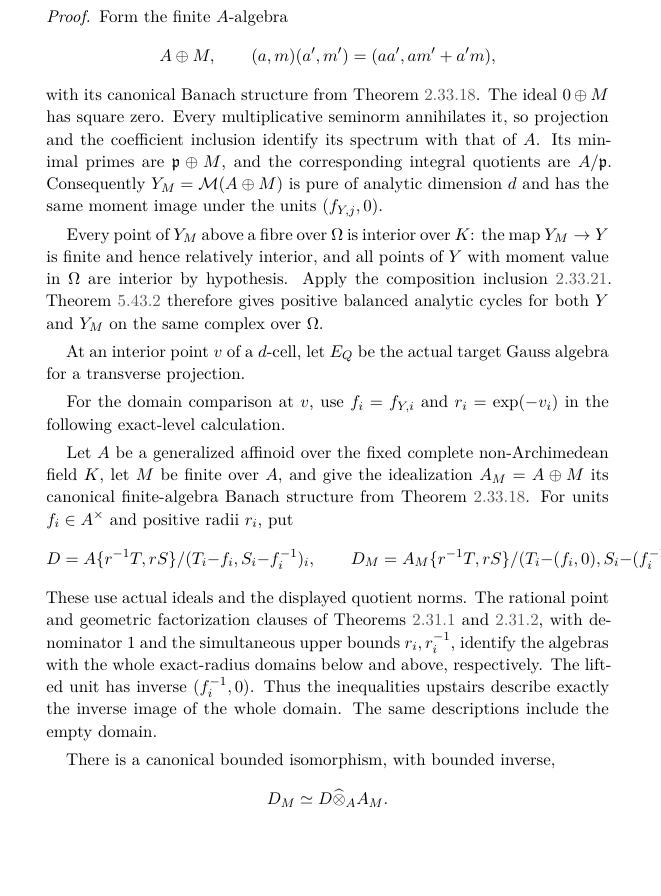
Form the finite $A$-algebra
\[
                         A\oplus M,\qquad
             (a,m)(a',m')=(aa',am'+a'm),
\]
with its canonical Banach structure from
Theorem~\ref{fnd:generalizedfinitealgebras}.
The ideal $0\oplus M$ has square zero. Every multiplicative
seminorm annihilates it, so projection and the coefficient
inclusion identify its spectrum with that of $A$.
Its minimal primes are $\mathfrak p\oplus M$, and the
corresponding integral quotients are $A/\mathfrak p$.
Consequently $Y_M=\mathcal M(A\oplus M)$ is pure of
analytic dimension $d$ and has the same moment image
under the units $(f_{Y,j},0)$.

Every point of $Y_M$ above a fibre over $\Omega$ is interior
over $K$: the map $Y_M\to Y$ is finite and hence relatively
interior, and all points of $Y$ with moment value in
$\Omega$ are interior by hypothesis. Apply the composition
inclusion \ref{fnd:affinoidinteriorcalculus}.
Theorem~\ref{v037:analytic:polyhedralcycle} therefore gives
positive balanced analytic cycles for both $Y$ and $Y_M$
on the same complex over $\Omega$.

At an interior point $v$ of a $d$-cell, let $E_Q$ be the
actual target Gauss algebra for a transverse projection.

For the domain comparison at $v$, use $f_i=f_{Y,i}$ and
$r_i=\exp(-v_i)$ in the following exact-level calculation.

Let \(A\) be a generalized affinoid over the fixed complete
non-Archimedean field \(K\), let \(M\) be finite over \(A\), and give
the idealization \(A_M=A\oplus M\) its canonical finite-algebra
Banach structure from Theorem~\ref{fnd:generalizedfinitealgebras}. For units \(f_i\in A^\times\)
and positive radii \(r_i\), put
\[
 D=A\{r^{-1}T,rS\}/(T_i-f_i,S_i-f_i^{-1})_i,\qquad
 D_M=A_M\{r^{-1}T,rS\}/(T_i-(f_i,0),S_i-(f_i^{-1},0))_i .
\]
These use actual ideals and the displayed quotient norms. The
rational point and geometric factorization clauses of
Theorems~\ref{fnd:generalizedrationalpoints}
and~\ref{fnd:generalizedrationaluniversal}, with denominator \(1\) and the
simultaneous upper bounds \(r_i,r_i^{-1}\), identify the algebras
with the whole exact-radius domains below and above, respectively.
The lifted unit has inverse \((f_i^{-1},0)\). Thus the inequalities
upstairs describe exactly the inverse image of the whole domain.
The same descriptions include the empty domain.

There is a canonical bounded isomorphism, with bounded inverse,
\[
                      D_M\simeq D\widehat\otimes_A A_M .
\]
Indeed, for a commutative Banach \(K\)-algebra \(C\) with a bounded
unital map \(\phi:A_M\to C\), the bounded factorization clause of
Theorem~\ref{fnd:generalizedrationaluniversal} says that extending \(\phi\) across \(D_M\) requires
exactly the estimates
\[
 \|\phi((f_i,0))^m\|\leq c_i^+r_i^m,\qquad
 \|\phi((f_i^{-1},0))^m\|\leq c_i^-r_i^{-m}\quad(m\geq0)
\]
for some constants \(c_i^\pm\). The factorization is unique. These
are precisely the estimates for extending \(\phi|_A\) across \(D\).
Thus \(D_M\) represents the pairs of bounded maps from \(A_M\) and
\(D\) agreeing on \(A\). Their balanced product on finite sums
\(\sum_j d_j\otimes b_j\) has norm bounded by the product of the
two operator bounds times \(\max_j\|d_j\|\|b_j\|\).
Taking the projective infimum and passing through separation and
completion gives the unique bounded map from
\(D\widehat\otimes_A A_M\). The two universal factorizations are
inverse because their composites fix both structural maps. This
comparison preserves the actual algebras over \(A_M\), hence also
the maps from the exact-radius target torus defined by the common
projecting monomials in the units.

Proposition~\ref{fnd:generalizedfinitebasechange} gives the
Gauss algebra of $Y_M$ as
\[
                (A\oplus M)\otimes_AE_Q
                         =E_Q\oplus(M\otimes_AE_Q).
\]
Thus its dimension is the sum of the two dimensions.
Theorem~\ref{v037:degree:moduleweight} and the common
lattice divisor give
\[
                    m_{Y_M}(v)=m_Y(v)+m_{M,f_Y}(v).
\]
Subtracting the two balanced cycles proves constancy and
balancing for the module weights. Their nonnegativity
and integrality are
\eqref{v037:degree:eqmoduleweight}. Additivity follows
from the exact-sequence assertion of that theorem, and
common-refinement invariance follows from the same
property of the two analytic cycles. This proves the
first part.

For the finite map $p$, every point of $X$ whose moment
value lies in $a^{-1}(\Omega)$ is interior over $K$,
again by finite relative interior and composition.
Thus the stated source analytic cycle is defined.
Exclude from the target the lower-dimensional cells of
$\mathcal C_Y$, the images of all cells of $\mathcal C_X$
of dimension less than $d$, and the images of those
$d$-cells on whose tangent space $a$ has rank less than
$d$. Linear images of the finitely many polyhedra are
polyhedra, by the finite elimination and refinement
construction in
Theorem~\ref{cand:balancedpolyhedralpushforward}.
Each excluded set has dimension at most $d-1$.
For $d=0$ the nonempty cells are points and every restriction
has rank zero. The exclusions therefore remove no point, so
every target point in the support is already in the complement.
For $d>0$ the complement is dense in the relative interior of
every target $d$-cell: a line in its affine span with
direction outside the finitely many excluded proper
direction subspaces meets those affine subspaces in
at most finitely many points. Such a line direction
exists by the finite-polynomial argument in
Theorem~\ref{v037:analytic:wallbalance}.

Fix a target point $v$ in this complement and in the
target support. Every source moment value above it
lies in the relative interior of a $d$-cell on which
$a$ is injective. There is at most one such point per
cell, so the full inverse image in $t_X(X)$ is finite.
If it is nonempty, all the hypotheses of
Theorem~\ref{v037:degree:finitecyclepushforward} hold:
the target and source germs are flat at cell interiors,
and the target whole fibre is interior. The theorem
identifies the lattice-index sum of source weights
with $m_{B,f_Y}(v)$.

If this finite inverse image is empty, the actual
inverse image of the entire target moment fibre is
empty. Its algebra is $B\otimes_AD_v$, by finite base
change and
Theorem~\ref{fnd:generalizeddomainbasechange}.
Theorem~\ref{fnd:generalizedpointunitcriterion} makes this
algebra zero. Hence $B\otimes_AE_Q=0$ and
$m_{B,f_Y}(v)=0$, which is also the empty lattice-index
sum.

The map $a$ on the actual source support over $\Omega$
is proper. For a compact subset $C\subset\Omega$, its
inverse image is the closed subset
$t_X(X)\cap a^{-1}(C)$ of the compact set $t_X(X)$.
Refine the target along the finitely many cell images
and pull the defining hyperplanes back to the source,
as in
Theorem~\ref{cand:balancedpolyhedralpushforward}.
The lattice-index sum then defines the local pushforward;
facets with smaller-dimensional image contribute zero.
On the generic part of every resulting target $d$-cell,
this sum equals the module weight just computed.
Both are constant there, so the cycles agree. This
proves \eqref{v037:degree:eqmodulecyclepushforward}.
The last assertion follows on every such cell from
Theorem~\ref{v037:degree:moduleweight} and its formula
for the structure module $A$.
\end{proof}
Typeset reader excerpt
Typed proof inputs
- NAG-001496 · selected whole (exact native proof input)
- NAG-001572 · selected whole (exact native proof input)
- NAG-001576 · selected whole (exact native proof input)
- NAG-001577 · selected whole (exact native proof input)
- NAG-001701 · selected whole (exact native proof input)
- NAG-001702 · selected whole (exact native proof input)
- NAG-001704 · selected whole (exact native proof input)
- NAG-001846 · selected whole (exact native proof input)
- NAG-002188 · selected whole (exact native proof input)
- NAG-002362 · selected whole (exact native proof input)
- NAG-002365 · selected whole (exact native proof input)
- NAG-002376 · selected whole (exact native proof input)
- NAG-002378 · selected whole (exact native proof input)
Reader cross-references
Proof map
Verified map inputs · NAG-002370
AND · joint registered proof inputs
- NAG-001496 · Compactness of the bounded spectrum · accepted whole
- NAG-001572 · Nonemptiness and the unit-ideal test · accepted whole
- NAG-001576 · Points of an arbitrary-radius rational presentation · accepted whole
- NAG-001577 · Bounded and geometric rational factorization · accepted whole
- NAG-001701 · Finite algebras with their canonical norm · accepted whole
- NAG-001702 · General finite base change · accepted whole
- NAG-001704 · Presentation calculus for relative interior · accepted whole
- NAG-001846 · Affinoid domains under arbitrary affinoid base change · accepted whole
- NAG-002188 · Balanced pushforward · accepted whole
- NAG-002362 · Weights of finite modules on an interior flat germ · accepted whole
- NAG-002365 · Finite pushforward with full generic lengths · accepted whole
- NAG-002376 · The normal equation at a polyhedral wall · accepted whole
- NAG-002378 · The analytic weights on a given polyhedral image · accepted whole
NAG-002370 · Module cycles and finite geometric pushforward · Chapter argument