NAG-002372 · Accepted whole
Finite-module pushforward and composition
5 Tropicalization, multiplicities and balancing
Open in the English reader · PDF page 999
Statement · exact TeX
\begin{theorem}[Finite-module pushforward and composition]
\label{v037:degree:modulefunctoriality}
Keep the finite morphism $p:X=\mathcal M(B)\to Y=\mathcal M(A)$,
the moment tuples, the lattice map $a$, and the given complexes
over $\Omega$ in Theorem~\ref{v037:degree:modulecycle}.
For every finite $B$-module $M$, regarded also as a finite
$A$-module, one has
\[
 a_*\operatorname{Trop}_{f_X,a^{-1}(\Omega)}(M)
                   =\operatorname{Trop}_{f_Y,\Omega}(M).
\]
Its target generic coefficients are
\[
 \operatorname{length}_{A_{\mathfrak p}}(M_{\mathfrak p})
 =\sum_{\substack{\mathfrak q\in\operatorname{Min}(B)\\
                   \mathfrak q\cap A=\mathfrak p}}
       \operatorname{length}_{B_{\mathfrak q}}(M_{\mathfrak q})
                         [\kappa(\mathfrak q):\kappa(\mathfrak p)]
       \qquad(\mathfrak p\in\operatorname{Min}(A)).
\]

These pushforwards respect finite composition. More precisely,
let $Z=\mathcal M(C)\to X$ also be finite with $Z$ pure of
analytic dimension $d$, and let a unit tuple $f_Z$ and an
integral map $b$ satisfy the corresponding character identity.
Assume a finite pure integral complex presents the actual
$f_Z$-image on $(ab)^{-1}(\Omega)$. For every finite $C$-module
$L$,
\[
 (ab)_*\operatorname{Trop}_{f_Z,(ab)^{-1}(\Omega)}(L)
   =a_*b_*\operatorname{Trop}_{f_Z,(ab)^{-1}(\Omega)}(L)
   =\operatorname{Trop}_{f_Y,\Omega}(L).
\]
Here $ab$ means $a\circ b$, and the middle pushforwards use
the indicated inverse open sets.

If $P$ is a finite locally free $A$-module of constant rank $r$,
then the tensor projection formula is
\[
 a_*\operatorname{Trop}_{f_X,a^{-1}(\Omega)}(M\otimes_AP)
       =\operatorname{Trop}_{f_Y,\Omega}(M\otimes_AP)
       =r\,\operatorname{Trop}_{f_Y,\Omega}(M).
\]
\end{theorem}
Full selected proof · exact TeX
\begin{proof}
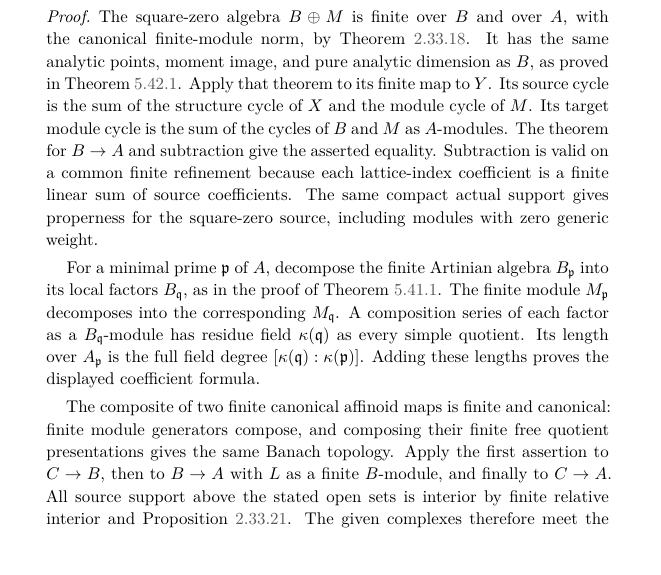
The square-zero algebra $B\oplus M$ is finite over $B$ and
over $A$, with the canonical finite-module norm, by
Theorem~\ref{fnd:generalizedfinitealgebras}.
It has the same analytic points, moment image, and pure
analytic dimension as $B$, as proved in
Theorem~\ref{v037:degree:modulecycle}.
Apply that theorem to its finite map to $Y$. Its source cycle
is the sum of the structure cycle of $X$ and the module cycle
of $M$. Its target module cycle is the sum of the cycles of
$B$ and $M$ as $A$-modules. The theorem for $B\to A$ and
subtraction give the asserted equality. Subtraction is valid
on a common finite refinement because each lattice-index
coefficient is a finite linear sum of source coefficients.
The same compact actual support gives properness for the
square-zero source, including modules with zero generic weight.

For a minimal prime $\mathfrak p$ of $A$, decompose the
finite Artinian algebra $B_{\mathfrak p}$ into its local
factors $B_{\mathfrak q}$, as in the proof of
Theorem~\ref{v037:degree:finitecyclepushforward}.
The finite module $M_{\mathfrak p}$ decomposes into the
corresponding $M_{\mathfrak q}$. A composition series of each
factor as a $B_{\mathfrak q}$-module has residue field
$\kappa(\mathfrak q)$ as every simple quotient.
Its length over $A_{\mathfrak p}$ is the full field degree
$[\kappa(\mathfrak q):\kappa(\mathfrak p)]$.
Adding these lengths proves the displayed coefficient formula.

The composite of two finite canonical affinoid maps is finite
and canonical: finite module generators compose, and composing
their finite free quotient presentations gives the same Banach
topology. Apply the first assertion to $C\to B$, then to
$B\to A$ with $L$ as a finite $B$-module, and finally to
$C\to A$. All source support above the stated open sets is
interior by finite relative interior and
Proposition~\ref{fnd:affinoidinteriorcalculus}.
The given complexes therefore meet the same hypotheses at
each step. The three equalities give the composition formula.

Finally, tensor $P$ with an actual Artinian Gauss algebra
$E_Q$ used to compute any of the target module weights.
On a local factor $E_j$, the map from $A$ factors through
the local ring at the contracted prime. A local free basis
of $P$ of rank $r$ therefore gives
$P\otimes_AE_j\simeq E_j^r$. Consequently
\[
 \dim_{H_Q}\bigl((M\otimes_AP)\otimes_AE_Q\bigr)
                       =r\,\dim_{H_Q}(M\otimes_AE_Q).
\]
Divide by the common lattice index and apply
Theorem~\ref{v037:degree:moduleweight}. This proves the target
tensor equality on every generic cell. The first assertion,
applied to the finite $B$-module $M\otimes_AP$, gives its
pushforward equality. All these tensors have their canonical
complete finite-module norms by
Proposition~\ref{fnd:generalizedfinitetensor}.
\end{proof}
Typeset reader excerpt
Typed proof inputs
- NAG-001561 · selected whole (exact native proof input)
- NAG-001565 · selected whole (exact native proof input)
- NAG-001701 · selected whole (exact native proof input)
- NAG-001704 · selected whole (exact native proof input)
- NAG-002362 · selected whole (exact native proof input)
- NAG-002365 · selected whole (exact native proof input)
- NAG-002370 · selected whole (exact native proof input)
Reader cross-references
Proof map
Verified map inputs · NAG-002372
AND · joint registered proof inputs
- NAG-001561 · Canonical norms and exactness for finite modules · accepted whole
- NAG-001565 · Finite tensors with generalized affinoid targets · accepted whole
- NAG-001701 · Finite algebras with their canonical norm · accepted whole
- NAG-001704 · Presentation calculus for relative interior · accepted whole
- NAG-002362 · Weights of finite modules on an interior flat germ · accepted whole
- NAG-002365 · Finite pushforward with full generic lengths · accepted whole
- NAG-002370 · Module cycles and finite geometric pushforward · accepted whole
NAG-002372 · Finite-module pushforward and composition · Chapter argument