NAG-002396 · Accepted whole
Inclusion--exclusion on interior fibre covers
5 Tropicalization, multiplicities and balancing
Open in the English reader · PDF page 1023
Statement · exact TeX
\begin{theorem}[Inclusion--exclusion on interior fibre covers]
\label{v037:localization:fibrecover}
Let $X=\mathcal M(A)$ be pure of analytic dimension $d$, let
$f_1,\ldots,f_n\in A^\times$, and put
$t=(-\log|f_1|,\ldots,-\log|f_n|)$. Fix $w\in t(X)$ and a
saturated rank-$d$ lattice $N\subset\mathbb Z^n$. Suppose that
\[
 F_w=t^{-1}(w)\subset\operatorname{Int}(X/K),\qquad
 t(X)\cap W\subset w+N_{\mathbb R}
\]
for an open neighborhood $W$ of $w$.
Let $V_1,\ldots,V_q\subseteq X$ be affinoid domains such that
\[
 F_w\subseteq\bigcup_{i=1}^q V_i,
 \qquad
 F_w\cap V_i\subseteq\operatorname{Int}(V_i/K)
                      \quad(1\leq i\leq q).
\]
For nonempty $I\subseteq\{1,\ldots,q\}$, write
$V_I=\bigcap_{i\in I}V_i$, $A_I=\mathcal O(V_I)$ and
$F_I=F_w\cap V_I$. Let $D$ and $D_I$ be the actual algebras of
$F_w$ and $F_I$.

Each $F_I$ is an open and closed affinoid domain of $F_w$.
There are unique idempotents $e_i\in D$ such that, with
$e_I=\prod_{i\in I}e_i$, restriction gives bounded isomorphisms
\begin{equation}
\label{v037:localization:eqfactors}
 D_I\simeq e_ID,
 \qquad
 \prod_{i=1}^q(1-e_i)=0.
\end{equation}
For every integral $Q:\mathbb Z^n\to\mathbb Z^d$ injective on $N$,
let $R_Q$ be the exact-radius polytorus algebra at $Qw$, let $H_Q$
be its Gauss field, and put
\[
 E_Q=D\widehat\otimes_{R_Q}H_Q,
 \qquad E_{Q,I}=D_I\widehat\otimes_{R_Q}H_Q,
 \qquad c_Q=[\mathbb Z^d:Q(N)].
\]
Then $E_{Q,I}=e_IE_Q$. For every finite $D$-module $P$,
\begin{equation}
\label{v037:localization:eqmoduledegree}
 \dim_{H_Q}(P\otimes_D E_Q)
 =\sum_{\varnothing\ne I\subseteq\{1,\ldots,q\}}
       (-1)^{|I|+1}
             \dim_{H_Q}(P\otimes_D E_{Q,I}).
\end{equation}
All these tensors also agree with their completed tensors for the
canonical finite-module norms.

In particular, let $M$ be a finite $A$-module and set
$M_I=M\otimes_A A_I$. Write $m_{M_I,f}(w)=0$ if $F_I$ is empty.
For a nonempty $F_I$, its whole fibre is interior in $V_I$ and
its module weight is defined by
Theorem~\ref{v037:degree:moduleweight}. Then
\begin{equation}
\label{v037:localization:eqmoduleweight}
 m_{M,f}(w)=
 \sum_{\varnothing\ne I\subseteq\{1,\ldots,q\}}
              (-1)^{|I|+1}m_{M_I,f}(w).
\end{equation}
For $M=A$ this is the same identity for the intrinsic weights
$m_{X,f}$ and $m_{V_I,f}$. If the selected parts $F_w\cap V_i$
are pairwise disjoint, it reduces to the sum of their weights.

There is an open neighborhood $W'$ of $w$ on which the same domains
cover every whole fibre. For every
$v\in t(X)\cap W'=(w+N_{\mathbb R})\cap W'$, all the preceding
assertions apply at $v$. The empty intersections remain empty, and
each module weight in \eqref{v037:localization:eqmoduleweight}
is constant on this neighborhood in the indicated plane.
\end{theorem}
Full selected proof · exact TeX
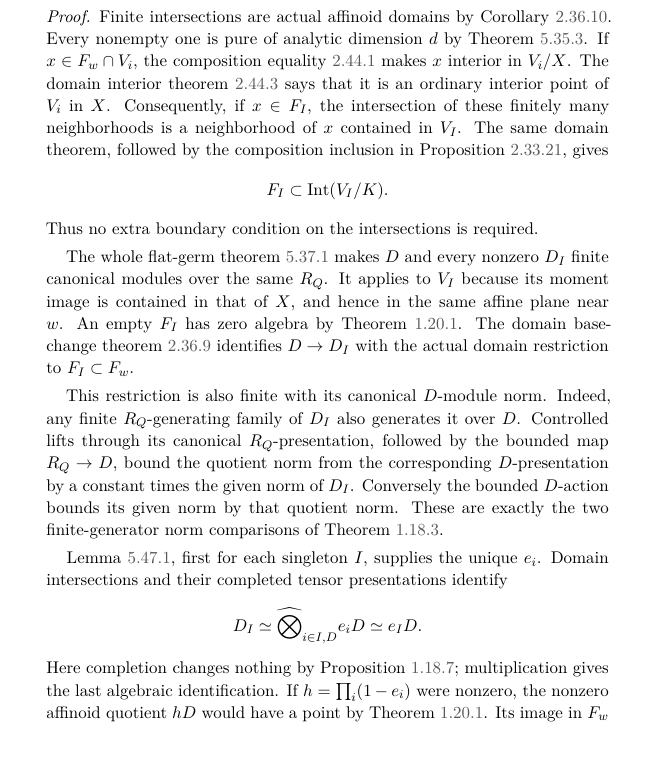
\begin{proof}
Finite intersections are actual affinoid domains by
Corollary~\ref{fnd:generalizeddomainintersections}. Every nonempty
one is pure of analytic dimension $d$ by
Theorem~\ref{v036:analytic:domainpurity}.
If $x\in F_w\cap V_i$, the composition equality
\ref{fnd:affinoidinteriorcompositionequality} makes $x$ interior
in $V_i/X$. The domain interior theorem
\ref{fnd:affinoiddomainordinaryinterior} says that it is an ordinary
interior point of $V_i$ in $X$. Consequently, if $x\in F_I$, the
intersection of these finitely many neighborhoods is a neighborhood
of $x$ contained in $V_I$. The same domain theorem, followed by
the composition inclusion in
Proposition~\ref{fnd:affinoidinteriorcalculus}, gives
\[
                        F_I\subset\operatorname{Int}(V_I/K).
\]
Thus no extra boundary condition on the intersections is required.

The whole flat-germ theorem \ref{v036:flatgermweight} makes $D$
and every nonzero $D_I$ finite canonical modules over the same
$R_Q$. It applies to $V_I$ because its moment image is contained
in that of $X$, and hence in the same affine plane near $w$.
An empty $F_I$ has zero algebra by
Theorem~\ref{fnd:generalizedpointunitcriterion}.
The domain base-change theorem
\ref{fnd:generalizeddomainbasechange} identifies $D\to D_I$
with the actual domain restriction to $F_I\subset F_w$.

This restriction is also finite with its canonical $D$-module
norm. Indeed, any finite $R_Q$-generating family of $D_I$ also
generates it over $D$. Controlled lifts through its canonical
$R_Q$-presentation, followed by the bounded map $R_Q\to D$,
bound the quotient norm from the corresponding $D$-presentation
by a constant times the given norm of $D_I$. Conversely the
bounded $D$-action bounds its given norm by that quotient norm.
These are exactly the two finite-generator norm comparisons of
Theorem~\ref{fnd:generalizedfinitemodules}.

Lemma~\ref{v037:localization:finiteclopen}, first for each singleton
$I$, supplies the unique $e_i$. Domain intersections and their
completed tensor presentations identify
\[
 D_I\simeq\widehat\bigotimes_{i\in I,D}e_iD
            \simeq e_ID.
\]
Here completion changes nothing by
Proposition~\ref{fnd:generalizedfinitetensor}; multiplication gives
the last algebraic identification. If
$h=\prod_i(1-e_i)$ were nonzero, the nonzero affinoid quotient
$hD$ would have a point by
Theorem~\ref{fnd:generalizedpointunitcriterion}. Its image in
$F_w$ would belong to none of the $V_i$, a contradiction.
This proves \eqref{v037:localization:eqfactors} with the actual
algebras, including their nilpotents.

Finite base change, Proposition~\ref{fnd:generalizedfinitebasechange},
gives $E_{Q,I}=e_IE_Q$. Put $L=P\otimes_D E_Q$, a finite-dimensional
$H_Q$-vector space. For each $J\subseteq\{1,\ldots,q\}$ set
\[
 a_J=\prod_{j\in J}e_j\prod_{j\notin J}(1-e_j).
\]
These are pairwise orthogonal idempotents with sum $1$, and
$a_{\varnothing}=0$. Therefore
$L=\bigoplus_{J\ne\varnothing}a_JL$. On the summand $a_JL$,
$e_I$ acts as $1$ precisely when $I\subseteq J$, and otherwise
as $0$. Its coefficient in the right side of
\eqref{v037:localization:eqmoduledegree} is
\[
 \sum_{\varnothing\ne I\subseteq J}(-1)^{|I|+1}=1,
\]
as follows by expanding $\prod_{j\in J}(1-1)=0$.
This proves that formula.

The finite $D$-module $P$ is finite over $R_Q$. Composing finite
free quotient presentations gives equivalent canonical norms for
this restriction of scalars. Proposition
\ref{fnd:generalizedfinitetensor} consequently identifies every
tensor just used with its complete canonical finite-dimensional
tensor. In particular, if $P=M\otimes_A D$, associativity identifies
its factor $P\otimes_D E_{Q,I}$ with
$M_I\otimes_{A_I}E_{Q,I}$. Dividing
\eqref{v037:localization:eqmoduledegree} by $c_Q$ and applying
Theorem~\ref{v037:degree:moduleweight} to $X$ and the nonempty
$V_I$ proves \eqref{v037:localization:eqmoduleweight}, independently
of $Q$. The structure-module case agrees with
Theorem~\ref{v036:flatgermweight}. Pairwise disjoint parts make
every intersection of size at least two empty.

We finally choose the neighborhood uniformly. The ordinary
interiors of the $V_i$ cover $F_w$, as proved above. The complement
of their union in compact $X$ is compact, and its moment image
misses $w$. Also the compact sets $\partial_KX$ and
$\partial_KV_i$ have moment images missing $w$. Shrink $W$ to
avoid all these images. Compactness and openness of interior are
Propositions~\ref{fnd:boundedspectrumcompact} and
\ref{fnd:affinoidinteriorcalculus}. The resulting neighborhood
has whole fibres covered by the same $V_i$, and each selected
fibre is interior in its own domain. The intersection argument
above applies unchanged. Every $V_I$ whose fibre at $w$ is empty
has compact moment image missing $w$; shrinking again keeps it
empty throughout the neighborhood.

Theorem~\ref{v036:flatgermlocalconstancy} makes the image of $X$
equal to the indicated plane nearby. For each fixed $V_I$, apply
the finite generic-component formula in
Theorem~\ref{v037:degree:moduleweight} to $M_I$. A component with
empty fibre at $w$ remains absent nearby by compactness. Every
other component has a whole interior flat fibre, as verified in
that theorem's proof, and its intrinsic weight is locally constant
by Theorem~\ref{v036:flatgermlocalconstancy}. There are only finitely
many components and intersections. One final shrinking gives
their simultaneous local constancy and all the stated assertions.
\end{proof}
Typeset reader excerpt
Typed proof inputs
- CLAUSE:NAG-001626:source_factor_interior_for_actual_affinoid_maps · selected scope (accepted native clause)
- NAG-001496 · selected whole (accepted native whole)
- NAG-001561 · selected whole (accepted native whole)
- NAG-001565 · selected whole (accepted native whole)
- NAG-001572 · selected whole (accepted native whole)
- NAG-001628 · selected whole (accepted native whole)
- NAG-001702 · selected whole (accepted native whole)
- NAG-001704 · selected whole (accepted native whole)
- NAG-001846 · selected whole (accepted native whole)
- NAG-001847 · selected whole (accepted native whole)
- NAG-002293 · selected whole (accepted native whole)
- NAG-002306 · selected whole (accepted native whole)
- NAG-002307 · selected whole (accepted native whole)
- NAG-002362 · selected whole (accepted native whole)
- NAG-002395 · selected whole (accepted native whole)
Reader cross-references
- fnd:affinoiddomainordinaryinterior
- fnd:affinoidinteriorcalculus
- fnd:boundedspectrumcompact
- fnd:generalizeddomainbasechange
- fnd:generalizeddomainintersections
- fnd:generalizedfinitebasechange
- fnd:generalizedfinitemodules
- fnd:generalizedfinitetensor
- v036:analytic:domainpurity
- v036:flatgermweight
- v037:degree:moduleweight
- v037:localization:finiteclopen
Proof map
Verified map inputs · NAG-002396
AND · joint registered proof inputs
- CLAUSE:NAG-001626:source_factor_interior_for_actual_affinoid_maps · source factor interior for actual affinoid maps · selected scope Exact source window 133–149
- Use actual affinoid intersections and preserved purity. The hypothesis gives absolute interior of every Vi fibre point. The source-factor implication for Vi → X → M(K) plus actual domain interior gives the needed open neighbourhoods. Compose forward on the intersections.
- NAG-001496 · Compactness of the bounded spectrum · accepted whole Exact source window 221–244
- Compactness away from the neighbourhood interiors and given boundaries yields one common smaller neighbourhood. Apply local constancy in the same plane to the actual nonempty generic component contributions.
- NAG-001561 · Canonical norms and exactness for finite modules · accepted whole Exact source windows 188–219, 151–186
- Base change the idempotents into the same Gauss algebra. Orthogonal splitting gives inclusion-exclusion for every finite module. The finite norm comparison validates completed tensors and the weight normalization uses the same lattice index.
- Use the common lattice Gauss field from the whole flat-germ theorem and actual domain base change. The finite clopen parts give exact idempotent factors by two norm comparisons, with the original nilpotents retained.
- NAG-001565 · Finite tensors with generalized affinoid targets · accepted whole Exact source windows 151–186, 188–219
- Use the common lattice Gauss field from the whole flat-germ theorem and actual domain base change. The finite clopen parts give exact idempotent factors by two norm comparisons, with the original nilpotents retained.
- Base change the idempotents into the same Gauss algebra. Orthogonal splitting gives inclusion-exclusion for every finite module. The finite norm comparison validates completed tensors and the weight normalization uses the same lattice index.
- NAG-001572 · Nonemptiness and the unit-ideal test · accepted whole Exact source window 151–186
- Use the common lattice Gauss field from the whole flat-germ theorem and actual domain base change. The finite clopen parts give exact idempotent factors by two norm comparisons, with the original nilpotents retained.
- NAG-001628 · Interior of an affinoid domain · accepted whole Exact source window 133–149
- Use actual affinoid intersections and preserved purity. The hypothesis gives absolute interior of every Vi fibre point. The source-factor implication for Vi → X → M(K) plus actual domain interior gives the needed open neighbourhoods. Compose forward on the intersections.
- NAG-001702 · General finite base change · accepted whole Exact source window 188–219
- Base change the idempotents into the same Gauss algebra. Orthogonal splitting gives inclusion-exclusion for every finite module. The finite norm comparison validates completed tensors and the weight normalization uses the same lattice index.
- NAG-001704 · Presentation calculus for relative interior · accepted whole Exact source windows 221–244, 133–149
- Compactness away from the neighbourhood interiors and given boundaries yields one common smaller neighbourhood. Apply local constancy in the same plane to the actual nonempty generic component contributions.
- Use actual affinoid intersections and preserved purity. The hypothesis gives absolute interior of every Vi fibre point. The source-factor implication for Vi → X → M(K) plus actual domain interior gives the needed open neighbourhoods. Compose forward on the intersections.
- NAG-001846 · Affinoid domains under arbitrary affinoid base change · accepted whole Exact source window 151–186
- Use the common lattice Gauss field from the whole flat-germ theorem and actual domain base change. The finite clopen parts give exact idempotent factors by two norm comparisons, with the original nilpotents retained.
- NAG-001847 · Intersections and restrictions of affinoid domains · accepted whole Exact source window 133–149
- Use actual affinoid intersections and preserved purity. The hypothesis gives absolute interior of every Vi fibre point. The source-factor implication for Vi → X → M(K) plus actual domain interior gives the needed open neighbourhoods. Compose forward on the intersections.
- NAG-002293 · Purity of affinoid domains · accepted whole Exact source window 133–149
- Use actual affinoid intersections and preserved purity. The hypothesis gives absolute interior of every Vi fibre point. The source-factor implication for Vi → X → M(K) plus actual domain interior gives the needed open neighbourhoods. Compose forward on the intersections.
- NAG-002306 · Positive intrinsic weights at arbitrary real flat germs · accepted whole Exact source windows 188–219, 151–186
- Base change the idempotents into the same Gauss algebra. Orthogonal splitting gives inclusion-exclusion for every finite module. The finite norm comparison validates completed tensors and the weight normalization uses the same lattice index.
- Use the common lattice Gauss field from the whole flat-germ theorem and actual domain base change. The finite clopen parts give exact idempotent factors by two norm comparisons, with the original nilpotents retained.
- NAG-002307 · Local constancy on an interior flat germ · accepted whole Exact source window 221–244
- Compactness away from the neighbourhood interiors and given boundaries yields one common smaller neighbourhood. Apply local constancy in the same plane to the actual nonempty generic component contributions.
- NAG-002362 · Weights of finite modules on an interior flat germ · accepted whole Exact source windows 188–219, 221–244
- Base change the idempotents into the same Gauss algebra. Orthogonal splitting gives inclusion-exclusion for every finite module. The finite norm comparison validates completed tensors and the weight normalization uses the same lattice index.
- Compactness away from the neighbourhood interiors and given boundaries yields one common smaller neighbourhood. Apply local constancy in the same plane to the actual nonempty generic component contributions.
- NAG-002395 · Finite affinoid domains and idempotents · accepted whole Exact source window 151–186
- Use the common lattice Gauss field from the whole flat-germ theorem and actual domain base change. The finite clopen parts give exact idempotent factors by two norm comparisons, with the original nilpotents retained.
NAG-002396 · Inclusion--exclusion on interior fibre covers · Chapter argument