NAG-002427 · Accepted whole
Compact smooth cutoffs
5 Tropicalization, multiplicities and balancing
Open in the English reader · PDF page 1049
Statement · exact TeX
\begin{lemma}[Compact smooth cutoffs]
\label{v037:forms:smoothcutoff}
Let $X$ be a good Hausdorff analytic space over the specified
complete field. The sheaf $\mathcal A_X^{0,0}$ identifies
with a subsheaf of continuous real-valued functions.
For every point $x$ and ordinary open neighbourhood
$O\subseteq X$, there is a section
$\chi\in\mathcal A_X^{0,0}(X)$ such that
\[
 \begin{gathered}
 0\leq\chi\leq1,\qquad
 \chi=1\ \hbox{on an ordinary neighbourhood of }x,\\
 \operatorname{supp}(\chi)\ \hbox{is compact in }O.
 \end{gathered}
\]
The assertion allows a trivially valued ground field.
\end{lemma}
Full selected proof · exact TeX
\begin{proof}
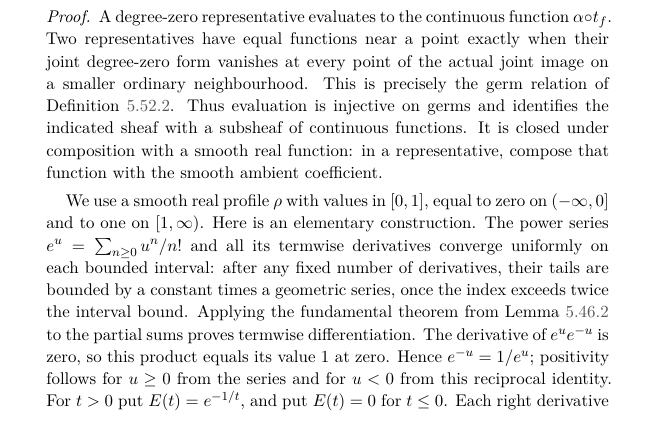
A degree-zero representative evaluates to the continuous
function $\alpha\circ t_f$. Two representatives have
equal functions near a point exactly when their joint
degree-zero form vanishes at every point of the actual
joint image on a smaller ordinary neighbourhood.
This is precisely the germ relation of
Definition~\ref{v037:forms:ordinarysmoothgerm}.
Thus evaluation is injective on germs and identifies
the indicated sheaf with a subsheaf of continuous
functions. It is closed under composition with a
smooth real function: in a representative, compose
that function with the smooth ambient coefficient.

We use a smooth real profile $\rho$ with values in
$[0,1]$, equal to zero on $(-\infty,0]$ and to one
on $[1,\infty)$. Here is an elementary construction.
The power series $e^u=\sum_{n\geq0}u^n/n!$ and all
its termwise derivatives converge uniformly on each
bounded interval: after any fixed number of
derivatives, their tails are bounded by a constant
times a geometric series, once the index exceeds
twice the interval bound. Applying the fundamental
theorem from Lemma~\ref{v037:integration:polyhedralcalculus}
to the partial sums proves termwise differentiation.
The derivative of $e^u e^{-u}$ is zero, so this product
equals its value $1$ at zero. Hence $e^{-u}=1/e^u$;
positivity follows for $u\geq0$ from the series and
for $u<0$ from this reciprocal identity.
For $t>0$ put $E(t)=e^{-1/t}$, and put $E(t)=0$
for $t\leq0$. Each right derivative is a polynomial
in $1/t$ times $e^{-1/t}$. Every such expression tends
to zero at zero, since
$e^u\geq u^{m+1}/(m+1)!$ for $u>0$.
Induction with difference quotients therefore proves
that $E$ is smooth with every derivative zero at zero.
The function
\[
                 \rho(t)=\frac{E(t)}{E(t)+E(1-t)}
\]
has the required properties; its denominator is positive.

Choose an ordinary affinoid neighbourhood
$W=\mathcal M(A)$ of $x$. In its evaluation topology,
choose finitely many strict upper and positive lower
bounds on absolute values of functions $a_j\in A$
whose intersection contains $x$ and is contained in
$O\cap\operatorname{Int}_{\rm top}(W,X)$.
The neighbourhood basis used in
Theorem~\ref{v037:forms:germsheaf} permits this choice.
For each upper condition $|a_j|<b_j$, choose
\[
                    |a_j(x)|<b_{j,0}<b_{j,1}<b_j.
\]
Use the factor
\[
 1-\rho\left(
       \frac{\log|a_j|-\log b_{j,0}}
            {\log b_{j,1}-\log b_{j,0}}\right),
\]
with value one where $a_j=0$.
For each lower condition $|a_j|>c_j>0$, choose
\[
                    c_j<c_{j,0}<c_{j,1}<|a_j(x)|
\]
and use the factor
\[
 \rho\left(
       \frac{\log|a_j|-\log c_{j,0}}
            {\log c_{j,1}-\log c_{j,0}}\right),
\]
with value zero where $a_j=0$.

Each factor is a smooth moment section on $W$.
At a zero of $a_j$ it is constant on an ordinary
neighbourhood, hence has a constant representative.
At a point where $a_j$ is nonzero, choose a smaller
ordinary affinoid neighbourhood where $|a_j|$ is
bounded below by a positive real constant.
The unit criterion
\ref{fnd:generalizedpointunitcriterion} makes its
restriction an analytic unit. The displayed expression
is then a smooth function of the moment coordinate
$-\log|a_j|$. These representatives agree as continuous
functions, and hence as germs by the first paragraph.
The sheaf theorem \ref{v037:forms:germsheaf} glues them.

Multiply the finitely many factors. The resulting
$\chi_W$ lies between zero and one and equals one
on an ordinary neighbourhood of $x$.
Its support is contained in the subset $C\subseteq W$
defined by the weak upper bounds $|a_j|\leq b_{j,1}$
and weak lower bounds $|a_j|\geq c_{j,0}$.
This subset is compact by
Proposition~\ref{fnd:boundedspectrumcompact}, is closed
in the Hausdorff space $X$, and is contained in
$O\cap\operatorname{Int}_{\rm top}(W,X)$ by the
strictly nested choices of bounds.
On the open cover
\[
             X=\operatorname{Int}_{\rm top}(W,X)
                                     \cup(X\setminus C)
\]
glue $\chi_W$ on the first member and zero on the
second. They agree on the overlap. The resulting
section has all the stated properties. All thresholds
were positive real numbers; the construction never
required them to be absolute values of ground-field
constants.
\end{proof}
Typeset reader excerpt
Typed proof inputs
- NAG-001496 · selected whole (selected native whole at 700)
- NAG-001572 · selected whole (selected native whole at 700)
- NAG-002389 · selected whole (selected native whole at 700)
- NAG-002424 · selected whole (earlier original in this reviewer packet)
Reader cross-references
Proof map
Verified map inputs · NAG-002427
AND · joint registered proof inputs
- NAG-001496 · Compactness of the bounded spectrum · accepted whole Exact source window 111–130
- NAG-001572 · Nonemptiness and the unit-ideal test · accepted whole Exact source window 64–109
- NAG-002389 · The real polyhedral integration calculation · accepted whole Exact source window 23–61
- NAG-002424 · The sheaf of ordinary smooth moment forms · accepted whole Exact source windows 23–61, 64–109, 111–130