NAG-002457 · Accepted whole
A finite neighbourhood of the entire analytic fibre
5 Tropicalization, multiplicities and balancing
Open in the English reader · PDF page 1063
Statement · exact TeX
\begin{lemma}[A finite neighbourhood of the entire analytic fibre]
\label{v038:degree:wholefinitefibre}
Let $p:Z\to Y$ be a compact morphism of good Hausdorff analytic
spaces. Suppose that $y\in Y$, that the underlying set of the
analytic fibre $Z_y$ is finite, and that every point above $y$
belongs to $\operatorname{Int}(Z/Y)$. There is an ordinary open
neighbourhood $N$ of $y$ such that the full restriction
\[
                         p^{-1}(N)\longrightarrow N
\]
is finite. One may require $N$ to lie in any prescribed ordinary
neighbourhood of $y$. Empty fibres are allowed.

Consequently, if $p$ is proper, the locus of target points with
finite analytic fibres is ordinary open, and the full restriction
of $p$ to that locus is finite.
\end{lemma}
Full selected proof · exact TeX
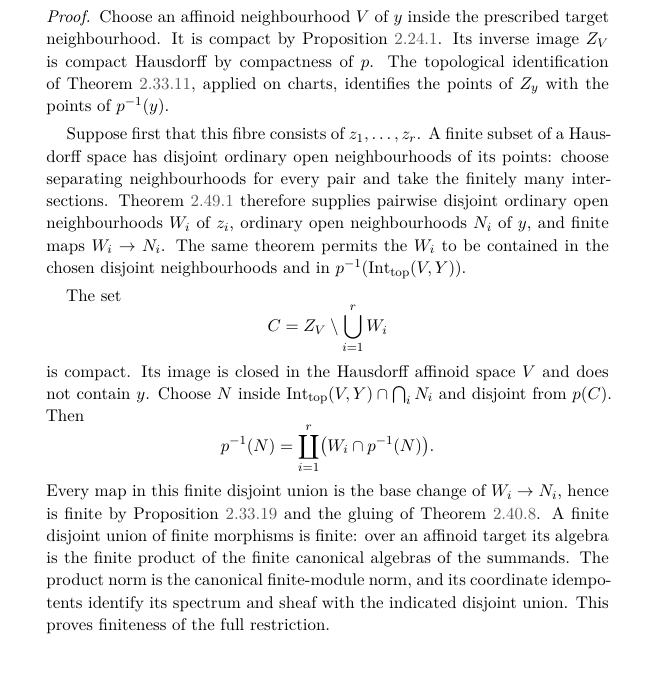
\begin{proof}
Choose an affinoid neighbourhood $V$ of $y$ inside the prescribed
target neighbourhood. It is compact by
Proposition~\ref{fnd:boundedspectrumcompact}. Its inverse image $Z_V$ is compact Hausdorff
by compactness of $p$. The topological identification of
Theorem~\ref{fnd:allpointaffinoidfibres}, applied on charts,
identifies the points of $Z_y$ with the points of $p^{-1}(y)$.

Suppose first that this fibre consists of $z_1,\ldots,z_r$.
A finite subset of a Hausdorff space has disjoint ordinary open
neighbourhoods of its points: choose separating neighbourhoods
for every pair and take the finitely many intersections.
Theorem~\ref{fnd:isolatedinteriorlocalfinite} therefore supplies
pairwise disjoint ordinary open neighbourhoods $W_i$ of $z_i$,
ordinary open neighbourhoods $N_i$ of $y$, and finite maps
$W_i\to N_i$. The same theorem permits the $W_i$ to be contained
in the chosen disjoint neighbourhoods and in
$p^{-1}(\operatorname{Int}_{\rm top}(V,Y))$.

The set
\[
                   C=Z_V\setminus\bigcup_{i=1}^r W_i
\]
is compact. Its image is closed in the Hausdorff affinoid space
$V$ and does not contain $y$. Choose $N$ inside
$\operatorname{Int}_{\rm top}(V,Y)\cap\bigcap_iN_i$
and disjoint from $p(C)$. Then
\[
             p^{-1}(N)=\coprod_{i=1}^r
                                \bigl(W_i\cap p^{-1}(N)\bigr).
\]
Every map in this finite disjoint union is the base change of
$W_i\to N_i$, hence is finite by
Proposition~\ref{fnd:generalizedfinitebasechange} and the gluing
of Theorem~\ref{fnd:generalnetmorphismgluing}.
A finite disjoint union of finite morphisms is finite:
over an affinoid target its algebra is the finite product of the
finite canonical algebras of the summands. The product norm is
the canonical finite-module norm, and its coordinate idempotents
identify its spectrum and sheaf with the indicated disjoint union.
This proves finiteness of the full restriction.

If the fibre is empty, use $C=Z_V$. The same compact-image
argument gives $p^{-1}(N)=\varnothing$, which is the finite
space represented by the zero algebra.

For a proper morphism the interior condition holds everywhere.
The neighbourhood just constructed consists of finite-fibre
points, since finite analytic fibres are finite discrete spaces
by Lemma~\ref{fnd:finiteanalyticbranchseparation}. Thus the
finite-fibre locus is open. On this open locus the restrictions
are finite on an ordinary open cover of the target; the
target-local definition of a finite analytic morphism glues
them to the full finite restriction.
\end{proof}
Typeset reader excerpt
Typed proof inputs
- NAG-001496 · selected whole (accepted native whole)
- NAG-001561 · selected whole (accepted native whole)
- NAG-001612 · selected whole (accepted native whole)
- NAG-001617 · selected whole (accepted native whole)
- NAG-001692 · selected whole (accepted native whole)
- NAG-001701 · selected whole (accepted native whole)
- NAG-001702 · selected whole (accepted native whole)
- NAG-001735 · selected whole (accepted native whole)
- NAG-001876 · selected whole (selected forward clause projection from admitted whole)
Reader cross-references
Proof map
Verified map inputs · NAG-002457
AND · joint registered proof inputs
- NAG-001496 · Compactness of the bounded spectrum · accepted whole Exact source windows 36–51, 53–80
- Use compact inverse image of the actual affinoid neighbourhood and its topological fibre at the given analytic point. Separate the finite points and use the staged isolated inner ⇒ finite ordinary direction with prescribed neighbourhoods.
- Remove the image of the compact complement. The entire preimage is a finite disjoint union of actual finite base changes, with its canonical bounded module norm. The empty case uses the zero algebra.
- NAG-001561 · Canonical norms and exactness for finite modules · accepted whole Exact source window 53–80
- Remove the image of the compact complement. The entire preimage is a finite disjoint union of actual finite base changes, with its canonical bounded module norm. The empty case uses the zero algebra.
- NAG-001612 · Local extension and gluing of morphisms · accepted whole Exact source window 53–80
- Remove the image of the compact complement. The entire preimage is a finite disjoint union of actual finite base changes, with its canonical bounded module norm. The empty case uses the zero algebra.
- NAG-001617 · Points and fibres on general analytic spaces · accepted whole Exact source window 36–51
- Use compact inverse image of the actual affinoid neighbourhood and its topological fibre at the given analytic point. Separate the finite points and use the staged isolated inner ⇒ finite ordinary direction with prescribed neighbourhoods.
- NAG-001692 · Affinoid fibres at all Berkovich points · accepted whole Exact source window 36–51
- Use compact inverse image of the actual affinoid neighbourhood and its topological fibre at the given analytic point. Separate the finite points and use the staged isolated inner ⇒ finite ordinary direction with prescribed neighbourhoods.
- NAG-001701 · Finite algebras with their canonical norm · accepted whole Exact source window 53–80
- Remove the image of the compact complement. The entire preimage is a finite disjoint union of actual finite base changes, with its canonical bounded module norm. The empty case uses the zero algebra.
- NAG-001702 · General finite base change · accepted whole Exact source windows 82–88, 53–80
- Properness supplies innerness, then every point of the selected open has finite analytic fibre. Ordinary target locality makes the entire restriction finite.
- Remove the image of the compact complement. The entire preimage is a finite disjoint union of actual finite base changes, with its canonical bounded module norm. The empty case uses the zero algebra.
- NAG-001735 · Separating the branches of a finite morphism · accepted whole Exact source window 82–88
- Properness supplies innerness, then every point of the selected open has finite analytic fibre. Ordinary target locality makes the entire restriction finite.
- NAG-001876 · The local finite criterion · accepted whole Exact source window 36–51
- Use compact inverse image of the actual affinoid neighbourhood and its topological fibre at the given analytic point. Separate the finite points and use the staged isolated inner ⇒ finite ordinary direction with prescribed neighbourhoods.
NAG-002457 · A finite neighbourhood of the entire analytic fibre · Chapter argument