NAG-002478 · Accepted whole
Local equality of moment norms
F Descent of an algebraized polarized tower
Open in the English reader · PDF page 1990
Statement · exact TeX
\begin{lemma}[Local equality of moment norms]
\label{f8cont:retraction}
Let $U$ and $Y$ be good Hausdorff $K$-analytic spaces, let
$i:Y\hookrightarrow U$ be a closed immersion, and let $r:U\to Y$ be an
analytic morphism with $r\circ i=\operatorname{id}_Y$.
Assume that every affinoid domain of $Y$ under consideration has analytic
dimension at most $d$.
Let $z=i(y)$, let $V\subset U$ be an ordinary affinoid neighbourhood of
$z$, and let $f=(f_1,\ldots,f_N)$ be analytic units on $V$.
There is an ordinary affinoid neighbourhood $W\subset V$ of $z$ such that
\[
                         \dim t_f(W)\leq d.
\]
The choice of $W$ depends on the tuple, but not on any ambient superform
subsequently pulled back by that tuple. Thus all such forms of bidegree
$(p,q)$ with $\max(p,q)>d$ induce zero ordinary sections on $\Int(W,U)$.
\end{lemma}
Full selected proof · exact TeX
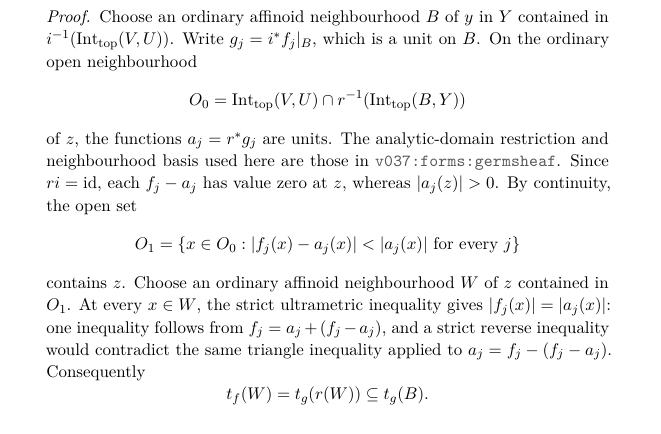
\begin{proof}
Choose an ordinary affinoid neighbourhood $B$ of $y$ in $Y$ contained in
$i^{-1}(\Int(V,U))$. Write $g_j=i^*f_j|_B$, which is a unit on $B$.
On the ordinary open neighbourhood
\[
 O_0=\Int(V,U)\cap r^{-1}(\Int(B,Y))
\]
of $z$, the functions $a_j=r^*g_j$ are units. The analytic-domain
restriction and neighbourhood basis used here are those in
\base{v037:forms:germsheaf}. Since $r i=\operatorname{id}$, each
$f_j-a_j$ has value zero at $z$, whereas $|a_j(z)|>0$.
By continuity, the open set
\[
 O_1=\{x\in O_0: |f_j(x)-a_j(x)|<|a_j(x)|
                         \text{ for every }j\}
\]
contains $z$. Choose an ordinary affinoid neighbourhood $W$ of $z$
contained in $O_1$. At every $x\in W$, the strict ultrametric inequality
gives $|f_j(x)|=|a_j(x)|$: one inequality follows from
$f_j=a_j+(f_j-a_j)$, and a strict reverse inequality would contradict the
same triangle inequality applied to $a_j=f_j-(f_j-a_j)$.
Consequently
\[
             t_f(W)=t_g(r(W))\subseteq t_g(B).
\]
By \base{v037:globaltrop:finiteimage}, the right-hand side is a finite
polyhedral set of dimension at most $d$, and the left-hand side is also
finite polyhedral. Hence its dimension is at most $d$. On every face
its tangent space has dimension at most $d$, so one of the exterior
factors of a form with $\max(p,q)>d$ restricts to zero. The ordinary
moment definition then gives the asserted zero sections.
\end{proof}
Typeset reader excerpt
Typed proof inputs
- NAG-001630 · selected whole (selected native whole)
- NAG-002358 · selected whole (selected native whole)
- NAG-002424 · selected whole (selected native whole)
Proof map
Verified map inputs · NAG-002478
AND · joint registered proof inputs
- NAG-001630 · Affinoid compatibility and arbitrary analytic domains · accepted whole Exact source window 302–310
- NAG-002358 · Global polyhedrality and the tropicalized boundary · accepted whole Exact source window 326–328
- NAG-002424 · The sheaf of ordinary smooth moment forms · accepted whole Exact source windows 302–310, 317–318, 329–331
NAG-002478 · Local equality of moment norms · Chapter argument