NAG-002495 · Accepted whole
Affinoid boundary-germ annihilation
Chapter 8 supplement: Interior Stokes with coherent coefficients
Open in the English reader · PDF page 1787
Statement · exact TeX
\begin{theorem}[Affinoid boundary-germ annihilation]
\label{f7v38:annihilation}
For every pure \(d\)-dimensional generalized affinoid \(V=\mathcal M(A)\),
\(d\geq1\), every finite \(A\)-module \(M\), every global unit tuple \(f\),
and every smooth ambient \((d-1,d)\)-representative \(\alpha\) near
\(t_f(V)\), implication \eqref{eq:target} holds.
Nonreduced and reducible \(A\), connected actual moment fibers, trivial
valuation, and arbitrary positive radii are allowed.
\end{theorem}
Full selected proof · exact TeX
\begin{proof}
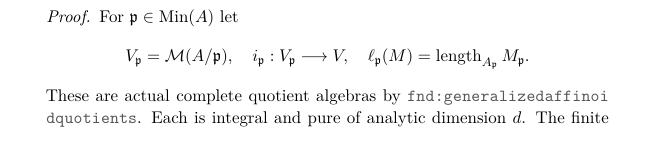
For \(\mathfrak p\in\Min(A)\) let
\[
 V_{\mathfrak p}=\mathcal M(A/\mathfrak p),\quad
 i_{\mathfrak p}:V_{\mathfrak p}\longrightarrow V,\quad
 \ell_{\mathfrak p}(M)=\len_{A_{\mathfrak p}}M_{\mathfrak p}.
\]
These are actual complete quotient algebras by
\src{fnd:generalizedaffinoidquotients}.
Each is integral and pure of analytic dimension \(d\).
The finite map \(i_{\mathfrak p}\) is everywhere relatively interior.
The exact formula \src{fnd:affinoidinteriorcompositionequality} yields
\begin{equation}\label{eq:boundarycomponents}
 \Int(V_{\mathfrak p}/K)=i_{\mathfrak p}^{-1}\Int(V/K),
 \qquad
 \partial_KV_{\mathfrak p}=i_{\mathfrak p}^{-1}(\partial_KV).
\end{equation}
Thus \(i_{\mathfrak p}^*\beta\) vanishes near
\(\partial_KV_{\mathfrak p}\).

For completeness the componentwise chain identity is
\begin{equation}\label{eq:componentchain}
 \T_f(M)=\sum_{\mathfrak p\in\Min(A)}
       \ell_{\mathfrak p}(M)\,
       \T_{f|V_{\mathfrak p}}(A/\mathfrak p).
\end{equation}
To see this, choose a finite common subdivision of the actual
images of \(V\), all \(V_{\mathfrak p}\), and their boundary images,
using \src{v037:globaltrop:finiteimage}. At a generic point of a
\(d\)-cell the whole relevant fibers are interior and their images
lie in the same affine \(d\)-plane.
The coefficient equality is exactly
\src{v037:degree:moduleweight}.
Together with the
\hyperref[fnd:nag002405:global-finite-module-chain-weights]{finite-module chain and weights},
this gives \eqref{eq:componentchain} on all top cells.
Cells of smaller dimension carry no \(d\)-chain term.

For each \(\mathfrak p\), apply Proposition~\ref{f7v38:integral}
to \(A/\mathfrak p\) with its structure module and the tuple
\(i_{\mathfrak p}^*f\). Use the same \(\alpha\) near the compact
image of this tuple. Its ordinary pullback is \(i_{\mathfrak p}^*\beta\),
which vanishes near \(\partial_K V_{\mathfrak p}\) by
\eqref{eq:boundarycomponents}. Each component integral therefore
vanishes. The
\hyperref[fnd:nag002405:finite-cell-functional]{finite-cell functional}
applied to \(d'\alpha\) in \eqref{eq:componentchain} gives
\[
 \I_{M,f}(d'\alpha)
  =\sum_{\mathfrak p}\ell_{\mathfrak p}(M)\,
       \I_{A/\mathfrak p,f|V_{\mathfrak p}}(d'\alpha)=0.
\]
All generic lengths, including nilpotent contributions, are retained.
These closed components are used for a finite linear identity,
not as an affinoid-domain cover.
\end{proof}
Typeset reader excerpt
Typed proof inputs
- CLAUSE:NAG-002405:finite_cell_functional · selected scope (explicit current dependencies)
- CLAUSE:NAG-002405:global_finite_module_chain_weights · selected scope (explicit current dependencies)
- NAG-001560 · selected whole (explicit current dependencies)
- NAG-001562 · selected whole (explicit current dependencies)
- NAG-001626 · selected whole (explicit current dependencies)
- NAG-001701 · selected whole (explicit current dependencies)
- NAG-002180 · selected whole (explicit current dependencies)
- NAG-002358 · selected whole (explicit current dependencies)
- NAG-002362 · selected whole (explicit current dependencies)
- NAG-002424 · selected whole (explicit current dependencies)
- NAG-002492 · selected whole (explicit current dependencies)
Reader cross-references
Proof map
Verified map inputs · NAG-002495
AND · joint registered proof inputs
- CLAUSE:NAG-002405:finite_cell_functional · finite cell functional · selected scope
- CLAUSE:NAG-002405:global_finite_module_chain_weights · global finite module chain weights · selected scope
- NAG-001560 · Closed submodules and controlled matrix images · accepted whole
- NAG-001562 · Actual quotients by arbitrary ideals · accepted whole
- NAG-001626 · The affinoid composition formula for interior · accepted whole
- NAG-001701 · Finite algebras with their canonical norm · accepted whole
- NAG-002180 · Refinement and products of balanced complexes · accepted whole
- NAG-002358 · Global polyhedrality and the tropicalized boundary · accepted whole
- NAG-002362 · Weights of finite modules on an interior flat germ · accepted whole
- NAG-002424 · The sheaf of ordinary smooth moment forms · accepted whole
- NAG-002492 · The integral affinoid case · accepted whole
NAG-002495 · Affinoid boundary-germ annihilation · Chapter argument