NAG-002514 · Accepted whole
Native global chains under complete extension
C Native scalar extension and finite restriction of constants
Open in the English reader · PDF page 1762
Statement and full selected proof · exact TeX
\begin{proposition}[Native global chains under complete extension]
\label{f9cand:chain}
Let $X=\M_K(A)$ be pure of analytic dimension $d$, $M$ a finite
$A$-module, and $f$ any finite tuple of analytic units. Then, in the
same real moment space and saturated integral lattices,
\begin{equation}\label{eq:chain}
                    \T^{\,L}_{p^*f}(M_L)=\T^{\,K}_f(M).
\end{equation}
Consequently their integrals against any smooth ambient $(d,d)$-form
defined near the compact actual moment image agree.
\end{proposition}
\begin{proof}
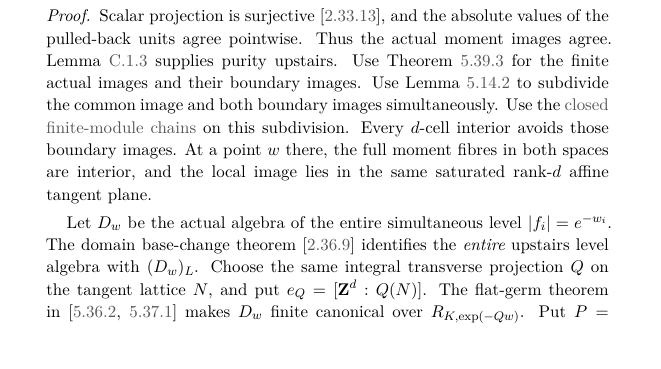
Scalar projection is surjective [\ref{fnd:scalarextensionspectralsurjective}], and the
absolute values of the pulled-back units agree pointwise. Thus the
actual moment images agree. Lemma~\ref{f9cand:purity} supplies purity
upstairs. Use Theorem~\ref{v037:globaltrop:finiteimage} for the finite actual
images and their boundary images. Use
Lemma~\ref{cand:polyhedralrefinementproduct} to subdivide the common
image and both boundary images simultaneously.
Use the
\hyperref[fnd:nag002405:global-finite-module-chain-weights]{closed finite-module chains}
on this subdivision.
Every $d$-cell interior
avoids those boundary images. At a point $w$ there, the full moment
fibres in both spaces are interior, and the local image lies in the
same saturated rank-$d$ affine tangent plane.

Let $D_w$ be the actual algebra of the entire simultaneous level
$|f_i|=e^{-w_i}$. The domain base-change theorem [\ref{fnd:generalizeddomainbasechange}]
identifies the \emph{entire} upstairs level algebra with
$(D_w)_L$. Choose the same integral transverse projection $Q$ on
the tangent lattice $N$, and put $e_Q=[\bb Z^d:Q(N)]$.
The flat-germ theorem in [\ref{v036:gaussbasechange}, \ref{v036:flatgermweight}] makes $D_w$ finite canonical over
$R_{K,\exp(-Qw)}$. Put $P=M\otimes_A D_w$.
All the completed module restrictions are the actual finite tensors
by [\ref{fnd:generalizedfinitetensor}]. Lemma~\ref{f9cand:gauss-module} therefore gives
\[
 \frac{\dim_{H_{L,\exp(-Qw)}}
          (P_L\otimes_{R_{L,\exp(-Qw)}}H_{L,\exp(-Qw)})}{e_Q}
 =
 \frac{\dim_{H_{K,\exp(-Qw)}}
          (P\otimes_{R_{K,\exp(-Qw)}}H_{K,\exp(-Qw)})}{e_Q}.
\]
By the exact module-weight theorem [\ref{v037:degree:genericgauss}, \ref{v037:degree:moduleweight}], these are the
two generic coefficients. That theorem also expresses them through
generic Artinian lengths as in Lemma~\ref{f9cand:generic-length}.
Equality on every top cell proves \eqref{eq:chain}.
Lower-dimensional cells carry no $d$-chain term on either side.
The same real form, cell, orientation and lattice measure are used
in the \hyperref[fnd:nag002405:finite-cell-functional]{finite-cell integral},
so the finite integral sums agree. Boundary-image codimension is used
only to read generic coefficients; no differential boundary term is
being discarded.
\end{proof}
Typeset reader excerpt
Typed proof inputs
- CLAUSE:NAG-002405:finite_cell_functional · selected scope
- CLAUSE:NAG-002405:finite_cell_functional · selected scope (planned proof)
- CLAUSE:NAG-002405:global_finite_module_chain_weights · selected scope (site rebind)
- NAG-001565 · selected whole (proof)
- NAG-001565 · selected whole
- NAG-001694 · selected whole (proof)
- NAG-001694 · selected whole
- NAG-001846 · selected whole (proof)
- NAG-001846 · selected whole
- NAG-002180 · selected whole (proof)
- NAG-002180 · selected whole
- NAG-002301 · selected whole (proof)
- NAG-002301 · selected whole
- NAG-002306 · selected whole (proof)
- NAG-002306 · selected whole
- NAG-002358 · selected whole (proof)
- NAG-002358 · selected whole
- NAG-002360 · selected whole, export unavailable (proof)
- NAG-002360 · selected whole, export unavailable
- NAG-002362 · selected whole (proof)
- NAG-002362 · selected whole
- NAG-002506 · selected whole (proof)
- NAG-002506 · selected whole
- NAG-002508 · selected whole (proof)
- NAG-002508 · selected whole
- NAG-002511 · selected whole (proof)
- NAG-002511 · selected whole
- NAG-002514 · selected whole
Reader cross-references
Proof map
Verified map inputs · NAG-002514
AND · joint registered proof inputs
- CLAUSE:NAG-002405:finite_cell_functional · finite cell functional · selected scope
- Integrate the same real form, cell, orientation and lattice measure.
- CLAUSE:NAG-002405:global_finite_module_chain_weights · global finite module chain weights · selected scope
- Replace historical broad chain reference by selected exact closed chain and weights.
- NAG-001565 · Finite tensors with generalized affinoid targets · accepted whole
- Actual finite completions and tensor restrictions.
- NAG-001694 · Surjectivity after an arbitrary complete extension · accepted whole
- Surjective actual scalar projection preserving unit values.
- NAG-001846 · Affinoid domains under arbitrary affinoid base change · accepted whole
- Entire simultaneous level after complete extension.
- NAG-002180 · Refinement and products of balanced complexes · accepted whole
- Common subdivision of actual image and both boundaries.
- NAG-002301 · Scalar extension of a finite Gauss fibre · accepted whole
- Transverse finite Gauss base change.
- NAG-002306 · Positive intrinsic weights at arbitrary real flat germs · accepted whole
- Actual flat germ weighted scope under same saturated rank-d tangent divisor.
- NAG-002358 · Global polyhedrality and the tropicalized boundary · accepted whole
- Finite actual images and lower-dimensional boundary images on both spaces.
- NAG-002360 · Result 5.40.1 · accepted whole; PDF destination
- Generic Gauss computation.
- NAG-002362 · Weights of finite modules on an interior flat germ · accepted whole
- Generic finite-module weights.
- NAG-002506 · The generic coefficient under scalar extension · accepted whole
- Full generic Artinian length expression.
- NAG-002508 · Purity after an arbitrary complete extension · accepted whole
- Pure same dimension under the actual complete isometric extension.
- NAG-002511 · Module base change at a complete Gauss field · accepted whole
- Extension of the actual complete transverse Gauss module preserves dimension.
NAG-002514 · Native global chains under complete extension · Chapter argument