NAG-002518 · Accepted whole
The analytic space with finite constants restricted
C Native scalar extension and finite restriction of constants
Open in the English reader · PDF page 1764
Statement · exact TeX
\begin{lemma}[The analytic space with finite constants restricted]
\label{f9cand:constants}
Suppose $n=[L:K]<\infty$. Every generalized $L$-affinoid algebra $B$
is a generalized $K$-affinoid algebra with the same Banach topology.
The two analytic spectra, domains, structure sheaves and completed
residue fields agree. On a good Hausdorff $L$-analytic space $Y$ this
gives $Y_{[K]}$, with the same ordinary moment sheaf and supports.
Purity of analytic dimension $d$ is unchanged.
\end{lemma}
Full selected proof · exact TeX
\begin{proof}
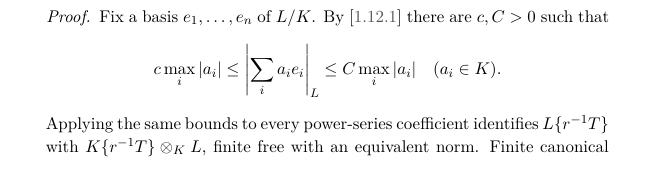
Fix a basis $e_1,\ldots,e_n$ of $L/K$. By [\ref{fnd:finiteextensionnorms}] there are
$c,C>0$ such that
\[
 c\max_i|a_i|\leq\left|\sum_i a_ie_i\right|_L
             \leq C\max_i|a_i| \quad(a_i\in K).
\]
Applying the same bounds to every power-series coefficient identifies
$L\{r^{-1}T\}$ with $K\{r^{-1}T\}\otimes_KL$, finite free with an
equivalent norm. Finite canonical algebras and their quotients are
actual generalized affinoids [\ref{fnd:generalizedfinitealgebras}, \ref{fnd:generalizedfinitebasechange}, \ref{fnd:generalizedfinitemodules}]. This gives
the asserted $K$-affinoid realization of $B$.
Every bounded $K$-seminorm on $B$ restricts to the unique extended
absolute value on $L$ [\ref{fnd:finiteextensionnorms}]. The spectra therefore consist
of the same seminorms with the same evaluation topology. Evaluated
fraction fields and their completions are unchanged.

Here is the domain comparison, including its norm condition.
A $K$-affinoid algebra $C$ with a bounded structural map $B\to C$
has an induced bounded $L$-action. A norm-admissible presentation
$K\{s^{-1}U\}\twoheadrightarrow C$ extends coefficientwise to
$L\{s^{-1}U\}\twoheadrightarrow C$. Bounded multiplication gives a
bounded map; the original $K$-lifts give a uniform quotient-norm
bound, so it is norm-admissible. Thus $C$ is also $L$-affinoid.
An $L$-affinoid test object is already $K$-affinoid by the first
paragraph. A $K$-test map into $B$ conversely gives its source this
$L$-structure. Hence the two domain universal properties are equivalent:
each tests exactly the same bounded factorizations over $B$.
Domain algebras and restriction maps agree by uniqueness.
Gluing affinoid charts gives the stated global space and structure sheaf.

The ordinary neighbourhoods, analytic units, absolute values and
joint moment images used in the definition [\ref{v037:forms:germsheaf}, \ref{v037:forms:compactintegral}] now coincide
literally; thus so do the germs and their relations.
At each point $y$, the valued-field tower
$K\subset L\subset\HH(y)$ has
$d(\HH(y)/K)=d(\HH(y)/L)$, since $L/K$ is algebraic
[\ref{fnd:valuedfielddimensioncalculus}]. The maximum formula [\ref{fnd:affinoidabhyankarmaximum}] gives
equality of analytic dimensions, also on every minimal-prime quotient.
This proves the purity assertion.
\end{proof}
Typeset reader excerpt
Typed proof inputs
- NAG-001398 · selected whole (selected native whole scoped use)
- NAG-001450 · selected whole (selected native whole scoped use)
- NAG-001561 · selected whole (selected native whole scoped use)
- NAG-001562 · selected whole (selected native whole scoped use)
- NAG-001586 · selected whole, export unavailable (selected native whole scoped use)
- NAG-001591 · selected whole (selected native whole scoped use)
- NAG-001607 · selected whole (selected native whole scoped use)
- NAG-001609 · selected whole (selected native whole scoped use)
- NAG-001612 · selected whole (selected native whole scoped use)
- NAG-001701 · selected whole (selected native whole scoped use)
- NAG-001702 · selected whole (selected native whole scoped use)
- NAG-002424 · selected whole (selected native whole scoped use)
Reader cross-references
Proof map
Verified map inputs · NAG-002518
AND · joint registered proof inputs
- NAG-001398 · Bounded substitution criterion · accepted whole
- With the induced bounded L-action, use actual weighted bounded substitution at the same radii. The equivalent L-homogeneous norm and the original effective quotient bound are verified in HYPOTHESES_EN.md.
- NAG-001450 · Finite-dimensional norms and finite field extensions · accepted whole
- Compare the actual finite valued absolute value and coordinate norm for a K-basis of L. Apply the fixed constants termwise to the same positive weighted Tate radii to get a finite free topological coefficient comparison.
- Restrict a bounded K-seminorm to the finite field L embedded in B, giving the unique extended absolute value. The kernel and completed valued fraction field are the same.
- NAG-001561 · Canonical norms and exactness for finite modules · accepted whole
- Keep the canonical finite-module norm equivalence and the closed ideal kernel of the actual L-affinoid quotient after restriction of constants.
- NAG-001562 · Actual quotients by arbitrary ideals · accepted whole
- Its closed ideal quotient is an actual generalized K-affinoid with the stated equivalent Banach topology.
- NAG-001586 · Result 3.22.2 · accepted whole; PDF destination
- Value ranks and residual transcendence degrees add on the actual tower of completed valued fields. The extension L/K is finite with value rank and residual transcendence degree zero.
- NAG-001591 · Dimension as a maximum over analytic points · accepted whole
- Apply the dimension maximum formula on the actual corresponding affinoid spectra and on each identical affinoid minimal-prime quotient. This gives dimension and purity without a field-extension purity theorem.
- NAG-001607 · Transport and saturation of charts · accepted whole
- The actual affine chart algebras and bounded maps agree, preserving restrictions between affinoid representative charts.
- NAG-001609 · Local calculus of analytic domains · accepted whole
- Once the affinoid bounded-test classes and their represented domains agree, the chart-domain calculus, local quasi-nets, admissibility and ordinary topology are the same.
- NAG-001612 · Local extension and gluing of morphisms · accepted whole
- Use gluing on the supplied unchanged atlas, with identical bounded transition maps and charts. No separate field-change gluing assertion.
- NAG-001701 · Finite algebras with their canonical norm · accepted whole
- Apply finite canonical K-affinoid algebra structure to the actual finite free coefficient extension of the K-Tate algebra.
- NAG-001702 · General finite base change · accepted whole
- The same actual finite coefficient tensor identification, with bounded inverse, after completion at these radii. Use no scalar integration conclusion.
- NAG-002424 · The sheaf of ordinary smooth moment forms · accepted whole
- The ordinary moment sheaf's local presentations, face tangent relations and ordinary support use the same open neighbourhoods, analytic units and actual moment images after restriction of constants.
NAG-002518 · The analytic space with finite constants restricted · Chapter argument