NAG-002562 · Accepted whole
Uniform top-degree excision; F8LA-P2R
Proper direct image on historical ordinary compact tests
Open in the English reader · PDF page 1817
Statement · exact TeX
\begin{theorem}[Uniform top-degree excision; F8LA-P2R]\label{thm:estimate}
Let \(C\) be a finite graph datum, and let \(\alpha\) be a smooth
\((n,n)\)-superform on a neighbourhood of \(B\).
There is a constant \(A_C<\infty\), depending only on the fixed weighted
cells and coordinate lattices, such that for every continuous function
\(v:\R\to\R\),
\[
 \norm{v(t)\pi^*\alpha}_{C,1}
 \leq A_C\sup_{a\leq s\leq H}|v(s)|\,
          \max_{I,J}\sup_{y\in B}|\alpha_{I,J}(y)|.
 \tag{2.3}
\]
The coefficient bound is taken to be zero when the coefficient
index set is empty (in particular when \(n>r\)), or when \(B\) is empty.
The integral is the continuous-coefficient cell integral just
specified, and the displayed supremum is finite by continuity.
On an unbounded cell the horizontal top pullback is identically zero,
so its product with the finite-valued \(v\) is identically zero.
In particular
\[
 \norm{t\pi^*\alpha}_{C,1}<\infty.
 \tag{2.4}
\]
If \(v_R:\R\to\R\) is continuous and \(v_R(t)=v(t)\) for
\(t\leq R\), then for every \(R\geq H\),
\[
 I_C(v_R(t)\pi^*\alpha)=I_C(v(t)\pi^*\alpha).
 \tag{2.5}
\]
The same \(H\) works for every \(\alpha\) in this fixed presentation.
No balancing assumption is needed.
\end{theorem}
Full selected proof · exact TeX
\begin{proof}
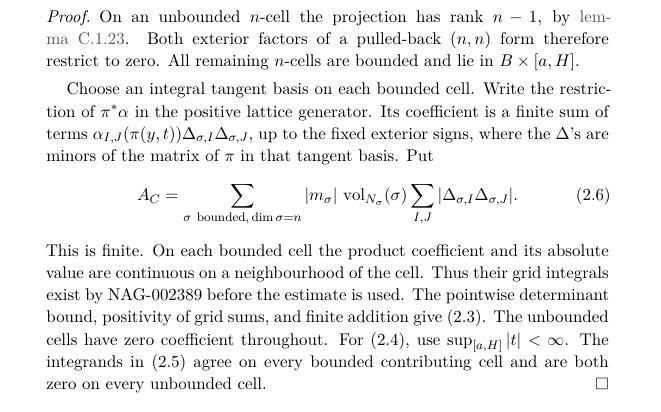
On an unbounded \(n\)-cell the projection has rank \(n-1\), by
\cref{lem:cylinder}. Both exterior factors of a pulled-back \((n,n)\)
form therefore restrict to zero. All remaining \(n\)-cells are bounded
and lie in \(B\times[a,H]\).

Choose an integral tangent basis on each bounded cell. Write the
restriction of \(\pi^*\alpha\) in the positive lattice generator.
Its coefficient is a finite sum of terms
\(\alpha_{I,J}(\pi(y,t))\Delta_{\sigma,I}\Delta_{\sigma,J}\),
up to the fixed exterior signs, where the \(\Delta\)'s are minors of
the matrix of \(\pi\) in that tangent basis. Put
\[
 A_C=\sum_{\sigma\ {\rm bounded},\,\dim\sigma=n}
  |m_\sigma|\,\operatorname{vol}_{N_\sigma}(\sigma)
  \sum_{I,J}|\Delta_{\sigma,I}\Delta_{\sigma,J}|.
 \tag{2.6}
\]
This is finite. On each bounded cell the product coefficient and its
absolute value are continuous on a neighbourhood of the cell. Thus
their grid integrals exist by NAG-002389 before the estimate is used.
The pointwise determinant bound, positivity of grid sums, and finite
addition give (2.3). The unbounded cells have zero coefficient throughout.
For (2.4), use \(\sup_{[a,H]}|t|<\infty\).
The integrands in (2.5) agree on every bounded contributing cell and
are both zero on every unbounded cell.
\end{proof}
Typeset reader excerpt
Typed proof inputs
- NAG-002389 · selected whole (sealed whole native proof)
- NAG-002561 · selected whole (sealed whole native proof)
- NAG-002389 · selected whole
- NAG-002389 · selected whole (requires)
- NAG-002561 · selected whole
- NAG-002561 · selected whole (requires)
Reader cross-references
Proof map
Verified map inputs · NAG-002562
AND · joint registered proof inputs
- NAG-002389 · The real polyhedral integration calculation · accepted whole
- NAG-002561 · Eventual cylinders; F8LA-P1 · accepted whole
NAG-002562 · Uniform top-degree excision; F8LA-P2R · Chapter argument