NAG-002579 · Accepted whole
A compact bump with one moment presentation
Chapter 8 supplement: Interior Stokes with coherent coefficients
Open in the English reader · PDF page 1789
Statement · exact TeX
\begin{lemma}[A compact bump with one moment presentation]
\label{f7gg:bump}
Let \(X\) be good and Hausdorff, let \(V=\mathcal M(A)\)
be an ordinary affinoid neighborhood of \(x\), and suppose
\[
 x\in\Int(V/K),\qquad \ker(x)=\mathfrak p\in\Min(A).
\]
Given an ordinary open neighborhood \(O\) of \(x\) in \(X\),
there exist an affinoid domain \(W\subseteq V\), containing
an ordinary neighborhood of \(x\) in \(X\), analytic units
\(g\) on \(W\), and a smooth real function \(\Phi\) on their
moment space such that the scalar section \(b_W=t_g^*\Phi\)
has the following properties:
\[
\begin{gathered}
 0\leq b_W\leq1,\qquad b_W=1\text{ near }x,\\
 \supp_W(b_W)\subseteq C,\qquad
 C\text{ compact},\\
 C\subseteq O\cap\Int_{\rm top}(W,X)\cap\Int(W/K).
\end{gathered}
\]
It extends by zero to a global \(b\in\A_X^{0,0}(X)\).
The restriction of this extension to all of \(W\) is \(b_W\).
If a form is represented by one tuple on \(V\), it remains
represented by that tuple on \(W\).
\end{lemma}
Full selected proof · exact TeX
\begin{proof}
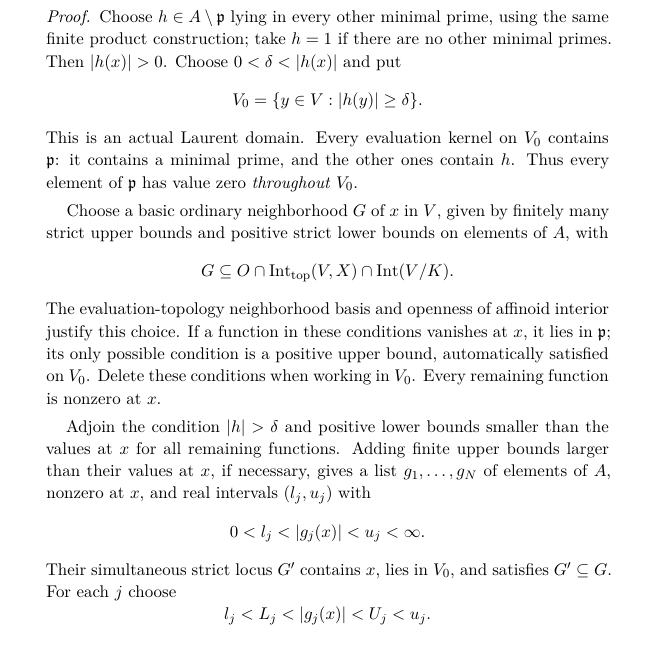
Choose \(h\in A\setminus\mathfrak p\) lying in every other
minimal prime, using the same finite product construction;
take \(h=1\) if there are no other minimal primes.
Then \(|h(x)|>0\).
Choose \(0<\delta<|h(x)|\) and put
\[
                 V_0=\{y\in V:|h(y)|\geq\delta\}.
\]
This is an actual Laurent domain.
Every evaluation kernel on \(V_0\) contains \(\mathfrak p\):
it contains a minimal prime, and the other ones contain \(h\).
Thus every element of \(\mathfrak p\) has value zero
\emph{throughout} \(V_0\).

Choose a basic ordinary neighborhood \(G\) of \(x\) in \(V\),
given by finitely many strict upper bounds and positive
strict lower bounds on elements of \(A\), with
\[
 G\subseteq O\cap\Int_{\rm top}(V,X)\cap\Int(V/K).
\]
The evaluation-topology neighborhood basis and openness
of affinoid interior justify this choice.
If a function in these conditions vanishes at \(x\), it lies
in \(\mathfrak p\); its only possible condition is a positive
upper bound, automatically satisfied on \(V_0\).
Delete these conditions when working in \(V_0\).
Every remaining function is nonzero at \(x\).

Adjoin the condition \(|h|>\delta\) and positive lower
bounds smaller than the values at \(x\) for all remaining
functions. Adding finite upper bounds larger than their
values at \(x\), if necessary, gives a list \(g_1,\ldots,g_N\)
of elements of \(A\), nonzero at \(x\), and real intervals
\((l_j,u_j)\) with
\[
 0<l_j<|g_j(x)|<u_j<\infty.
\]
Their simultaneous strict locus \(G'\) contains \(x\),
lies in \(V_0\), and satisfies \(G'\subseteq G\).
For each \(j\) choose
\[
             l_j<L_j<|g_j(x)|<U_j<u_j.
\]
Set
\[
           W=\{y\in V:L_j\leq|g_j(y)|\leq U_j
                              \text{ for every }j\}.
\]
The actual rational-domain point and joint-presentation
theorems make \(W\) an affinoid domain. It is an ordinary
neighborhood of \(x\) in \(X\), since its inequalities
are strict at \(x\) and \(x\in\Int_{\rm top}(V,X)\).
Each \(g_j|_W\) is a unit, with inverse supplied by its
Laurent presentation. Moreover \(W\subseteq G\).

Choose \(0\leq\Phi_j\leq1\) smooth with compact support in
\((-\log U_j,-\log L_j)\), equal to \(1\) near
\(-\log|g_j(x)|\), and put \(\Phi=\prod_j\Phi_j\).
These real profiles are those constructed in
\src{v037:forms:smoothcutoff}.
The compact set
\[
                   C=t_g^{-1}(\supp\Phi)\subseteq W
\]
contains the support of \(b_W=t_g^*\Phi\).
Every point of \(C\) satisfies all defining inequalities
of \(W\) strictly. Thus \(C\subseteq\Int_{\rm top}(W,X)\):
use the strict locus in \(V\) and \(W\subseteq
\Int_{\rm top}(V,X)\).
Also \(C\subseteq\Int(V/K)\).
The domain-interior theorem and composition give
\(C\subseteq\Int(W/K)\).

Finally glue \(b_W\) on \(\Int_{\rm top}(W,X)\) to zero on
\(X\setminus C\). These are an ordinary open cover of \(X\)
and the sections agree on the overlap.
The ordinary sheaf theorem gives a global smooth moment
function \(b\). On \(W\setminus C\) both its restriction
and \(b_W\) are zero locally, so they agree on all of \(W\).
Compactness of \(C\) and Hausdorffness of \(X\) are essential
for this zero-extension argument.
\end{proof}
Typeset reader excerpt
Typed proof inputs
- NAG-001496 · selected whole (selected native applied clause)
- NAG-001560 · selected whole (selected native applied clause)
- NAG-001576 · selected whole (selected native applied clause)
- NAG-001577 · selected whole (selected native applied clause)
- NAG-001578 · selected whole (selected native applied clause)
- NAG-001628 · selected whole (selected native applied clause)
- NAG-001704 · selected whole (selected native applied clause)
- NAG-002424 · selected whole (selected native applied clause)
- NAG-002427 · selected whole (selected native applied clause)
Reader cross-references
Proof map
Verified map inputs · NAG-002579
AND · joint registered proof inputs
- NAG-001496 · Compactness of the bounded spectrum · accepted whole Exact source windows 43–50, 89–98
- Evaluation topology of M(A) gives finite strict coordinate constraints.
- W is compact; the continuous moment map pulls the closed support back to compact C.
- NAG-001560 · Closed submodules and controlled matrix images · accepted whole Exact source window 29–31
- Noetherianity of the actual generalized affinoid A.
- NAG-001576 · Points of an arbitrary-radius rational presentation · accepted whole Exact source windows 33–37, 68–82
- Point set of the rational datum with denominator h, numerator 1, radius 1/delta.
- For each upper bound use denominator 1 and numerator g_j; for each lower bound use denominator g_j and numerator 1. Both generate the unit ideal.
- NAG-001577 · Bounded and geometric rational factorization · accepted whole Exact source windows 33–37, 68–82
- The geometric universal property makes that presentation an analytic domain.
- Each rational factor has the geometric domain universal property.
- NAG-001578 · Joint presentations and completed pushouts · accepted whole Exact source window 68–82
- Finite joint actual quotient. The same lower-bound relations give the actual inverse to every g_j on W.
- NAG-001628 · Interior of an affinoid domain · accepted whole Exact source window 94–100
- The strict locus in the affinoid parent V gives C inside the ordinary interior of W in V, then the selected forward implication gives the analytic relative interior of W/V.
- NAG-001704 · Presentation calculus for relative interior · accepted whole Exact source windows 98–100, 43–50
- Forward composition for W -> V -> M(K), with the same point lying over Int(V/K).
- Openness of the absolute interior of V over M(K).
- NAG-002424 · The sheaf of ordinary smooth moment forms · accepted whole Exact source window 102–109
- Ordinary sheaf gluing and analytic pullback on the inclusion W -> X. On W minus C both sections have zero germ. Analytic pullback preserves the full original restricted tuple as units and its same ambient coefficient.
- NAG-002427 · Compact smooth cutoffs · accepted whole Exact source window 84–88
- Only the elementary real profile is used. Two translated/rescaled transitions give each interval profile.
NAG-002579 · A compact bump with one moment presentation · Chapter argument