NAG-002629 · Accepted whole
Point labels and sector labels are both necessary
I Descent of the polarized mixed tower
Open in the English reader · PDF page 2105
Statement · exact TeX
\begin{proposition}[Point labels and sector labels are both necessary]
\label{mso:twolifttest}
The hypotheses of Definition~\ref{mso:setup} occur in every
dimension with $r=2$, a nonflat three-cone fan, and different
nilpotent lengths on the two Gauss lifts.
For this example $Q_{1,1}$ and $Q_{1,2}$ have whole degrees $6$
and $9$, and even after separation by Gauss lift their degrees
are respectively $(2,4)$ and $(3,6)$.
After separation by original moment weight, the normalized
coefficients on each cone are $(1,2)$ for both projections.

Moreover, on either individual lift there is no analytic
idempotent on a full projected neighbourhood of the central
Gauss fibre that selects the first positive sector and excludes
the second on every sufficiently close positive Gauss fibre.
Thus the sector idempotents need not extend across the vertex.
\end{proposition}
Full selected proof · exact TeX
\begin{proof}
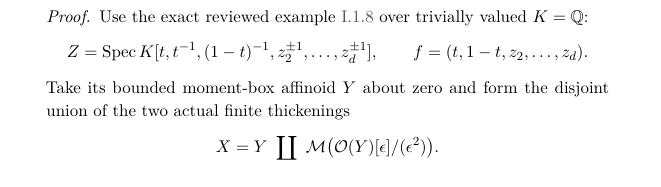
Use the exact reviewed example \Dep{mpw:nonflatobstruction}
over trivially valued $K=\mathbb Q$:
\[
 Z=\operatorname{Spec}
       K[t,t^{-1},(1-t)^{-1},z_2^{\pm1},\ldots,z_d^{\pm1}],
 \qquad f=(t,1-t,z_2,\ldots,z_d).
\]
Take its bounded moment-box affinoid $Y$ about zero and
form the disjoint union of the two actual finite thickenings
\[
 X=Y\ \coprod\
   \mathcal M\bigl(\mathcal O(Y)[\epsilon]/(\epsilon^2)\bigr).
\]
Use the same moment functions on both components and $M=A$.
The two points $x_1,x_2$ are the trivial generic norms on the
two reductions; their thicknesses are $h_1=1,h_2=2$.
The reviewed example proves the pure dimension, interior,
full pointed fan and norm-admissible saturated finite collars.
Finite products and these canonical thickenings preserve them.
The fan on each component is
\[
 \bigl(\mathbb R_{\geq0}(1,0)\cup
       \mathbb R_{\geq0}(0,1)\cup
       \mathbb R_{\geq0}(-1,-1)\bigr)\times\mathbb R^{d-1}.
\]
For $Q_{a,b}(u,v,\lambda)=(au+bv,\lambda)$, $a,b>0$,
the whole finite algebra in the reviewed example has degree
$a+b$. Its central analytic Gauss algebra on the $j$th
component is
\[
 K(t,z_2,\ldots,z_d)[\epsilon]/(\epsilon^{h_j})
       \quad\hbox{over}\quad K(t^a(1-t)^b,z_2,\ldots,z_d).
\]
For $h_j=1$ this means the field itself.
These fields have their trivial complete norms; the full
degree is $a+b$. Each algebra is local, so the central
analytic Gauss fibre consists of precisely $x_j$.
Thus both projections have the same full two-point set $S$,
although their central algebras have different dimensions.

The cone indices are $a,b,a+b$.
At a small positive first projected weight $s$, the two original
moment weights are
\[
          (s/a,0,\lambda),\qquad(0,s/b,\lambda).
\]
Their Gauss dimensions on component $j$ are $h_ja$ and $h_jb$,
by the reviewed cone-weight calculation and finite thickening.
At a negative projected weight only the third cone contributes,
with dimension $h_j(a+b)$.
Consequently the full degrees are $(h_1+h_2)(a+b)$, giving
$6$ and $9$, and the point-labelled degrees are as stated.
Dividing each \emph{sector} factor by its own index gives
$h_j$, hence $(1,2)$ for both projections.
Dividing a mixed point-labelled degree by the first cone index
still gives $2$ versus $3$ on the first component.
Matching the two point labels by an arbitrary permutation
would likewise compare $1$ with $2$.
The same points and the same original weights, rather than
counts or degree multisets, fix the correct matching.

Finally fix a component $j$ and one $Q_{a,b}$.
Its central analytic Gauss fibre is the singleton $x_j$.
Suppose an analytic idempotent on the full inverse image of
an ordinary target neighbourhood of the central Gauss point
made the proposed separation for all small $s>0$.
Its value at $x_j$ is $0$ or $1$, and continuity makes it
constant on an ordinary neighbourhood of $x_j$.
Shrink to an affinoid target neighbourhood to use compactness.
The image of the compact complement of that source
neighbourhood misses the central Gauss point.
The target Gauss points of weights $(s,0,\ldots,0)$ converge
to the central Gauss point, so their \emph{entire analytic
fibres} eventually lie in that one constant-idempotent locus.
Both positive-sector factors are nonzero: their Gauss
dimensions are $h_ja>0$ and $h_jb>0$.
The idempotent therefore cannot be $1$ on one and $0$ on the
other. This contradiction proves the nonextension assertion.
It does not prevent the actual sector idempotents at each
nonzero regular projected level.
\end{proof}
Typeset reader excerpt
Typed proof inputs
- NAG-000182 · selected whole (explicit current dependencies)
- NAG-001496 · selected whole (explicit current dependencies)
- NAG-001692 · selected whole (explicit current dependencies)
- NAG-001701 · selected whole (explicit current dependencies)
- NAG-001702 · selected whole (explicit current dependencies)
- NAG-002306 · selected whole (explicit current dependencies)
- NAG-002362 · selected whole (explicit current dependencies)
- NAG-002595 · selected whole (explicit current dependencies)
Proof map
Verified map inputs · NAG-002629
AND · joint registered proof inputs
- NAG-000182 · Multiplicativity of the weighted Gauss norm · accepted whole
- NAG-001496 · Compactness of the bounded spectrum · accepted whole
- NAG-001692 · Affinoid fibres at all Berkovich points · accepted whole
- NAG-001701 · Finite algebras with their canonical norm · accepted whole
- NAG-001702 · General finite base change · accepted whole
- NAG-002306 · Positive intrinsic weights at arbitrary real flat germs · accepted whole
- NAG-002362 · Weights of finite modules on an interior flat germ · accepted whole
- NAG-002595 · One whole degree is not one cone weight · accepted whole
NAG-002629 · Point labels and sector labels are both necessary · Chapter argument