NAG-002755 · Accepted whole
Power projection and the specified norm metric
I Descent of the polarized mixed tower
Open in the English reader · PDF page 2134
Statement · exact TeX
\begin{proposition}[Power projection and the specified norm metric]
\label{f9fm:powerprojection}
Let $q:X'=(\mathbf P^1_K)^d\to X$ be $T_i=S_i^{n_i}$, with
$n_i\geq1$ and $N=\prod_i n_i$. Give $q^*L_i$ the pulled-back metrics
and denote their full mixed measure from Theorem~\ref{f9fm:alltests}
by $\mu'$. For every $u\in C(X^\an)$,
\begin{equation}\label{ex68:full:eq:power}
       \int_{X'^\an}q^*u\,d\mu'=N\int_{X^\an}u\,d\mu_\Gamma,
       \qquad\left|\int q^*u\,d\mu'\right|\leq ND\|u\|_\infty.
\end{equation}
This is the same identity for the extended frozen integrals and the
primary smooth measures. The rank $N$ includes inseparable degree.
For a continuously metrized analytic line $(M,h_0)$ on $X^\an$, use
only the projection-compatible metric on
$\Nm_q(q^*M)\simeq M^{\otimes N}$. Replacing $h_0$ by $e^{-u}h_0$
changes its norm-metric weight by $Nu$; its bounded curvature pairing
is the value in \eqref{ex68:full:eq:power}.
\end{proposition}
Full selected proof · exact TeX
\begin{proof}
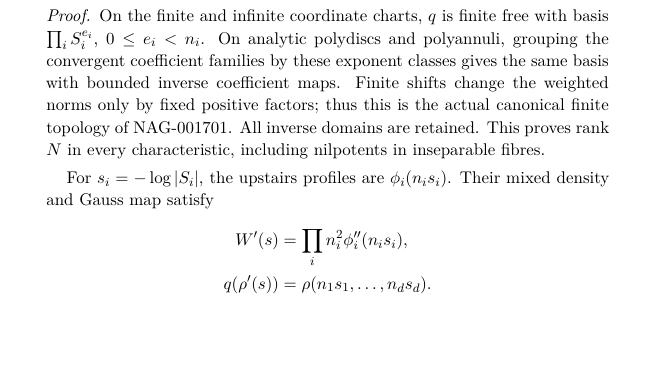
On the finite and infinite coordinate charts, $q$ is finite free with
basis $\prod_i S_i^{e_i}$, $0\leq e_i<n_i$. On analytic polydiscs and
polyannuli, grouping the convergent coefficient families by these
exponent classes gives the same basis with bounded inverse coefficient
maps. Finite shifts change the weighted norms only by fixed positive
factors; thus this is the actual canonical finite topology of
NAG-001701. All inverse domains are retained. This proves rank $N$ in
every characteristic, including nilpotents in inseparable fibres.

For $s_i=-\log|S_i|$, the upstairs profiles are $\phi_i(n_i s_i)$.
Their mixed density and Gauss map satisfy
\[
 \begin{aligned}
 W'(s)&=\prod_i n_i^2\phi_i''(n_i s_i),\\
 q(\rho'(s))&=\rho(n_1s_1,\ldots,n_ds_d).
 \end{aligned}
\]
The second equality follows by evaluating Laurent polynomials in the
Gauss norm: multiplying distinct exponents by $(n_i)$ does not identify
them. Hence the full-measure formula yields
\[
 \int q^*u\,d\mu'
  =\int u(\rho(n_1s_1,\ldots,n_ds_d))
                       \prod_i n_i^2\phi_i''(n_i s_i)\,ds.
\]
The real substitution $t_i=n_i s_i$ removes one product of the $n_i$
and leaves $N$. This proves \eqref{ex68:full:eq:power} for every continuous $u$.
The computation still gives $p$ for $T=S^p$ in characteristic $p$;
a point count or separable degree would be wrong.
Finally the frozen norm isomorphism NAG-002539 and the specified metric
of NAG-002554 identify the norm frame weight with $N$ times the
downstairs weight. Its change is $Nu$, giving the stated bounded pairing.
\end{proof}
Typeset reader excerpt
Typed proof inputs
- NAG-001701 · selected whole (explicit current dependencies)
- NAG-002539 · selected whole (explicit current dependencies)
- NAG-002554 · selected whole (explicit current dependencies)
- NAG-002751 · selected whole (explicit current dependencies)
Reader cross-references
Proof map
Verified map inputs · NAG-002755
AND · joint registered proof inputs
- NAG-001701 · Finite algebras with their canonical norm · accepted whole
- NAG-002539 · Norm projection · accepted whole
- NAG-002554 · Compatibility on the pulled-back metric class · accepted whole
- NAG-002751 · Identity (M) on all continuous analytic tests · accepted whole
NAG-002755 · Power projection and the specified norm metric · Chapter argument