NAG-002751 · Accepted whole
Identity (M) on all continuous analytic tests
I Descent of the polarized mixed tower
Open in the English reader · PDF page 2132
Statement · exact TeX
\begin{theorem}[Identity (M) on all continuous analytic tests]
\label{f9fm:alltests}
Under the standing hypotheses, for every $u\in\mathcal A$,
\begin{equation}\label{ex68:full:eq:fullsmooth}
 L_K(u)=\int_{\mathbf R^d}u(\rho(t))W(t)\,dt,
 \qquad |L_K(u)|\leq D\sup_{\rho(S)}|u|.
\end{equation}
It has a unique continuous extension to all $u\in C(X^\an)$ in the
uniform norm. For every such test, including nonradial tests, this
extension and the primary smooth Gubler--K\"unnemann measure satisfy
\begin{equation}\label{ex68:full:eq:fullM}
 \overline L_K(u)=\int_{X^\an}u\,d\mu_{\rm GK}
       =\int_{X^\an}u\,d\mu_\Gamma
       =\int_{\mathbf R^d}u(\rho(t))W(t)\,dt.
\end{equation}
The measures have support exactly $\rho(S)$ and mass
$D=\prod_i m_i$, the explicit algebraic mixed degree. The product line
$L_1\otimes\cdots\otimes L_d$ has self-measure $d!\mu_\Gamma$ and
self-degree $d!D$. No logarithmic test with a zero or pole is asserted
to be integrable by this theorem.
\end{theorem}
Full selected proof · exact TeX
\begin{proof}
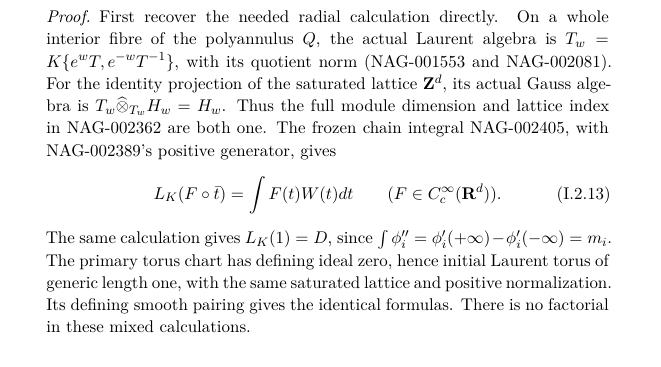
First recover the needed radial calculation directly. On a whole
interior fibre of the polyannulus $Q$, the actual Laurent algebra is
$T_w=K\{e^wT,e^{-w}T^{-1}\}$, with its quotient norm
(NAG-001553 and NAG-002081). For the identity projection of the
saturated lattice $\mathbf Z^d$, its actual Gauss algebra is
$T_w\widehat\otimes_{T_w}H_w=H_w$. Thus the full module dimension and
lattice index in NAG-002362 are both one. The frozen chain integral
NAG-002405, with NAG-002389's positive generator, gives
\begin{equation}\label{ex68:full:eq:radialbase}
 L_K(F\circ\bar t)=\int F(t)W(t)dt\qquad(F\in C_c^\infty(\mathbf R^d)).
\end{equation}
The same calculation gives $L_K(1)=D$, since
$\int\phi_i''=\phi_i'(+\infty)-\phi_i'(-\infty)=m_i$.
The primary torus chart has defining ideal zero, hence initial Laurent
torus of generic length one, with the same saturated lattice and positive
normalization. Its defining smooth pairing gives the identical formulas.
There is no factorial in these mixed calculations.

Let $u\in\mathcal A$. The trace $u\circ\rho$ is continuous on
$\mathbf R^d$. On a compact neighbourhood of $S$, convolution and a
smooth compact cutoff give $F_\epsilon\in C_c^\infty(\mathbf R^d)$
with
\[
       \sup_{t\in S}|u(\rho(t))-F_\epsilon(t)|<\epsilon.
\]
For example, first multiply the trace by a cutoff equal to one near
$S$, convolve with a sufficiently small smooth approximate identity,
and multiply by a second cutoff equal to one on that neighbourhood.
The function $v=u-F_\epsilon\circ\bar t$ is globally ordinary smooth.
It satisfies $|v|<\epsilon$ on $\rho(S)$ and hence on an open
neighbourhood of this compact set. By Lemma~\ref{f9fm:gausssupport},
$\theta$ has zero germ outside $\rho(S)$. Therefore both
$(\epsilon+v)\theta$ and $(\epsilon-v)\theta$ are globally positive
sections: on that neighbourhood their scalar coefficients are positive,
and on its complement they are zero germs. Positivity of NAG-002425
and $L_K(1)=D$ imply
\[
 |L_K(u)-L_K(F_\epsilon\circ\bar t)|\leq\epsilon D.
\]
Using \eqref{ex68:full:eq:radialbase} and the same error bound for the real
integral proves \eqref{ex68:full:eq:fullsmooth}. This proof uses the trace only
in the approximation, without pretending that $u\circ\rho\circ\bar t$
is itself smooth.

The ordinary smooth algebra is uniformly dense by
Lemma~\ref{f9fm:smoothdensity}; the bound in \eqref{ex68:full:eq:fullsmooth}
is at most $D\|u\|_\infty$. Thus $L_K$ has a unique continuous
extension. The explicit functional $u\mapsto\int u\,d\mu_\Gamma$
already extends it, so the first and last expressions in
\eqref{ex68:full:eq:fullM} agree for every continuous $u$. This constructs the
full measure in the frozen class without invoking a general Riesz
existence result for all smooth forms.

For a common smooth function $u\in\mathcal A_{\rm com}$, apply exactly
the same approximation to the primary smooth pairing. The primary
zero-germ statement was proved separately in
Lemma~\ref{f9fm:gausssupport}. Its smooth chart integral is nonnegative
on a nonnegative smooth top form: after restriction to faces its
coefficients are integrated against the nonnegative tropical
multiplicities, with the fixed positive normalization. This is the
chart definition, and is all the positivity required here. Its radial
value and mass were computed above. Hence its value at $u\theta$ is
$\int u\circ\rho\,Wdt$. The defining smooth action of the given finite
signed measure $\mu_{\rm GK}$ has these values. The common algebra is
uniformly dense, and integration against either finite signed Radon
measure is continuous in that norm. Thus the equality extends to every
continuous $u$, proving \eqref{ex68:full:eq:fullM} and, in particular, positivity
and support of $\mu_{\rm GK}$ in this class. The nonnegative continuous
density $W$ has support exactly $S$: every product neighbourhood of a
point of $\prod_i\supp(\phi_i'')$ contains a product of points where
all factors are positive. Thus its measure has support $S$, and the
section homeomorphism gives measure support exactly $\rho(S)$.

For the degree normalization choose $a_i\in K^\times$ and the divisors
$m_i\{T_i=a_i\}$. They meet at one point with regular sequence
$z_1^{m_1},\ldots,z_d^{m_d}$ in the local polynomial ring, where
$z_i=T_i-a_i$. The quotient basis is $\prod_i z_i^{e_i}$ with
$0\leq e_i<m_i$, so its full length is $D$, including nilpotent
layers; its residue degree is one. This computes the mixed degree.
Finally $\theta_i\wedge\theta_i=0$ and the $(1,1)$-factors commute,
so $(\sum_i\theta_i)^d=d!\theta$. The Hilbert polynomial of the
product line is $\prod_i(m_i k+1)$, confirming self-degree $d!D$.
\end{proof}
Typeset reader excerpt
Typed proof inputs
- NAG-001553 · selected whole (explicit current dependencies)
- NAG-002081 · selected whole (explicit current dependencies)
- NAG-002362 · selected whole (explicit current dependencies)
- NAG-002389 · selected whole (explicit current dependencies)
- NAG-002425 · selected whole (explicit current dependencies)
- NAG-002744 · selected whole (explicit current dependencies)
- NAG-002749 · selected whole (explicit current dependencies)
Reader cross-references
Proof map
Verified map inputs · NAG-002751
AND · joint registered proof inputs
- NAG-001553 · The actual multi-Laurent relation quotient · accepted whole
- NAG-002081 · The tropical fibre algebra · accepted whole
- NAG-002362 · Weights of finite modules on an interior flat germ · accepted whole
- NAG-002389 · The real polyhedral integration calculation · accepted whole
- NAG-002425 · Integration of compactly supported smooth moment forms · accepted whole
- NAG-002744 · Local cancellation forces rank drop · accepted whole
- NAG-002749 · A common smooth algebra is uniformly dense · accepted whole
NAG-002751 · Identity (M) on all continuous analytic tests · Chapter argument