NAG-002816 · Accepted whole
Gauss branches and the finite maximal-rank set
Proper direct image on historical ordinary compact tests
Open in the English reader · PDF page 1963
Statement · exact TeX
\begin{lemma}[Gauss branches and the finite maximal-rank set]
\label{sgo:gaussbranches}
For any analytic map $\psi:X\to T^d$, the underlying set of
$\psi^{-1}(\eta_s)$ is finite. If $x$ belongs to this fibre and
$x\in\operatorname{Int}(X/K)$, there are arbitrarily small
ordinary affinoid neighbourhoods $Y=\mathcal M(B)$ of $x$
and $N=\mathcal M(C)$ of $\eta_s$ such that
$\psi:Y\to N$ is norm-admissible finite and
$\psi^{-1}(\eta_s)\cap Y=\{x\}$.
One can take $C$ integral. The ordinary stalk
$\kappa_s:=\mathcal O_{T^d,\eta_s}$ is a field, and, with
\[
 E=B\widehat\otimes_C H_s=B\otimes_C H_s,\qquad
 P=M\otimes_A E,
\]
$E$ is the actual local Artinian fibre algebra at $x$, with
residue field $\mathcal H(x)$. There are natural identifications
\[
 E=\mathcal O_{X,x}\otimes_{\kappa_s}H_s,\qquad
 P=\mathcal F_x\otimes_{\kappa_s}H_s,
\]
and the finite integer
\begin{equation}
 \delta_\psi(M,x):=\dim_{H_s}P
 =\dim_{\kappa_s}\mathcal F_x
 =\operatorname{length}_E(P)[\mathcal H(x):H_s]
 \label{sgo:localdegree}
\end{equation}
is independent of the isolating neighbourhoods.
After shrinking $N$ ordinarily and taking the inverse image in
$Y$, the direct images of $\mathcal O_Y$ and $\mathcal F|Y$
are free, of ranks $\delta_\psi(A,x)>0$ and
$\delta_\psi(M,x)$ respectively.
Moreover, writing
$\beta_{\mathfrak p}(M)=\operatorname{length}_{A_{\mathfrak p}}
M_{\mathfrak p}$, one has
\begin{equation}
 \delta_\psi(M,x)=
 \sum_{\mathfrak p\in\operatorname{Min}(A)}
       \beta_{\mathfrak p}(M)\dim_{H_s}(E/\mathfrak pE).
 \label{sgo:genericlengths}
\end{equation}
For every unit tuple $f$ and every $w$, the set $S_w$ is finite,
without an interior assumption on its points.
\end{lemma}
Full selected proof · exact TeX
\begin{proof}
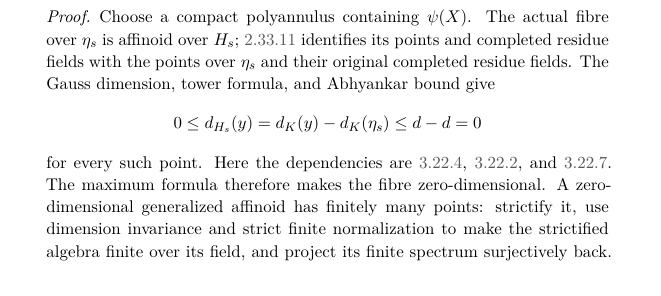
Choose a compact polyannulus containing $\psi(X)$.
The actual fibre over $\eta_s$ is affinoid over $H_s$;
\Dep{fnd:allpointaffinoidfibres} identifies its points and
completed residue fields with the points over $\eta_s$ and
their original completed residue fields. The Gauss dimension,
tower formula, and Abhyankar bound give
\[
 0\leq d_{H_s}(y)=d_K(y)-d_K(\eta_s)\leq d-d=0
\]
for every such point. Here the dependencies are
\Dep{fnd:gaussvaluedfielddimension},
\Dep{fnd:valuedfielddimensioncalculus}, and
\Dep{fnd:affinoidabhyankarmaximum}.
The maximum formula therefore makes the fibre
zero-dimensional. A zero-dimensional generalized affinoid
has finitely many points: strictify it, use dimension
invariance and strict finite normalization to make the
strictified algebra finite over its field, and project its
finite spectrum surjectively back. These are exactly
\Dep{fnd:simultaneousstrictification},
\Dep{fnd:analyticdimensionindependence},
\Dep{fnd:strictfinitenormalization},
\Dep{fnd:stricttatedimension},
\Dep{fnd:strictfinitealgebras},
\Dep{fnd:finiteanalyticbranchseparation}, and
\Dep{fnd:scalarextensionspectralsurjective}.
No finiteness assertion over the whole $\mathbb T_s$ follows.

We give the field-stalk argument over the original $K$.
If a generalized affinoid $D$ has analytic dimension at most
$d$ and $z\in\mathcal M(D)$ has $d_K(z)=d$, then
$\mathfrak p=\ker(D\to\mathcal H(z))$ is minimal.
Otherwise choose a minimal prime $\mathfrak q\subsetneq\mathfrak p$.
Simultaneously strictify $D/\mathfrak q$ and $D/\mathfrak p$
by a finite $K$-free extension, making the new field nontrivially
valued as well. The domain-preservation and quotient statements
of \Dep{v036:analytic:freecomponents}, together with faithful
flatness \Dep{fnd:freeextensionfaithfullyflat}, preserve the
strict inclusion of these primes. The strictified domain has
Krull dimension at most $d$; quotienting by a nonzero prime
lowers it to at most $d-1$, since every prime chain in the
quotient can be preceded by the zero prime of the domain.
Analytic dimension invariance gives
$\dim(D/\mathfrak p)\leq d-1$, contradicting the Abhyankar
bound applied to $z$ on that quotient.
Here equality of strict analytic and Krull dimensions is the
strict dimension theory in \Dep{fnd:analyticdimensionindependence}
and \Dep{fnd:strictfinitenormalization}.

An affinoid neighbourhood of $\eta_s$ in $T^d$ is an affinoid
domain of affine $d$-space. It is regular by
\Dep{fnd:affinespacedomainregular}, and is a finite product of
integral affinoid algebras by \Dep{fnd:regularaffinoidcomponents}.
Pass to the open-and-closed component containing $\eta_s$.
It is still an ordinary neighbourhood. Its evaluation kernel
is minimal by the preceding paragraph, hence zero.
If a germ at $\eta_s$ evaluates to zero, represent it on such
an integral neighbourhood inside its domain of definition.
It is zero there. Evaluation on the ordinary stalk is therefore
injective. The description of its maximal ideal in
\Dep{fnd:ordinaryaffinoidstalks} makes that ideal zero, so this
local ring is the asserted field $\kappa_s$.
This argument does not identify $\kappa_s$ with its completion.

The torus is boundaryless over $K$ by
\Dep{fnd:algebraicmorphismboundaryless}, and absolute interior at
$x$ implies relative interior for $\psi$ there: test on ordinary
affinoid neighbourhoods and use
\Dep{fnd:goodinteriorlocaltesting} and
\mbox{\hyperref[fnd:nag001626:source-factor-interior]{the source-factor implication}}.
The finite set already proved makes $x$ isolated in its analytic
fibre. The local finite criterion
\Dep{fnd:isolatedinteriorlocalfinite}, applied inside an
ordinary neighbourhood disjoint from the other fibre points,
gives ordinary open finite neighbourhoods. Restrict the target
to an ordinary affinoid neighbourhood, and then to its integral
component at $\eta_s$. Finite base change gives the asserted
$Y\to N$; $Y$ remains an ordinary neighbourhood of $x$.

The finite direct-image and stalk identities
\Dep{fnd:finitecoherentdirectimagebasechange} and
\Dep{fnd:finitepushforwardflatness} give
\[
 B\otimes_C\kappa_s=\mathcal O_{X,x},\qquad
 (M\otimes_A B)\otimes_C\kappa_s=\mathcal F_x.
\]
There is only one summand because the isolated analytic fibre
has only $x$. The finite tensor comparison
\Dep{fnd:generalizedfinitebasechange} then gives the displayed
identifications with $E$ and $P$, retaining their actual
canonical complete norms. A finite algebra over the complete
field $H_s$ has one analytic point for each local Artinian
factor. Thus $E$ is local, and its residue field is precisely
$\mathcal H(x)$ by \Dep{fnd:allpointaffinoidfibres}.
A composition series of $P$ has copies of this residue field
as its simple factors, proving \eqref{sgo:localdegree}.
Since $\kappa_s$ is a field, both finite direct-image stalks
are free. Apply \Dep{fnd:coherentflatstalkfree} to each, and
intersect the resulting ordinary neighbourhoods. This derives
freeness from the Gauss stalk; no generic-flatness assumption
has been made.

For \eqref{sgo:genericlengths}, \mbox{\hyperref[fnd:nag002360:fraction-field-flatness]{the fraction-field argument}} applies: $C\hookrightarrow H_s$ factors
through $\operatorname{Frac}(C)$, so $H_s$ is flat over $C$.
The domain map $A\to B$ is flat by
\mbox{\hyperref[fnd:nag001832:ordinary-single-domain-flatness]{ordinary single-domain flatness}}; hence $A\to E$ is flat.
The algebraic composition-series argument of
\mbox{\hyperref[fnd:nag002360:artin-composition-series]{the local Artinian calculation}} now applies verbatim to this
actual Artinian algebra: flat going down makes its prime
contract to a minimal prime of $A$, and tensoring a composition
series at that prime gives the displayed sum. Every other
minimal-prime quotient of $E$ is zero. In particular neither
nilpotent length nor the full residue-field degree is discarded.

Finally, if $r_f(x)=d$, some $d$ of the $n$ homogeneous elements
$\widetilde{f_i(x)}$ are algebraically independent. For that
coordinate subset $I$, the map $\psi_I=(f_i)_{i\in I}$ sends
$x$ to $\eta_{w_I}$: for every Laurent polynomial the nonzero
initial terms of maximal norm cannot cancel, which is exactly
the weighted Gauss norm. There are finitely many choices of
$I$, and each $\psi_I^{-1}(\eta_{w_I})$ is finite by the first
paragraph. Their union contains $S_w$. If $n<d$, $S_w$ is empty.
\end{proof}
Typeset reader excerpt
Typed proof inputs
- CLAUSE:NAG-001626:source_factor_interior_for_actual_affinoid_maps · selected scope (selected clause)
- CLAUSE:NAG-001832:ordinary_single_domain_flatness · selected scope, text unavailable (selected clause)
- NAG-001451 · selected whole (selected whole)
- NAG-001483 · selected whole (selected whole)
- NAG-001557 · selected whole (selected whole)
- NAG-001566 · selected whole (selected whole)
- NAG-001586 · selected whole, export unavailable (selected whole)
- NAG-001588 · selected whole (selected whole)
- NAG-001591 · selected whole (selected whole)
- NAG-001631 · selected whole (selected whole)
- NAG-001657 · selected whole (selected whole)
- NAG-001664 · selected whole (selected whole)
- NAG-001692 · selected whole (selected whole)
- NAG-001694 · selected whole (selected whole)
- NAG-001698 · selected whole (selected whole)
- NAG-001702 · selected whole (selected whole)
- NAG-001711 · selected whole (selected whole)
- NAG-001735 · selected whole (selected whole)
- NAG-001752 · selected whole (selected whole)
- NAG-001753 · selected whole (selected whole)
- NAG-001754 · selected whole (selected whole)
- NAG-001760 · selected whole (selected whole)
- NAG-001861 · selected whole (selected whole)
- NAG-001876 · selected whole (selected whole)
- NAG-002291 · selected whole (selected whole)
- NAG-002360 · selected whole, export unavailable (selected proof argument reuse)
Proof map
Verified map inputs · NAG-002816
AND · joint registered proof inputs
- CLAUSE:NAG-001626:source_factor_interior_for_actual_affinoid_maps · source factor interior for actual affinoid maps · selected scope
- Absolute source interior gives relative interior over the actual target chart
- NAG-001451 · Finite normalization for strict affinoid algebras · accepted whole
- Common K-free strictification preserves the prime chain and dimension; Abhyankar bound rules out a nonminimal evaluation kernel at maximal rank
- Zero-dimensional actual fibre: simultaneous isometric strictification, dimension equality, finite strict normalization over the field and surjectivity back
- NAG-001483 · The affinoid norm on a finite algebra · accepted whole
- Zero-dimensional actual fibre: simultaneous isometric strictification, dimension equality, finite strict normalization over the field and surjectivity back
- NAG-001557 · Simultaneous strictification of closed presentations · accepted whole
- Zero-dimensional actual fibre: simultaneous isometric strictification, dimension equality, finite strict normalization over the field and surjectivity back
- NAG-001566 · Free-radius extension is algebraically faithfully flat · accepted whole
- Common K-free strictification preserves the prime chain and dimension; Abhyankar bound rules out a nonminimal evaluation kernel at maximal rank
- NAG-001586 · Result 3.22.2 · accepted whole; PDF destination
- Actual completed analytic Gauss fibre, point/residue-field identification, and dimension calculation
- NAG-001588 · Residual dimension of a Gauss field · accepted whole
- Actual completed analytic Gauss fibre, point/residue-field identification, and dimension calculation
- NAG-001591 · Dimension as a maximum over analytic points · accepted whole
- Common K-free strictification preserves the prime chain and dimension; Abhyankar bound rules out a nonminimal evaluation kernel at maximal rank
- Actual completed analytic Gauss fibre, point/residue-field identification, and dimension calculation
- NAG-001631 · Ordinary local testing for good spaces · accepted whole
- Transfer from X → actual ordinary target polyannulus to the torus
- NAG-001657 · Dimension of a strict normalization · accepted whole
- Zero-dimensional actual fibre: simultaneous isometric strictification, dimension equality, finite strict normalization over the field and surjectivity back
- NAG-001664 · Intrinsic analytic dimension and scalar extension · accepted whole
- Common K-free strictification preserves the prime chain and dimension; Abhyankar bound rules out a nonminimal evaluation kernel at maximal rank
- Zero-dimensional actual fibre: simultaneous isometric strictification, dimension equality, finite strict normalization over the field and surjectivity back
- NAG-001692 · Affinoid fibres at all Berkovich points · accepted whole
- Actual completed analytic Gauss fibre, point/residue-field identification, and dimension calculation
- Coherent finite direct-image and single-branch ordinary stalk product; actual finite analytic fibre and its completed residue field
- NAG-001694 · Surjectivity after an arbitrary complete extension · accepted whole
- Zero-dimensional actual fibre: simultaneous isometric strictification, dimension equality, finite strict normalization over the field and surjectivity back
- NAG-001698 · Ordinary affinoid stalks · accepted whole
- Integral open and closed component of an ordinary affinoid in the torus, and the evaluation kernel of the filtered ordinary stalk
- NAG-001702 · General finite base change · accepted whole
- Isolated inner point admits arbitrarily small ordinary finite chart; actual finite inverse over integral affinoid neighbourhood
- Coherent finite direct-image and single-branch ordinary stalk product; actual finite analytic fibre and its completed residue field
- Actual ordinary finite tensor; scalar extension along a flat C-module
- NAG-001711 · Relative neighbourhoods for algebraic morphisms · accepted whole
- Original true torus boundarylessness; source-factor direction itself already follows from 001626 clause
- NAG-001735 · Separating the branches of a finite morphism · accepted whole
- Coherent finite direct-image and single-branch ordinary stalk product; actual finite analytic fibre and its completed residue field
- Zero-dimensional actual fibre: simultaneous isometric strictification, dimension equality, finite strict normalization over the field and surjectivity back
- NAG-001752 · Coherent direct image under a finite morphism · accepted whole
- Coherent finite direct-image and single-branch ordinary stalk product; actual finite analytic fibre and its completed residue field
- NAG-001753 · A flat coherent ordinary stalk is locally free · accepted whole
- The two finite stalks are vector spaces over the Gauss ordinary stalk field, so become free on a common ordinary neighbourhood
- NAG-001754 · Finite pushforward detects flatness · accepted whole
- Coherent finite direct-image and single-branch ordinary stalk product; actual finite analytic fibre and its completed residue field
- NAG-001760 · Regular affine-space domains · accepted whole
- Integral open and closed component of an ordinary affinoid in the torus, and the evaluation kernel of the filtered ordinary stalk
- NAG-001861 · Regular affinoids and their components · accepted whole
- Integral open and closed component of an ordinary affinoid in the torus, and the evaluation kernel of the filtered ordinary stalk
- NAG-001876 · The local finite criterion · accepted whole
- Isolated inner point admits arbitrarily small ordinary finite chart; actual finite inverse over integral affinoid neighbourhood
- NAG-002291 · Components under a free-radius extension · accepted whole
- Common K-free strictification preserves the prime chain and dimension; Abhyankar bound rules out a nonminimal evaluation kernel at maximal rank
- NAG-002360 · Result 5.40.1 · accepted whole; PDF destination
- Signed fraction-field flatness calculation applied to the checked injection C → H_s; C is the actual ordinary neighbourhood algebra
- Exact one-local-factor composition argument over A; minimal contraction, flat tensor of composition series and other minimal prime quotients vanish
Unlinked source pointers
These pointers have no operative linked edge in this map.
CLAUSE:NAG-001832:ordinary_single_domain_flatness
NAG-002816 · Gauss branches and the finite maximal-rank set · Chapter argument