NAG-002823 · Accepted whole
Excision of lower-rank central loci in top degree
Proper direct image on historical ordinary compact tests
Open in the English reader · PDF page 1968
Statement · exact TeX
\begin{theorem}[Excision of lower-rank central loci in top degree]
\label{sgo:skeletalexcision}
Let $w\in t(X)$ and suppose only that
\begin{equation}
                         S_w\subset\operatorname{Int}(X/K).
 \label{sgo:skeletoninterior}
\end{equation}
Choose pairwise disjoint ordinary affinoid neighbourhoods
$U_x$ of all $x\in S_w$, sufficiently small for
Theorem~\ref{sgo:pointedoverlap}, and contained in
$\operatorname{Int}(X/K)$. Then
\begin{equation}
 [\mathcal T_f(M)]_w=\sum_{x\in S_w}\mathcal C_{x,f}(M).
 \label{sgo:excision}
\end{equation}
More precisely, there are a real neighbourhood $B$ of $w$
and a finite union $E$ of rational polyhedral fan germs
translated to $w$, each of dimension at most $d-1$, such that
for $v\in B\setminus E$ the entire original source fibre
satisfies
\begin{equation}
 F_v=\coprod_{x\in S_w}(F_v\cap U_x)
       \subset\bigcup_{x\in S_w}\operatorname{Int}_{\rm top}(U_x,X).
 \label{sgo:fullnearbyfibres}
\end{equation}
The assertion permits positive-dimensional analytic projection
fibres and boundary points elsewhere in the central fibre
$F_w$. If $S_w$ is empty, the entire image germ has dimension
at most $d-1$ and the $d$-chain germ is zero.
\end{theorem}
Full selected proof · exact TeX
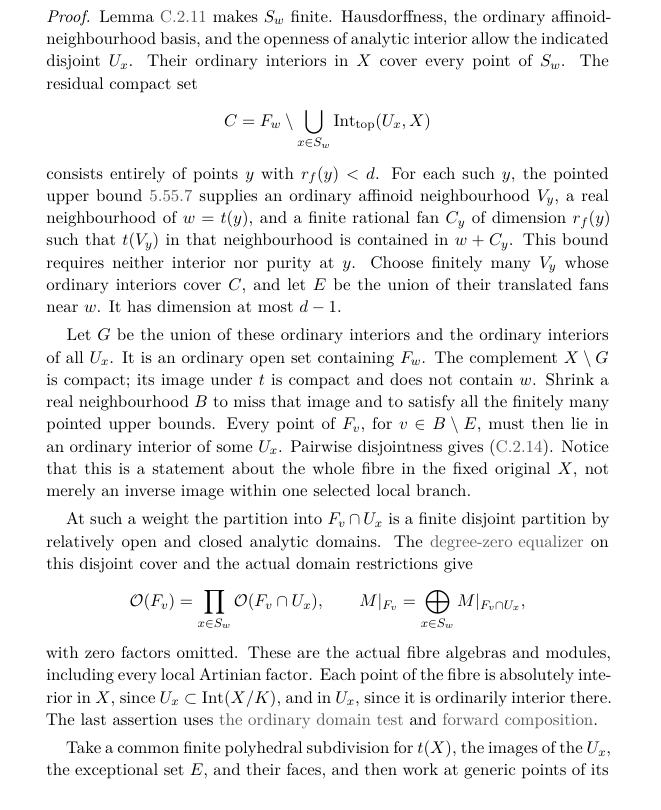
\begin{proof}
Lemma~\ref{sgo:gaussbranches} makes $S_w$ finite. Hausdorffness,
the ordinary affinoid-neighbourhood basis, and the openness
of analytic interior allow the indicated disjoint $U_x$.
Their ordinary interiors in $X$ cover every point of $S_w$.
The residual compact set
\[
 C=F_w\setminus\bigcup_{x\in S_w}
                         \operatorname{Int}_{\rm top}(U_x,X)
\]
consists entirely of points $y$ with $r_f(y)<d$.
For each such $y$, the pointed upper bound
\Dep{v038:pointed:pointedupper} supplies an ordinary affinoid
neighbourhood $V_y$, a real neighbourhood of $w=t(y)$, and a
finite rational fan $C_y$ of dimension $r_f(y)$ such that
$t(V_y)$ in that neighbourhood is contained in $w+C_y$.
This bound requires neither interior nor purity at $y$.
Choose finitely many $V_y$ whose ordinary interiors cover $C$,
and let $E$ be the union of their translated fans near $w$.
It has dimension at most $d-1$.

Let $G$ be the union of these ordinary interiors and the
ordinary interiors of all $U_x$. It is an ordinary open set
containing $F_w$. The complement $X\setminus G$ is compact;
its image under $t$ is compact and does not contain $w$.
Shrink a real neighbourhood $B$ to miss that image and to
satisfy all the finitely many pointed upper bounds. Every
point of $F_v$, for $v\in B\setminus E$, must then lie in
an ordinary interior of some $U_x$. Pairwise disjointness
gives \eqref{sgo:fullnearbyfibres}. Notice that this is a
statement about the whole fibre in the fixed original $X$,
not merely an inverse image within one selected local branch.

At such a weight the partition into $F_v\cap U_x$ is a
finite disjoint partition by relatively open and closed
analytic domains. The \mbox{\hyperref[fnd:nag001831:degree-zero-equalizer]{degree-zero equalizer}} on this disjoint cover and the
actual domain restrictions give
\[
 \mathcal O(F_v)=\prod_{x\in S_w}\mathcal O(F_v\cap U_x),
 \qquad
 M|_{F_v}=\bigoplus_{x\in S_w}M|_{F_v\cap U_x},
\]
with zero factors omitted. These are the actual fibre algebras
and modules, including every local Artinian factor. Each
point of the fibre is absolutely interior in $X$, since
$U_x\subset\operatorname{Int}(X/K)$, and in $U_x$, since it
is ordinarily interior there. The last assertion uses \mbox{\hyperref[fnd:affinoiddomainordinaryinterior]{the ordinary domain test}} and \mbox{\hyperref[fnd:affinoidinteriorcalculus]{forward composition}}.

Take a common finite polyhedral subdivision for $t(X)$,
the images of the $U_x$, the exceptional set $E$, and their
faces, and then work at generic points of its $d$-cells.
All applicable local image germs lie in the same affine
$d$-plane, with the same saturated tangent lattice $N$;
absent local images contribute zero. Choose an integral
projection injective on $N$. The interior module-weight
theorem \Dep{v037:degree:moduleweight} applies to $X$ and
every nonempty $U_x$ fibre. Tensoring the displayed finite
product decomposition with the projected Gauss field retains
all factors, so the dimensions of the actual Gauss modules
add. Dividing every term by the common index
$[\mathbb Z^d:Q(N)]$ proves equality of the generic weights.
By \mbox{\hyperref[fnd:nag002405:global-finite-module-chain-weights]{the finite-module chain}}, this proves the chain-germ equality \eqref{sgo:excision} by
Theorem~\ref{sgo:pointedoverlap}.
If $S_w$ is empty, the same compact-cover argument puts the
whole image near $w$ inside $E$, giving the final assertion.
\end{proof}
Typeset reader excerpt
Typed proof inputs
- CLAUSE:NAG-002405:global_finite_module_chain_weights · selected scope (detached reviewed clause)
- NAG-001496 · selected whole (selected native whole)
- NAG-001577 · selected whole (selected native whole)
- NAG-001628 · selected whole (selected native whole)
- NAG-001641 · selected whole (selected native whole)
- NAG-001702 · selected whole (selected native whole)
- NAG-001704 · selected whole (selected native whole)
- NAG-001831 · selected whole, export unavailable (selected native whole)
- NAG-001834 · selected whole (selected native whole)
- NAG-001847 · selected whole (selected native whole)
- NAG-002179 · selected whole (selected native whole)
- NAG-002293 · selected whole (selected native whole)
- NAG-002358 · selected whole (selected native whole)
- NAG-002362 · selected whole (selected native whole)
- NAG-002454 · selected whole (selected native whole)
- NAG-002816 · selected whole (detached reviewed whole)
- NAG-002819 · selected whole (conditional downstream whole)
Reader cross-references
Proof map
Verified map inputs · NAG-002823
AND · joint registered proof inputs
- CLAUSE:NAG-002405:global_finite_module_chain_weights · global finite module chain weights · selected scope
- Standing full-chain notation.
- Defines the full-chain and restricted-chain germs.
- The generic-weight rule gives actual equality as global chain germs, and the empty-S_w clause vanishes in degree d.
- NAG-001496 · Compactness of the bounded spectrum · accepted whole
- Hausdorff separation of finite S_w and compactness of the residual central fibre.
- Compact entire complement has closed moment image missing w.
- NAG-001577 · Bounded and geometric rational factorization · accepted whole
- Paired bounds on actual unit values and inverses give the actual affinoid weight level.
- NAG-001628 · Interior of an affinoid domain · accepted whole
- Each factor point is in the relative domain interior of U_x in X by ordinary capture.
- NAG-001641 · Inner rational neighborhoods · accepted whole
- Choose pairwise disjoint ordinary affinoid neighbourhoods within the prescribed small ordinary opens.
- NAG-001702 · General finite base change · accepted whole
- Use actual finite Gauss base changes, distribute the finite product and finite module sum without losing factors.
- NAG-001704 · Presentation calculus for relative interior · accepted whole
- Forward composition with the already absolutely interior point of X.
- Absolute affinoid interior is open so the neighbourhoods may lie inside it.
- NAG-001831 · Result 2.38.1 · accepted whole; PDF destination
- Degree zero of the finite disjoint affinoid cover: actual algebra and module restriction into the factors.
- NAG-001834 · Structure sheaf and rational comparison · accepted whole
- Finite restriction sheaf identifies the actual finite modules on F_v and its subdomains.
- NAG-001847 · Intersections and restrictions of affinoid domains · accepted whole
- Actual domains F_v intersect U_x; pairwise intersections are the empty actual domain.
- NAG-002179 · Primitive vectors and saturated lattices · accepted whole
- Choose a lattice projection injective on the saturated common tangent rank-d lattice.
- NAG-002293 · Purity of affinoid domains · accepted whole
- Nonempty actual neighbourhood domains are pure of dimension d.
- NAG-002358 · Global polyhedrality and the tropicalized boundary · accepted whole
- Common finite actual image/boundary subdivisions of X and the nonempty pure domains, refined with E.
- NAG-002362 · Weights of finite modules on an interior flat germ · accepted whole
- Same saturated tangent index for full and partial nonempty actual fibre factors, and generic weight formula.
- NAG-002454 · A graded residual fan bounds a pointed moment germ · accepted whole
- Pointed upper bound of dimension r_f(y)<d at each residual point even on the boundary.
- NAG-002816 · Gauss branches and the finite maximal-rank set · accepted whole
- Finiteness of the entire maximal-rank central set, locally without initially requiring interior.
- NAG-002819 · Cofinal pointed weighted germs · accepted whole
- The cofinal choices and resulting pointed germs in the statement.
- The restricted global chain germs agree with the pointed germs.
NAG-002823 · Excision of lower-rank central loci in top degree · Chapter argument