NAG-002834 · Accepted whole
Horizontal and vertical divisor coefficients
I Descent of the polarized mixed tower
Open in the English reader · PDF page 2059
Statement and full selected proof · exact TeX
\begin{proposition}[Horizontal and vertical divisor coefficients]
\label{f9ml:cyclecompat}
Assume the height-one DVR hypotheses given above also for the horizontal
prime divisors. Then, as codimension-one cycles on $\cX$ with rational
coefficients,
\begin{equation}\label{eq:ex68:f9ml:cycle}
 \frac1{e_0}\cyc\bigl(\operatorname{div}_{\cX}(s^{\otimes e_0})\bigr)
 =\overline{\cyc(\operatorname{div}_X(s))}
       +\sum_V\frac{c_V}{e_0}[V].
\end{equation}
Here the bar means coefficientwise closure of the horizontal prime
cycles. At any height-one point with DVR $A$, a local coefficient
$f=a/b\in\operatorname{Frac}(A)^\times$, $a,b\in A\setminus\{0\}$,
has order
\begin{equation}\label{eq:ex68:f9ml:quotient-length}
       \ord_A(f)=\length_A(A/aA)-\length_A(A/bA).
\end{equation}
For an effective local equation $f$, its coefficient is
$\length_A(A/fA)$, using the actual quotient, including its nilpotents.
This is algebraic Cartier-to-cycle compatibility; it does not identify
an analytic current or an F8 tropical end cycle.
\end{proposition}
\begin{proof}
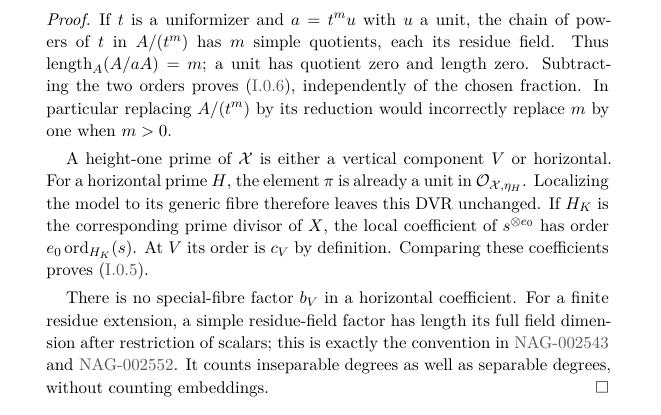
If $t$ is a uniformizer and $a=t^m u$ with $u$ a unit, the chain of
powers of $t$ in $A/(t^m)$ has $m$ simple quotients, each its residue
field. Thus $\length_A(A/aA)=m$; a unit has quotient zero and length
zero. Subtracting the two orders proves \eqref{eq:ex68:f9ml:quotient-length},
independently of the chosen fraction. In particular replacing $A/(t^m)$
by its reduction would incorrectly replace $m$ by one when $m>0$.

\hypertarget{foundations.nag002834.stacks.00KV.vertical-minimal-prime}{}A height-one prime of $\cX$ is either a vertical component $V$ or
horizontal. For a horizontal prime $H$, the element $\pi$ is already
a unit in $\cO_{\cX,\eta_H}$. Localizing the model to its generic
fibre therefore leaves this DVR unchanged. If $H_K$ is the corresponding
prime divisor of $X$, the local coefficient of $s^{\otimes e_0}$ has
order $e_0\ord_{H_K}(s)$. At $V$ its order is $c_V$ by definition.
Comparing these coefficients proves \eqref{eq:ex68:f9ml:cycle}.

There is no special-fibre factor $b_V$ in a horizontal coefficient.
For a finite residue extension, a simple residue-field factor has length
its full field dimension after restriction of scalars; this is exactly
the convention in \hyperref[f9ds:lengthprojection]{NAG-002543} and \hyperref[f9nm:dvrlength]{NAG-002552}. It counts inseparable
degrees as well as separable degrees, without counting embeddings.
\end{proof}
Typeset reader excerpt
Typed proof inputs
- NAG-002543 · selected whole (explicit current dependencies)
- NAG-002552 · selected whole (explicit current dependencies)
- NAG-003111 · selected whole (explicit current dependencies)
Proof map
Verified map inputs · NAG-002834
AND · joint registered proof inputs
- NAG-002543 · Finite locally free intersection lengths · accepted whole
- NAG-002552 · A finite algebra over a DVR · accepted whole
- NAG-003111 · Ordinary height-one model local rings · accepted whole
NAG-002834 · Horizontal and vertical divisor coefficients · Chapter argument