NAG-002857 · Accepted whole
A criterion for an affinoid containing the whole interior fibre
I Descent of the polarized mixed tower
Open in the English reader · PDF page 2085
Statement · exact TeX
\begin{theorem}[A criterion for an affinoid containing the whole interior fibre]
\label{wfi:wholecollarcriterion}
Assume \(w\in t(\Omega)\), and suppose that for one closed
full-dimensional box \(P_0\), with
\(w\in\operatorname{int}(P_0)\), the whole domain
\(\Omega_{P_0}\) is compact Hausdorff.
The following conditions are equivalent.
\begin{enumerate}
\item There is an affinoid domain \(X\subset\Omega\) such that
\[
                     F_w^\Omega\subset\operatorname{Int}(X/K).
 \tag{2}\label{wfi:wholeinner}
\]
\item Every point of \(F_w^\Omega\) is in
      \(\operatorname{Int}(\Omega/T)\), and for \emph{every}
      analytic point \(a\in T_w\) the underlying set of the
      entire analytic fibre \(\Omega_a\) is finite.
      Empty fibres are allowed.
\item There is a closed full-dimensional box \(P\subset
      \operatorname{int}(P_0)\), with
      \(w\in\operatorname{int}(P)\), such that
\[
               \phi:\Omega_P\longrightarrow T_P
                         \quad\hbox{is norm-admissible finite}.
 \tag{3}\label{wfi:wholefinite}
\]
      In particular \(\Omega_P\) is affinoid and
      \(F_w^\Omega\subset\operatorname{Int}(\Omega_P/K)\).
\end{enumerate}
The boxes in condition 3 may be made arbitrarily small about
\(w\). Restriction to any analytic point of \(T_P\), or any
exact polytorus \(T_v\subset T_P\), retains the entire
original-source analytic fibre with its actual algebra and
canonical norm.

If \(\Omega\) is boundaryless over \(K\), the relative-interior
part of condition 2 is automatic. Alternatively, if
\(\Omega_{P_0}\to T_{P_0}\) is analytically proper, it supplies
both compactness and the required relative interiority at the
central level. In either case the finite-fibre condition still
quantifies over all of \(T_w\), not only \(\eta_w\).
No flatness assumption is made.
\end{theorem}
Full selected proof · exact TeX
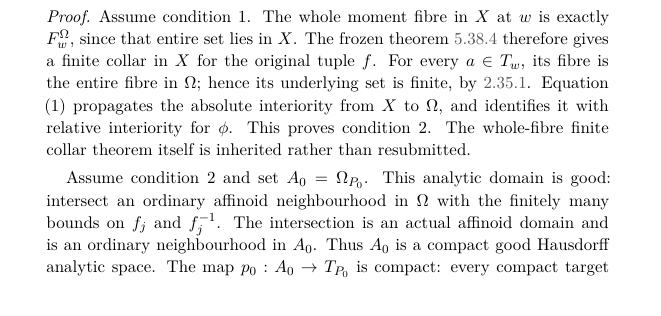
\begin{proof}
Assume condition 1. The whole moment fibre in \(X\) at \(w\)
is exactly \(F_w^\Omega\), since that entire set lies in \(X\).
The frozen theorem \Dep{v037:analytic:wholemomentcollar}
therefore gives a finite collar in \(X\) for the original tuple
\(f\). For every \(a\in T_w\), its fibre is the entire fibre
in \(\Omega\); hence its underlying set is finite, by
\Dep{fnd:finiteanalyticbranchseparation}.
Equation (1) propagates the absolute interiority from \(X\)
to \(\Omega\), and identifies it with relative interiority
for \(\phi\). This proves condition 2. The whole-fibre finite
collar theorem itself is inherited rather than resubmitted.

Assume condition 2 and set \(A_0=\Omega_{P_0}\).
This analytic domain is good: intersect an ordinary affinoid
neighbourhood in \(\Omega\) with the finitely many bounds on
\(f_j\) and \(f_j^{-1}\). The intersection is an actual
affinoid domain and is an ordinary neighbourhood in \(A_0\).
Thus \(A_0\) is a compact good Hausdorff analytic space.
The map \(p_0:A_0\to T_{P_0}\) is compact: every compact
target domain is closed in the Hausdorff target, and its
inverse image is closed in the compact source.

Fix \(a\in T_w\). Its fibre under \(p_0\) is the entire
\(\Omega_a\). At every point of that fibre, both
\(A_0\subset\Omega\) and \(T_{P_0}\subset T\) are ordinary
neighbourhoods, since all box inequalities are strict at
weight \(w\). Ordinary local testing transfers the relative
interiority in condition 2 to \(p_0\).
The frozen lemma \Dep{v038:degree:wholefinitefibre} therefore
supplies an ordinary open neighbourhood \(N_a\subset T_{P_0}\)
over which the \emph{full} restriction of \(p_0\) is finite.
This includes the empty-fibre case. The union
\(N=\bigcup_{a\in T_w}N_a\) contains the entire exact polytorus,
and \(p_0^{-1}(N)\to N\) is finite by target locality.
No branch or Gauss lift has been selected.

The compact set \(T_{P_0}\setminus N\) has compact tropical
image, and that image misses \(w\).
Choose a closed box \(P\) about \(w\), inside
\(\operatorname{int}(P_0)\), avoiding that image and lying in
any prescribed real neighbourhood of \(w\).
Then \(T_P\subset N\). Finite base change yields the finite
map
\[
 p_0^{-1}(T_P)=\Omega_P\longrightarrow T_P.
\]
Its source is affinoid by the definition of a finite analytic
morphism, and its Banach algebra has the canonical finite
norm. For \(y\in F_w^\Omega\), the target point is absolutely
interior in \(T_P\), and the finite map is relatively interior.
The affinoid composition formula gives
\(y\in\operatorname{Int}(\Omega_P/K)\).
This proves condition 3. Condition 3 immediately implies 1.

All source identifications are inverse-image domain identities,
using \Dep{fnd:generalanalyticproducts}.
Actual finite base change and
\Dep{fnd:allpointaffinoidfibres} give the stated analytic fibre
identifications; finite tensor comparison preserves the
complete algebras. In particular, neither reduction nor a
selection of a local Artinian factor occurs.

If \(\Omega\) is boundaryless, (1) proves the final interior
assertion. For an analytically proper \(p_0\), compactness is
part of properness and every source point is relatively
interior. At the central level ordinary local testing again
transfers that interiority to \(\Omega/T\).
This is exactly the project convention
\Dep{fnd:compactmorphismconvention}; topological compactness
alone does not include boundarylessness.
\end{proof}
Typeset reader excerpt
Typed proof inputs
- CLAUSE:NAG-001626:source_factor_interior_for_actual_affinoid_maps · selected scope (explicit current dependencies)
- NAG-001554 · selected whole (explicit current dependencies)
- NAG-001565 · selected whole (explicit current dependencies)
- NAG-001576 · selected whole (explicit current dependencies)
- NAG-001612 · selected whole (explicit current dependencies)
- NAG-001615 · selected whole (explicit current dependencies)
- NAG-001628 · selected whole (explicit current dependencies)
- NAG-001631 · selected whole (explicit current dependencies)
- NAG-001692 · selected whole (explicit current dependencies)
- NAG-001701 · selected whole (explicit current dependencies)
- NAG-001702 · selected whole (explicit current dependencies)
- NAG-001704 · selected whole (explicit current dependencies)
- NAG-001735 · selected whole (explicit current dependencies)
- NAG-002351 · selected whole (explicit current dependencies)
- NAG-002457 · selected whole (explicit current dependencies)
Proof map
Verified map inputs · NAG-002857
AND · joint registered proof inputs
- CLAUSE:NAG-001626:source_factor_interior_for_actual_affinoid_maps · source factor interior for actual affinoid maps · selected scope
- NAG-001554 · Closed presentations after adjoining coefficients · accepted whole
- NAG-001565 · Finite tensors with generalized affinoid targets · accepted whole
- NAG-001576 · Points of an arbitrary-radius rational presentation · accepted whole
- NAG-001612 · Local extension and gluing of morphisms · accepted whole
- NAG-001615 · Fibre products of analytic spaces · accepted whole
- NAG-001628 · Interior of an affinoid domain · accepted whole
- NAG-001631 · Ordinary local testing for good spaces · accepted whole
- NAG-001692 · Affinoid fibres at all Berkovich points · accepted whole
- NAG-001701 · Finite algebras with their canonical norm · accepted whole
- NAG-001702 · General finite base change · accepted whole
- NAG-001704 · Presentation calculus for relative interior · accepted whole
- NAG-001735 · Separating the branches of a finite morphism · accepted whole
- NAG-002351 · A finite analytic image around a whole moment fibre · accepted whole
- NAG-002457 · A finite neighbourhood of the entire analytic fibre · accepted whole
NAG-002857 · A criterion for an affinoid containing the whole interior fibre · Chapter argument