NAG-002970 · Accepted whole
Native top-form measures; F8CR-M
8 Intrinsic smooth forms, integration and Stokes
Open in the English reader · PDF page 1145
Statement · exact TeX
\begin{proposition}[Native top-form measures; F8CR-M]
\label{prop:measure}
Let \(Y\) be good, Hausdorff, and pure of dimension \(d\). For every
real ordinary compact \((d,d)\)-form \(\omega\), there is a unique
finite signed Radon measure \(\mu_{Y,\omega}\), supported in
\(S=\Supp\omega\), with
\begin{equation}\label{eq:measure}
 \int_Y\phi\,d\mu_{Y,\omega}=\int_Y\phi\omega
 \quad\text{for every ordinary smooth scalar }\phi.
\end{equation}
The construction is linear in \(\omega\) and positive for positive
\(\omega\). If its compact support is contained in an open subspace,
the measure on \(Y\) is the zero extension of the measure there. It defines a separate
Borel-measure extension; it does not enlarge the class of coefficients
admitted by the frozen grid integral. Empty support gives the zero
measure.
\end{proposition}
Full selected proof · exact TeX
\begin{proof}
We spell out the boundedness and representation steps.

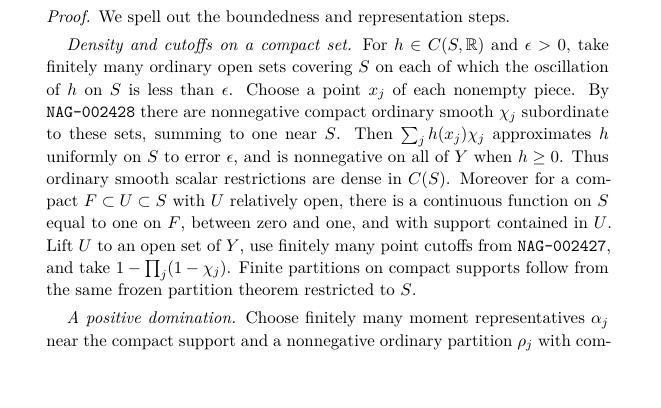
\emph{Density and cutoffs on a compact set.}
For \(h\in C(S,\R)\) and \(\epsilon>0\), take finitely many ordinary
open sets covering \(S\) on each of which the oscillation of \(h\)
on \(S\) is less than \(\epsilon\). Choose a point \(x_j\) of each
nonempty piece. By \tagg{NAG-002428} there are nonnegative compact
ordinary smooth \(\chi_j\) subordinate to these sets, summing to one
near \(S\). Then \(\sum_jh(x_j)\chi_j\) approximates \(h\) uniformly
on \(S\) to error \(\epsilon\), and is nonnegative on all of \(Y\)
when \(h\geq0\). Thus ordinary smooth scalar restrictions are dense
in \(C(S)\). Moreover for a compact \(F\subset U\subset S\) with
\(U\) relatively open, there is a continuous function on \(S\) equal
to one on \(F\), between zero and one, and with support contained in
\(U\). Lift \(U\) to an open set of \(Y\), use finitely many point
cutoffs from \tagg{NAG-002427}, and take
\(1-\prod_j(1-\chi_j)\). Finite partitions on compact supports follow
from the same frozen partition theorem restricted to \(S\).

\emph{A positive domination.}
Choose finitely many moment representatives \(\alpha_j\) near the
compact support and a nonnegative ordinary partition \(\rho_j\)
with compact supports inside those chart opens, summing to one near
\(S\). In the ambient real coordinates \(t_1,\ldots,t_r\) of a chart,
put
\[
 \Theta_j=\frac1{d!}\left(\sum_{k=1}^r d't_k\wedge d''t_k\right)^d.
\]
For \(d=0\) take \(\Theta_j=1\). On a \(d\)-plane the coefficient
of \(\Theta_j\) is the Euclidean Gram square and is positive. Replace
\(\alpha_j\) by
\((\alpha_j+(-1)^dJ\alpha_j)/2\); this does not change its restriction
to any \(d\)-plane, since the top generator has \(J\)-sign
\((-1)^d\). On the compact moment image of \(\Supp\rho_j\), its
coefficient matrix on \(\bigwedge^d\R^r\) is bounded. The elementary
finite-dimensional inequality \(|v^TCv|\leq c_j|v|^2\), for a
sufficiently large constant \(c_j\), therefore shows that
\(c_j\Theta_j\pm\alpha_j\) are nonnegative on all \(d\)-planes
there. This remains true on the tangent planes of every joint moment
refinement, including rank-deficient ones. If \(r<d\), both
restrictions are zero.

The zero extensions of \(\rho_jc_jt_g^*\Theta_j\) define a positive
compact form \(\theta\) satisfying \(-\theta\leq\omega\leq\theta\).
For \(M=\sup_S|\phi|\), the forms \(M\theta\pm\phi\omega\)
are positive: on \(S\) use the displayed bound and outside \(S\)
use \(\omega=0\). Positivity of \tagg{NAG-002425} gives
\begin{equation}\label{eq:bound}
 \left|\int_Y\phi\omega\right|\leq C_\omega\sup_S|\phi|,
 \qquad C_\omega=\int_Y\theta<\infty.
\end{equation}
Hence the native functional depends only on \(\phi|_S\) and extends
uniquely by uniform limits to a bounded linear functional
\(\Lambda_\omega:C(S)\to\R\). For positive \(\omega\) the positive
approximants above prove that this extension is positive.

\emph{Representation of a positive functional, with the construction.}
For any positive bounded \(\Lambda:C(S)\to\R\), define, for open
\(U\subset S\) and arbitrary \(E\subset S\),
\begin{align*}
 a(U)&=\sup\{\Lambda(g):g\in C(S),\ 0\leq g\leq1,
                                      \ \Supp g\subset U\},\\
 a^*(E)&=\inf\{a(U):E\subset U,\ U\text{ open in }S\}.
\end{align*}
Here \(a(S)=\Lambda(1)\), and every quantity is finite. If an open
set is covered by countably many open sets, the compact support of
any test \(g\) is covered by finitely many of them. A finite partition
on that support splits \(g\) into admissible summands, proving
countable subadditivity for \(a\) on open sets. Choosing open
supersets with errors \(\epsilon2^{-j}\) proves that \(a^*\) is
an outer measure; it agrees with \(a\) on open sets.

Every open \(U\) is measurable for this outer measure. Indeed, fix
\(E\) and choose open \(V\supset E\) with
\(a(V)\leq a^*(E)+\epsilon\). Choose a test \(g\) supported on a
compact \(F\subset V\cap U\) with
\(\Lambda(g)\geq a(V\cap U)-\epsilon\). For a test \(h\) supported
in \(V\setminus F\), the function \(g+h\) is still between zero
and one and supported in \(V\). Thus
\(a(V\setminus F)\leq a(V)-\Lambda(g)\), and
\[
 a^*(E\cap U)+a^*(E\setminus U)
 \leq a(V\cap U)+a(V\setminus F)
 \leq a^*(E)+2\epsilon.
\]
Outer subadditivity supplies the reverse inequality. Let
\(\epsilon\downarrow0\). The sets satisfying this splitting equality
form a sigma-algebra. Complements are immediate. For disjoint measurable
\(E_j\), finite iteration gives, for every \(H\),
\[
 a^*(H)\geq\sum_{j=1}^N a^*(H\cap E_j)
                  +a^*\left(H\setminus\bigcup_{j\geq1}E_j\right).
\]
Pass to the supremum over \(N\) and use outer subadditivity on
\(H\cap\bigcup E_j\) to obtain measurability of the union. General
countable unions reduce to disjoint ones by differences. The same
finite-iteration inequality and outer subadditivity prove countable
additivity of the restricted outer measure. Hence
\(\mu=a^*|_{\text{Borel}(S)}\) is a finite Borel measure.

For a test \(g\) above, \(\Lambda(g)\leq\mu(\Supp g)\), since
every open set containing that support admits \(g\) in its defining
supremum. It follows that the measure of an open set is the supremum
of the measures of its compact subsets. Outer regularity is built
into \(a^*\). Inner regularity for every Borel set follows by taking
complements and using finiteness of \(\mu(S)\). Thus \(\mu\) is
Radon. Integrals of nonnegative Borel functions are defined by the
supremum over dominated nonnegative simple functions; bounded
functions may equivalently be approximated uniformly by their
finite dyadic step functions.

To verify representation without importing it, let \(u\geq0\) be
continuous, \(0\leq u\leq m\delta\). Tests supported in
\(\{u>k\delta\}\), \(k=1,\ldots,m\), give
\[
 \delta\sum_{k=1}^m\mu\{u>k\delta\}\leq\Lambda(u).
\]
For the upper bound put
\(v_k=\min(1,\max(0,(u-k\delta)/\delta))\),
\(k=0,\ldots,m-1\). Then \(u=\delta\sum v_k\), and for \(k\geq1\)
the support of \(v_k\) is contained in
\(\{u>(k-1)\delta\}\). Consequently
\[
 \Lambda(u)\leq\delta\mu(S)
                  +\delta\sum_{k=1}^{m-1}\mu\{u>(k-1)\delta\}.
\]
The lower simple sum differs from \(u\) by at most \(\delta\), and
the upper one by at most \(2\delta\). Let \(\delta\to0\), choosing
\(m\delta\geq\|u\|_\infty\). Both bounds tend to \(\int u\,d\mu\).
Linearity gives \(\Lambda(u)=\int u\,d\mu\) for all continuous \(u\).
Uniqueness follows from the cutoff formula for open sets and Radon
inner regularity.

\emph{Signed functionals and locality.}
For a bounded real \(\Lambda\), define on \(u\geq0\)
\[
 \Lambda^+(u)=\sup_{0\leq v\leq u}\Lambda(v).
\]
This is finite, nonnegative, positively homogeneous, and additive:
for one inequality split any \(v\leq u_1+u_2\) into
\(\min(v,u_1)\) and \(v-\min(v,u_1)\); for the other add two
nearly maximizing choices. Extend linearly to all of \(C(S)\).
It is bounded, since \(\Lambda^+(u)\leq\|\Lambda\|\|u\|_\infty\)
for \(u\geq0\). The functional \(\Lambda^-:=\Lambda^+-\Lambda\)
is positive and bounded. The positive construction gives
\(\mu=\mu^+-\mu^-\). Any two finite signed Radon representations
are equal by comparing the positive measures in their two
decompositions and using positive uniqueness. Apply this construction
to \(\Lambda_\omega\) on \(S\), then extend by zero along the closed
inclusion \(S\hookrightarrow Y\). This yields \eqref{eq:measure}.
The same uniqueness, density on a compact union of supports, and
locality of the frozen integral prove linearity and compatibility
with open restrictions wherever the form has compact support.

\paragraph{Cutoffs and the order-zero bound (lines 296--348).}
For compact $F\subset O\subset S$ with $O$ relatively open, lift
$O$ to an ordinary open of $Y$. Finitely many point cutoffs there
give $1-\prod_j(1-\chi_j)$ restricted to $S$, equal to one on $F$
and supported in $O$. More generally a finite relatively open cover
of $F$ lifts to ambient opens; apply 002428 on $F$ and restrict.
For $u\in C(S)$, a finite such cover of $S$ by sets of oscillation
less than $\epsilon$ gives an approximant $\sum_j u(x_j)\chi_j$ of
uniform error at most $\epsilon$. If $u\ge0$ the approximant is
nonnegative. No continuous extension of $u$ to $Y$ is required.

In each moment presentation on a neighbourhood of $S$, use the
interleaved form $\Theta=(\sum_k d't_k\wedge d''t_k)^d/d!$.
In interleaved coordinates a tangent $d$-frame with Pl\"ucker vector
$v$ evaluates $\Theta$ to $\sum_I v_I^2$ and the given coefficient
matrix to $v^{\mathsf t}A v$ (absorbing the fixed coordinate sign
in $A$). The latter has absolute value bounded by
$c\sum_I v_I^2$ on the compact chart region used by its cutoff.
Projection of a frame under refinement uses the same calculation,
including $v=0$. In dimension zero take $\Theta=1$. With the finite
nonnegative partition, sum the cutoff multiples of $c\Theta$, extended
by zero, to get a compact positive form $\theta$ bounding $\pm\omega$.

Here is a way to use precisely $M=\sup_S|\phi|$ even if $\phi$ is much
larger just outside $S$. For $\epsilon>0$ choose a smooth real
scalar truncation $\beta$ equal to the identity on
$[-M-\epsilon/2,M+\epsilon/2]$ and bounded in modulus by $M+\epsilon$.
For example multiply the identity by the cutoff profile of 002427
applied to $2(M+\epsilon-|t|)/\epsilon$; this factor is constant
near zero. Then $\beta(\phi)\omega=\phi\omega$ as sections.
Nonnegativity in common charts and 002425 give
\[
 \left|\int_Y\phi\omega\right|
 \le (M+\epsilon)\int_Y\theta.
\]
Let $\epsilon$ decrease to zero. For empty $S$ take the zero
measure. Otherwise the estimate and the approximants above extend
the functional uniquely to a bounded linear $\Lambda$ on $C(S)$:
use limits of the real integrals of uniform approximants. Positivity
is preserved for positive $\omega$.

\paragraph{Positive representation (lines 350--425).}
For $\Lambda\ge0$ let $a(O)$ be the supremum of $\Lambda(g)$ over
$0\le g\le1$ continuous with support in an open $O\subset S$, and put
$m(H)=\inf_{O\supset H}a(O)$ over open supersets. An open cover of
$\operatorname{supp}g$ admits a finite subordinate partition there as
above. Splitting $g$ by the partition gives countable subadditivity
of $a$ on open covers. Taking open supersets of $H_j$ within
$\epsilon 2^{-j}$ of $m(H_j)$ gives countable subadditivity of $m$.
It is monotone, $m(\varnothing)=0$, $m(O)=a(O)$ for open $O$, and
$m(S)=\Lambda(1)<\infty$. For arbitrary $H$ and open $O$, choose
open $V\supset H$ within $\epsilon$ of $m(H)$ and an admissible $g$
in $V\cap O$ within $\epsilon$ of $a(V\cap O)$. Put
$F=\operatorname{supp}g$. Any admissible test in $V\setminus F$
can be added to $g$ without exceeding one. Thus
$m(H\cap O)+m(H\setminus O)\le m(H)+2\epsilon$.
Subadditivity gives the reverse inequality after passage to the limit.

The finite-intersection step implicit at lines 379--392 is as follows.
Call $A$ splitting if $m(H)=m(H\cap A)+m(H\setminus A)$ for every $H$.
Complements split. For splitting $A,B$, split $H$ by $A$, then
$H\cap A$ by $B$. The last two pieces
$(H\cap A)\setminus B$ and $H\setminus A$ have union
$H\setminus(A\cap B)$. Subadditivity yields the splitting inequality
for $A\cap B$, and the opposite inequality always holds. Hence
splitting sets form an algebra. For disjoint splitting $A_j$,
$A=\bigcup_j A_j$, finite iteration and monotonicity give
\[
 m(H)\ \ge\ \sum_{j\le N}m(H\cap A_j)+m(H\setminus A).
\]
Taking the supremum over $N$ and using countable subadditivity on
$H\cap A$ proves $A$ splits. Finite differences in the algebra now
disjointify any countable union. Taking $H=A$ gives countable
additivity on disjoint splitting sets by the same inequalities.
Since all opens split, $\mu=m|_{\rm Borel}$ is a finite measure.

For an admissible $g$, $\Lambda(g)\le m(\operatorname{supp}g)$
by taking the infimum over open supersets of its support. This
gives inner regularity on opens; outer regularity is by construction.
For any Borel $A$, an open outer approximation to $S\setminus A$
has compact complement inside $A$, giving inner regularity there too.
To check representation, fix $u\ge0$ continuous, $0\le u\le m_0\delta$.
Put $O_k=\{u>k\delta\}$. For $1\le k\le m_0$ choose near-maximizing
tests $g_k$ in $O_k$. The pointwise inequality
$\delta\sum_k g_k\le u$ gives the lower sum
$\delta\sum_{k=1}^{m_0}\mu(O_k)\le\Lambda(u)$ by finite approximation.
For the upper sum, $u=\delta\sum_{k=0}^{m_0-1}
\min(1,\max(0,u/\delta-k))$. For $k\ge1$ each summand has support
in $O_{k-1}$. Thus the upper sum is
$\delta\mu(S)+\delta\sum_{k=1}^{m_0-1}\mu(O_{k-1})$.
The two simple functions approximate $u$ uniformly to within
$2\delta$. Finiteness gives $\Lambda(u)=\int u\,d\mu$; differences
give the identity on $C(S)$. Any positive Radon representation
$\lambda$ satisfies $\lambda(O)=a(O)$: use compact inner approximation
and a cutoff equal to one on each chosen compact. Outer regularity
then gives uniqueness on Borel sets.

\paragraph{Signed measures and locality (lines 427--446).}
For arbitrary bounded real $\Lambda$ use the source construction
$\Lambda^+(u)=\sup_{0\le v\le u}\Lambda(v)$ on continuous $u\ge0$.
Splitting $v\le u_1+u_2$ into $\min(v,u_1)$ and the remainder, and
adding nearly maximizing tests in the other direction, prove additivity.
Positive homogeneity gives a linear extension by differences, since
$u-v=u'-v'$ implies $u+v'=u'+v$. Both $\Lambda^+$ and
$\Lambda^-=\Lambda^+-\Lambda$ are positive and bounded; for the
first use $|\Lambda^+(w)|\le\Lambda^+(|w|)\le\|\Lambda\|\|w\|_\infty$.
Let $\mu_\pm$ be their positive Radon representatives. Then
$\sigma=\mu_+-\mu_-$ represents $\Lambda$.

For conventions requiring regular \emph{total variation}, the following
argument is internal to this proof. Put $\nu=\mu_++\mu_-$.
It is regular: for any Borel $A$, take the union of two compact inner
approximants and the intersection of two open outer approximants.
Define $v(A)$ by the supremum of $\sum_i|\sigma(A_i)|$ over finite
Borel partitions of $A$. Then $v\le\nu$. On disjoint Borel $A_j$,
intersecting any finite partition of their union with each $A_j$
gives $v(\bigcup_j A_j)\le\sum_jv(A_j)$ by countable additivity of
$\sigma$ and the triangle inequality. Conversely combine near-optimal
finite partitions on the first $N$ pieces, adding the remainder as
one block; take the supremum and then let $N$ increase. Thus $v$
is a finite measure. Compact and open approximants $F\subset A\subset O$
with $\nu(O\setminus F)<\epsilon$ give $v(O\setminus F)<\epsilon$,
so $v=|\sigma|$ is Radon. Conversely, any candidate signed measure
with regular finite variation decomposes as
$(|\sigma|+\sigma)/2-(|\sigma|-\sigma)/2$ into positive measures
dominated by its variation and hence regular by the same estimate.
Signed uniqueness therefore reduces, by adding the opposite positive
parts, to positive uniqueness. This proves what is needed here
without borrowing the downstream NAG-002973.

The compact carrier $S$ is closed in Hausdorff $Y$. Push each
positive measure forward along $S\hookrightarrow Y$; compact inner
approximants stay compact, and an outer open of $S$ lifts to an open
of $Y$ to which $Y\setminus S$ may be added. This gives the claimed
signed Radon measure on $Y$. For linearity compare on the compact
union of the carriers by density. For support inside an open, the
local integral equals the ambient integral on every multiplier by
002425 and 002428. Uniqueness on the same compact carrier proves
the zero-extension assertion.
\end{proof}
Typeset reader excerpt
Typed proof inputs
- CLAUSE:NAG-002428:compact_partition_only · selected scope (explicit current dependencies)
- NAG-002424 · selected whole (explicit current dependencies)
- NAG-002425 · selected whole (explicit current dependencies)
- NAG-002427 · selected whole (explicit current dependencies)
Proof map
Verified map inputs · NAG-002970
AND · joint registered proof inputs
- CLAUSE:NAG-002428:compact_partition_only · compact partition only · selected scope
- NAG-002424 · The sheaf of ordinary smooth moment forms · accepted whole
- NAG-002425 · Integration of compactly supported smooth moment forms · accepted whole
- NAG-002427 · Compact smooth cutoffs · accepted whole
NAG-002970 · Native top-form measures; F8CR-M · Chapter argument