NAG-003008 · Accepted whole
Result H.0.1
H Quotient action in the mixed tame tower
Open in the English reader · PDF page 2048
Statement and full selected proof · exact TeX
\clearpage
\begingroup
\renewcommand{\addtocontents}[2]{}%
\providecommand{\dep}[1]{\ref{#1}}%
\providecommand{\stacks}[1]{\mbox{\href{https://stacks.math.columbia.edu/tag/#1}{Stacks Tag #1}}}%
\chapter{Quotient action in the mixed tame tower}
\label{fnd:mixedtamevaluationringcontext}
All valuation rings below are the actual valuation rings, with the
specified extending absolute values. Fix the following supplied field
configuration, denoted (T):
\[
 K\subset M\subset L,\qquad O=K^\circ,\quad A=M^\circ,
 \quad B=L^\circ,\qquad k=\widetilde K,\quad l=\widetilde M.
 \tag{T}
\]
The field $K$ is complete and nontrivially real-valued. The extension
$M/K$ is the finite unramified Galois lift of a finite Galois extension
$l/k$, in the exact sense of \dep{v036:f5:unramifiedcoefficients}.
The extension $L/K$ is finite Galois, with group $G$, and restriction
gives the exact sequence
\[
 1\longrightarrow I=\operatorname{Gal}(L/M)
 \longrightarrow G\longrightarrow H=\operatorname{Gal}(M/K)
 \longrightarrow1.
 \tag{8}
\]
The extension $L/M$ satisfies the exact class of
\dep{cand:f5tame:charactercriterion}: for $e=|I|\geq2$,
\[
 \begin{gathered}
 e\in A^\times,\quad \zeta\in A,\quad
 \operatorname{ord}(\zeta)=\operatorname{ord}(\bar\zeta)=e,\qquad
 L=M(s),\quad s^e=c\in M^\times,\\
 \gamma=v(s)>0,\qquad
 j\gamma\notin v(M^\times)\quad(0<j<e).
 \end{gathered}
 \tag{9}
\]
Thus $I$ is generated by $s\mapsto\zeta s$, $\widetilde L=l$,
and $A\to B$ is faithfully flat, possibly not finite.
In contrast, $O\to A$ is finite free, faithfully flat and etale,
and
\[
 A\otimes_O A\simeq\prod_{h\in H}A,
 \qquad a\otimes b\longmapsto(a\,h(b))_h.
 \tag{10}
\]
These facts are outputs of the two exact coefficient results just
cited. No splitting of (8), invertibility of $|H|$, or discreteness
of the value group is assumed.

Scheme actions are left actions $\rho_g$ covering
$\operatorname{Spec}(g^{-1})$. Linearizations are isomorphisms
$\lambda_g:\rho_g^*\mathcal L\simeq\mathcal L$ compatible with
composition. The induced left action on functions and sections is
formed using $\rho_{g^{-1}}^*$ and $\lambda_{g^{-1}}$, so its
coefficient action is $g$. Identity on a special scheme or module
always means scheme-theoretic identity on the entire restriction.

\NextLinkTarget{foundations.nag003008.original}
\begin{lemma}[The quotient action on the inertia descent]
\label{cand:f5mix:quotientaction}
Assume (T). Let $Y_B/B$ be projective, flat, finitely presented,
and at-worst-nodal of relative dimension one, with a semilinear
$G$-action. Suppose $I$ acts identically on $C=(Y_B)_l$.
The canonical $I$-descent $Y_A/A$ carries a canonical semilinear
$H$-action, and its comparison
\[
                         Y_A\times_A B\simeq Y_B
 \tag{13}
\]
is $G$-equivariant, where $g$ acts on $Y_A$ through $gI$ and
on the coefficient ring $B$ as specified. The model $Y_A$ is
projective, flat, finitely presented and nodal of relative
dimension one.

If $\mathcal L_B$ is a $G$-linearized relatively ample invertible
sheaf whose restricted $I$-action on $C$ is the identity, then
its inertia descent $\mathcal L_A$ carries a canonical
$H$-linearization, is relatively ample, and (13) identifies its
pullback equivariantly with $\mathcal L_B$. Both constructions
are functorial for equivariant isomorphisms and retain their
specified comparison maps.
\end{lemma}
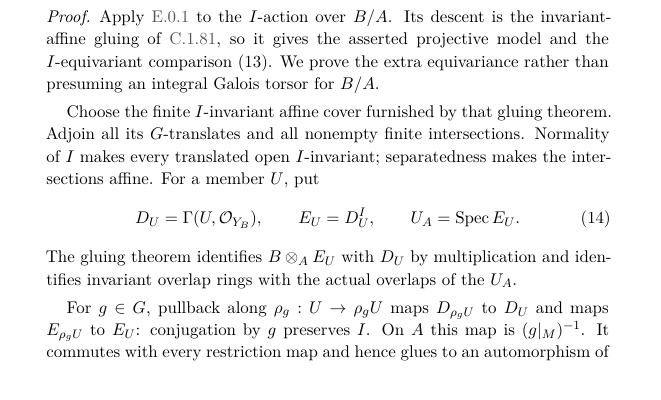
\begin{proof}
\hypertarget{foundations.nag003008.scheme_component}{}Apply \dep{cand:f5proj:projectivedescent} to the $I$-action over
$B/A$. Its descent is the invariant-affine gluing of
\dep{cand:f5glue:globaldescent}, so it gives the asserted
projective model and the $I$-equivariant comparison (13).
We prove the extra equivariance rather than presuming an integral
Galois torsor for $B/A$.

Choose the finite $I$-invariant affine cover furnished by that
gluing theorem. Adjoin all its $G$-translates and all nonempty
finite intersections. Normality of $I$ makes every translated
open $I$-invariant; separatedness makes the intersections affine.
For a member $U$, put
\[
 D_U=\Gamma(U,\mathcal O_{Y_B}),\qquad E_U=D_U^I,
 \qquad U_A=\operatorname{Spec}E_U.
 \tag{14}
\]
The gluing theorem identifies $B\otimes_A E_U$ with $D_U$ by
multiplication and identifies invariant overlap rings with the
actual overlaps of the $U_A$.

For $g\in G$, pullback along $\rho_g:U\to\rho_gU$ maps
$D_{\rho_gU}$ to $D_U$ and maps $E_{\rho_gU}$ to $E_U$:
conjugation by $g$ preserves $I$. On $A$ this map is
$(g|_M)^{-1}$. It commutes with every restriction map and hence
glues to an automorphism of $Y_A$ covering
$\operatorname{Spec}((g|_M)^{-1})$. The multiplication
comparisons commute with these pullbacks, which proves the
claimed $G$-equivariance of (13). The group law follows already
on the invariant coordinate rings. For $i\in I$, the map on
each $E_U$ is the identity and $\rho_iU=U$, so the action
factors through $H$, independently of a choice of coset lifts.

\hypertarget{foundations.nag003008.same_bundle_component}{}The given bundle has the inertia descent
$\mathcal L_A=(p_*\mathcal L_B)^I$ by
\dep{cand:f5proj:linebundledescent}, with $p:Y_B\to Y_A$.
That result supplies its invertibility, ampleness and comparison.
On (14), its sections are
$\Gamma(U,\mathcal L_B)^I$. The linearized pullbacks send these
invariant sections to invariant sections by the same conjugation
calculation, and commute with restriction. They therefore define
a $G$-linearization of $\mathcal L_A$ over the just constructed
action. Every $i\in I$ is the identity on these invariant modules,
so the linearization factors through $H$ as well.

An equivariant isomorphism transports the invariant-affine data
and their invariant modules. Intersecting either cover with the
transported other cover gives a common invariant affine refinement;
the canonical gluing comparisons agree there. This proves the
stated functoriality and independence of the cover. Uniqueness of
a comparison can also be checked after the faithfully flat base
change, using the faithful part of \hypertarget{foundations.nag003008.stacks_02W0_faithful_scheme}{}\stacks{02W0} for schemes
and the faithful part of \hypertarget{foundations.nag003008.stacks_023T_faithful_line}{}\stacks{023T} for their sheaves.
\end{proof}
\endgroup
Typeset reader excerpt
Typed proof inputs
- NAG-002262 · selected whole (prerequisites)
- NAG-002610 · selected whole (prerequisites)
- NAG-002683 · selected whole (prerequisites)
- NAG-002906 · selected whole (prerequisites)
- NAG-002907 · selected whole (prerequisites)
- NAG-002908 · selected whole (prerequisites)
- NAG-002262 · selected whole (explicit current dependencies)
- NAG-002610 · selected whole (explicit current dependencies)
- NAG-002683 · selected whole (explicit current dependencies)
- NAG-002906 · selected whole (explicit current dependencies)
- NAG-002907 · selected whole (explicit current dependencies)
- NAG-002908 · selected whole (explicit current dependencies)
Reader cross-references
Proof map
Verified map inputs · NAG-003008
AND · joint registered proof inputs
- NAG-002262 · Integral Galois descent for unramified coefficients · accepted whole
- NAG-002610 · Character modules give an exact integral test · accepted whole
- NAG-002683 · Effective descent of a supplied separated nodal curve · accepted whole
- NAG-002906 · Line bundles and relative ampleness · accepted whole
- NAG-002907 · Orbit tensor and its canonical linearization · accepted whole
- NAG-002908 · Projective descent in the exact tame Kummer class · accepted whole