NAG-003058 · Accepted whole
Two ways that forgetting support loses information
I Descent of the polarized mixed tower
Open in the English reader · PDF page 2140
Statement · exact TeX
\begin{proposition}[Two ways that forgetting support loses information]
\label{f9md:supportobstruction}
In every dimension $d\geq2$ the following hold.
\begin{enumerate}
\item On $\mathbf P^d_R$, a closed rational special-fibre point has class
zero in the ordinary Chow group $CH_0(\mathbf P^d_R)$, but has vertical
degree one. Thus a degree homomorphism on that ordinary Chow group
cannot recover the required vertical intersection degree. The support
must be retained.
\item On the blowup of Section~3, $p_*[F]=0$ as a $d$-cycle, but
\[
              \deg_{A|_F,\ldots,A|_F,k}(F)=1.
\]
The two semipositive model metrics $h_H,h_A$ on the same generic
$\cO(1)$ agree outside the tube of $P$. On the standard unit polydisc
around $P$ their difference of weights is
\begin{equation}\label{ex68:model:eq:tube}
 u=\log(h_A/h_H)
        =-\log\max\{|\pi|,|z_1|,\ldots,|z_d|\}.
\end{equation}
It satisfies $u(\xi_0)=0$ and $u(\xi_F)=\lambda$. With the
semipositive model measure $\mu_A=\delta_{\xi_F}$ one therefore has
$\int u\,d\mu_A=\lambda>0$. Agreement outside that tube and equality
of generic line-bundle classes do not imply zero metric correction.
If the supported model values of the preceding proposition are available,
changing the first model line from $A$ to $H=A(F)$, with the other $d$
lines equal to $A$, changes that value by $+\lambda$.
\end{enumerate}
\end{proposition}
Full selected proof · exact TeX
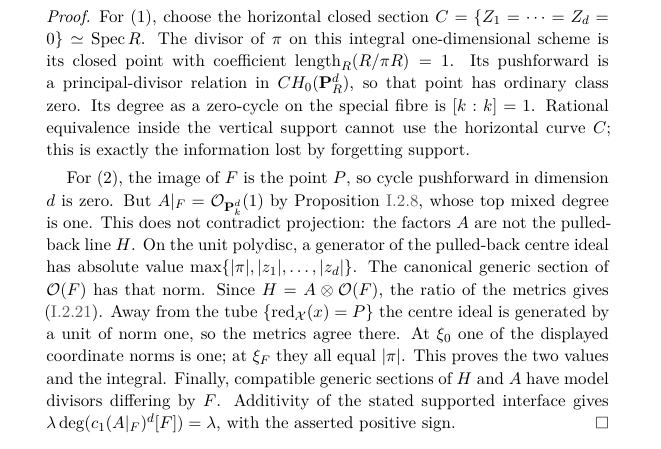
\begin{proof}
For (1), choose the horizontal closed section
$C=\{Z_1=\cdots=Z_d=0\}\simeq\operatorname{Spec}R$.
The divisor of $\pi$ on this integral one-dimensional scheme is its
closed point with coefficient $\length_R(R/\pi R)=1$. Its pushforward
is a principal-divisor relation in $CH_0(\mathbf P^d_R)$, so that point
has ordinary class zero. Its degree as a zero-cycle on the special fibre
is $[k:k]=1$. Rational equivalence inside the vertical support cannot
use the horizontal curve $C$; this is exactly the information lost by
forgetting support.

For (2), the image of $F$ is the point $P$, so cycle pushforward in
dimension $d$ is zero. But $A|_F=\cO_{\mathbf P^d_k}(1)$ by
Proposition~\ref{f9md:blowup}, whose top mixed degree is one.
This does not contradict projection: the factors $A$ are not the
pulled-back line $H$. On the unit polydisc, a generator of the pulled-back
centre ideal has absolute value
$\max\{|\pi|,|z_1|,\ldots,|z_d|\}$. The canonical generic section
of $\cO(F)$ has that norm. Since $H=A\otimes\cO(F)$, the ratio of
the metrics gives \eqref{ex68:model:eq:tube}. Away from the tube
$\{\operatorname{red}_{\cX}(x)=P\}$ the centre ideal is generated
by a unit of norm one, so the metrics agree there.
At $\xi_0$ one of the displayed coordinate norms is one; at $\xi_F$
they all equal $|\pi|$. This proves the two values and the integral.
Finally, compatible generic sections of $H$ and $A$ have model divisors
differing by $F$. Additivity of the stated supported interface gives
$\lambda\deg(c_1(A|_F)^d[F])=\lambda$, with the asserted positive sign.
\end{proof}
Typeset reader excerpt
Typed proof inputs
- NAG-003052 · selected whole (explicit current dependencies)
- NAG-003054 · selected whole (explicit current dependencies)
Reader cross-references
Proof map
Verified map inputs · NAG-003058
AND · joint registered proof inputs
- NAG-003052 · Two semipositive systems on the point blowup · accepted whole
- NAG-003054 · Common domination and the uniformizer test · accepted whole
NAG-003058 · Two ways that forgetting support loses information · Chapter argument