NAG-003145 · Accepted whole
A Galois-normal sequence of exact Kummer steps
G Stable inertia and original-field models
Open in the English reader · PDF page 2036
Source provenance: transcription from the printed reader.
Statement and full selected proof · exact TeX
\NextLinkTarget{foundations.nag003145.pdf-derived}
\begin{theorem}[A Galois-normal sequence of exact Kummer steps]
\label{f5gt:pdf-derived:inertiafiltration}
Let \(L/K\) be finite Galois satisfying \eqref{eq:f5gt:pdf-derived:tame-hypotheses}, with group \(G\).
Put \(k=\widetilde K\) and \(l=\widetilde L\). Then \(l/k\) is Galois, and
its actual unramified lift \(M\subset L\) satisfies
% @formula 18 229
\begin{equation}\label{eq:f5gt:pdf-derived:inertia-sequence}
 1\longrightarrow I=\Gal(L/M)\longrightarrow G
 \longrightarrow\Gal(l/k)\longrightarrow1,\qquad |I|=e.
\end{equation}
Here \(I\) is exactly the kernel of the action on \(l\). It is abelian,
and every subgroup of \(I\) is normal in \(G\). There is consequently a chain
% @formula 19 229
\begin{equation}\label{eq:f5gt:pdf-derived:normal-series}
 1=J_0\subset J_1\subset\cdots\subset J_r=I,\qquad
 F_j=L^{J_j},\qquad L=F_0\supset\cdots\supset F_r=M,
\end{equation}
whose nontrivial factors \(J_j/J_{j-1}\) have prime order and whose steps
\(F_{j-1}/F_j\) are exact Kummer. All fields in \eqref{eq:f5gt:pdf-derived:normal-series} have residue field \(l\).
No roots of unity are assumed in \(K\), and no cyclicity of \(I\) or
splitting of \eqref{eq:f5gt:pdf-derived:inertia-sequence} is assumed.
\end{theorem}
\par\smallskip\noindent{\small\textit{Direct inputs} \hyperref[fnd:finiteextensionnorms]{\texttt{NAG-001450}}, \hyperref[cand:galoisresidueextensionlift]{\texttt{NAG-002052}}, \hyperref[f5gt:pdf-derived:radicalsteps]{\texttt{NAG-003143}}, \hyperref[f5gt:pdf-derived:unramifiedbridge]{\texttt{NAG-003144}}.}\par\smallskip
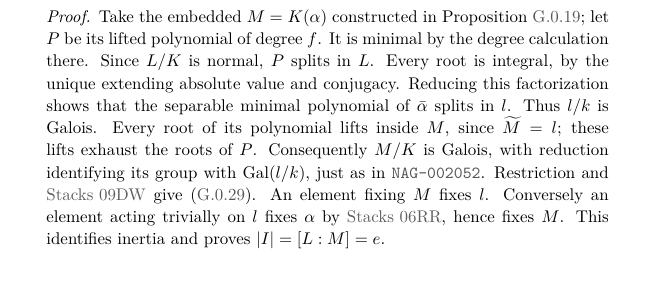
\begin{proof}
Take the embedded \(M=K(\alpha)\) constructed in Proposition~\ref{f5gt:pdf-derived:unramifiedbridge}; let
\(P\) be its lifted polynomial of degree \(f\). It is minimal by the degree
calculation there. Since \(L/K\) is normal, \(P\) splits in \(L\). Every
root is integral, by the unique extending absolute value and conjugacy.
Reducing this factorization shows that the separable minimal polynomial
of \(\bar\alpha\) splits in \(l\). Thus \(l/k\) is Galois.
Every root of its polynomial lifts inside \(M\), since
\(\widetilde M=l\); these lifts exhaust the roots of \(P\).
Consequently \(M/K\) is Galois, with reduction identifying its group with
\(\Gal(l/k)\), just as in \hyperref[cand:galoisresidueextensionlift]{\texttt{NAG-002052}}.
Restriction and \stacks{09DW} give \eqref{eq:f5gt:pdf-derived:inertia-sequence}. An element fixing \(M\) fixes
\(l\). Conversely an element acting trivially on \(l\) fixes \(\alpha\)
by \stacks{06RR}, hence fixes \(M\). This identifies inertia and proves
\(|I|=[L:M]=e\).

We give the needed ramification argument to avoid importing a DVR-only
cyclicity theorem. For \(i\in I\) define
% @formula 20 229
\begin{equation}\label{eq:f5gt:pdf-derived:inertia-character}
 \theta_i:\Gamma_L/\Gamma_M\longrightarrow l^\times,\qquad
 \theta_i(v(a))=\overline{i(a)/a}.
\end{equation}
This is well defined: changing \(a\) by an element of the same value
changes the ratio by \(i(u)/u\) for a unit \(u\), whose residue is one;
changing the value by \(v(b)\), \(b\in M^\times\), has no effect.
Multiplication shows that \(\theta_i\) is a character. Since \(I\) fixes
\(l\), composition gives a homomorphism \(I\to\Hom(\Gamma_L/\Gamma_M,l^\times)\).
It is injective. Indeed use the radical tower of Lemma~\ref{f5gt:pdf-derived:radicalsteps} for \(L/M\).
If \(\theta_i=1\) and \(i\) fixes the previous field, then \(i(s_j)/s_j\)
is an \(n_j\)-th root of unity with residue one. It equals one by
\stacks{06RR}. Induction fixes every radical and hence all of \(L\).
The target of \eqref{eq:f5gt:pdf-derived:inertia-character} is abelian, so \(I\) is abelian.

All values of \eqref{eq:f5gt:pdf-derived:inertia-character} lie in \(\mu_e(l)\), since the value quotient has order
\(e\). This finite group is cyclic by \stacks{09HX}. For \(g\in G\),
valuation preservation gives
% @formula 21 229
\begin{equation}\label{eq:f5gt:pdf-derived:conjugation}
 \theta_{gig^{-1}}(\gamma)=\bar g(\theta_i(\gamma)).
\end{equation}
To see this directly, represent \(\gamma\) by \(a\) and apply \(g\) to
\(i(g^{-1}a)/(g^{-1}a)\); the value of \(g^{-1}a\) is still \(\gamma\).
If \(t=|\mu_e(l)|\), the automorphism \(\bar g\) of this cyclic group
is exponentiation by some integer \(q_g\)
% @witness proof_continued 230:4-15
coprime to \(t\). Thus injectivity of \eqref{eq:f5gt:pdf-derived:inertia-character} implies \(gig^{-1}=i^{q_g}\).
Also \eqref{eq:f5gt:pdf-derived:inertia-character} implies \(i^t=1\) for every \(i\).
Exponentiation by \(q_g\) therefore preserves every subgroup of \(I\),
proving its normality in \(G\).

A finite abelian group has a series with prime cyclic factors: take a
maximal proper subgroup and induct on its order; the quotient is simple
abelian, so any nonidentity element generates it and its order is prime.
All groups in the resulting series are \(G\)-normal by the preceding paragraph.
The correspondence \stacks{09DW} gives \eqref{eq:f5gt:pdf-derived:normal-series} and its cyclic prime-degree
extensions. Their residue fields all equal \(l\), since they lie between
\(M\) and \(L\). The product of their degrees and the product of their
value indices both equal \(e\). Each index is at most its degree by
\stacks{0ASH}, so equality holds at every step.
For a prime-degree step its value quotient has prime order, hence is cyclic.
The first radical in Lemma~\ref{f5gt:pdf-derived:radicalsteps} already generates that step; its Galois clause
supplies a primitive root with primitive reduction. This is exactly \eqref{eq:f5gt:pdf-derived:exact-kummer} for
each step.
\end{proof}
Typeset reader excerpt
Typed proof inputs
- NAG-001450 · selected whole (prerequisites)
- NAG-002052 · selected whole (prerequisites)
- NAG-003143 · selected whole (prerequisites)
- NAG-003144 · selected whole (prerequisites)
- STACKS-06RR · named external application
- STACKS-09DW · named external application
- STACKS-09DW-GALOIS-CORRESPONDENCE-SCOPE · named external application
- STACKS-09HX · named external application
- STACKS-0ASH · named external application
- NAG-001450 · selected whole (explicit current dependencies)
- NAG-002052 · selected whole (explicit current dependencies)
- NAG-003143 · selected whole (explicit current dependencies)
- NAG-003144 · selected whole (explicit current dependencies)
Reader cross-references
Proof map
Verified map inputs · NAG-003145
AND · joint registered proof inputs
- NAG-001450 · Finite-dimensional norms and finite field extensions · accepted whole
- NAG-002052 · Lifting a finite Galois residue extension · accepted whole
- NAG-003143 · Corrected radicals and a value basis · accepted whole
- NAG-003144 · An actual unramified base change supplies the steps · accepted whole
NAG-003145 · A Galois-normal sequence of exact Kummer steps · Chapter argument