NAG-003204 · Accepted whole
Finite base extension and numerical descent
Proper direct image on historical ordinary compact tests
Open in the English reader · PDF page 1951
Statement · exact TeX
\begin{theorem}[Finite base extension and numerical descent]\label{f9be:degree}
For the full pulled-back computing datum,
\begin{equation}\label{eq:push}
 q_*\beta_{\cY}=n\beta_{\cX}
                    \quad\text{in }\CH_0(T_{\red}),
 \qquad
 \deg_{k'}\beta_{\cY}=e\,\deg_k\beta_{\cX}.
\end{equation}
Consequently its native $R'$-normalized value is
\begin{equation}\label{eq:invariant}
 J_{R'}(\cY):=\frac{\lambda_L}{A}\deg_{k'}\beta_{\cY}
                         =J_R(\cX).
\end{equation}
If the same upstairs data are instead regarded over $R$, with
the $R$-normalization, then
\begin{equation}\label{eq:restricted}
 J_{\cY/R}:=\frac{\lambda_K}{A}\deg_k\beta_{\cY}
                       =n J_{R'}(\cY)=nJ_R(\cX).
\end{equation}
These formulas hold for nonreduced $\cY$ and nonreduced $X_L$,
respect finite extension towers, and are unchanged by tensor-power
replacement of any root presentation.
\end{theorem}
Full selected proof · exact TeX
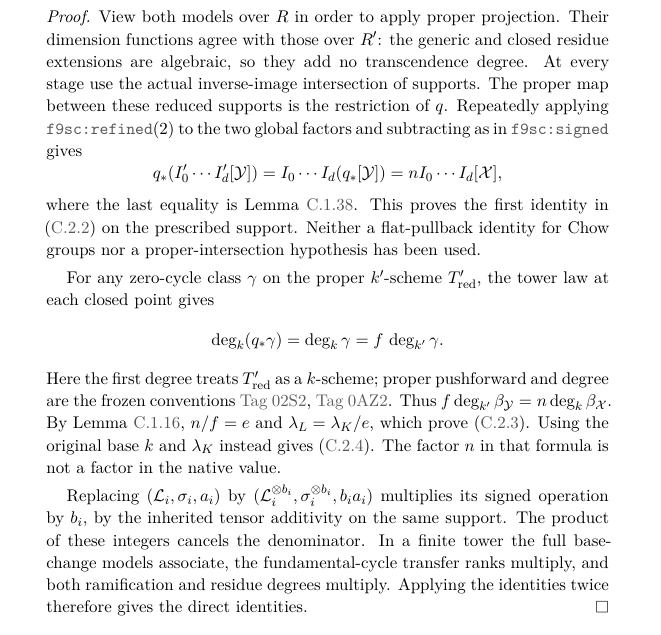
\begin{proof}
View both models over $R$ in order to apply proper projection.
Their dimension functions agree with those over $R'$: the generic
and closed residue extensions are algebraic, so they add no
transcendence degree. At every stage use the actual inverse-image
intersection of supports. The proper map between these reduced
supports is the restriction of $q$.
Repeatedly applying \texttt{f9sc:refined}(2) to the two global
factors and subtracting as in \texttt{f9sc:signed} gives
\[
 q_*(I'_0\cdots I'_d[\cY])
      =I_0\cdots I_d(q_*[\cY])
      =nI_0\cdots I_d[\cX],
\]
where the last equality is Lemma~\ref{f9be:transfer}.
This proves the first identity in \eqref{eq:push} on the prescribed
support. Neither a flat-pullback identity for Chow groups nor a
proper-intersection hypothesis has been used.

For any zero-cycle class $\gamma$ on the proper $k'$-scheme
$T'_{\red}$, the tower law at each closed point gives
\[
 \deg_k(q_*\gamma)=\deg_k\gamma
                    =f\,\deg_{k'}\gamma.
\]
Here the first degree treats $T'_{\red}$ as a $k$-scheme;
proper pushforward and degree are the frozen conventions
\st{02S2}, \st{0AZ2}.
Thus $f\deg_{k'}\beta_{\cY}=n\deg_k\beta_{\cX}$.
By Lemma~\ref{f9be:dvr}, $n/f=e$ and $\lambda_L=\lambda_K/e$,
which prove \eqref{eq:invariant}. Using the original base $k$ and
$\lambda_K$ instead gives \eqref{eq:restricted}.
The factor $n$ in that formula is not a factor in the native value.

Replacing $(\cL_i,\sigma_i,a_i)$ by
$(\cL_i^{\otimes b_i},\sigma_i^{\otimes b_i},b_i a_i)$
multiplies its signed operation by $b_i$, by the inherited tensor
additivity on the same support. The product of these integers
cancels the denominator. In a finite tower the full base-change
models associate, the fundamental-cycle transfer ranks multiply,
and both ramification and residue degrees multiply.
Applying the identities twice therefore gives the direct identities.
\end{proof}
Typeset reader excerpt
Typed proof inputs
- CLAUSE:NAG-003112:supported_gysin_1_4 · selected scope (selected native clause)
- NAG-003116 · selected whole (selected native whole)
- NAG-003200 · selected whole (selected native whole)
- NAG-003201 · selected whole (selected native whole)
- NAG-003203 · selected whole (earlier proposed whole)
Reader cross-references
Proof map
Verified map inputs · NAG-003204
AND · joint registered proof inputs
- CLAUSE:NAG-003112:supported_gysin_1_4 · supported gysin 1 4 · selected scope Exact source window 432
- selected NAG-003112 part (2), on the prescribed reduced support
- NAG-003116 · Independence with no extra support · accepted whole Exact source window 433
- selected signed-presentation construction
- NAG-003200 · Result C.1.16 · accepted whole Exact source window 425–467
- Exact original proof scope in the signed mainline dependency graph.
- NAG-003201 · The full finite flat cycle · accepted whole Exact source window 425–467
- Exact original proof scope in the signed mainline dependency graph.
- NAG-003203 · Pullback of the data and of the root norms · accepted whole Exact source window 425–467
- Exact original proof scope in the signed mainline dependency graph.
NAG-003204 · Finite base extension and numerical descent · Chapter argument