NAG-002321 · Accepted whole
Which original-field points occur as model vertices
Open in the English reader · PDF page 785
Statement · exact TeX
\begin{theorem}[Which original-field points occur as model vertices]
\label{v037:f5:vertexcertificate}
Suppose $C$ admits a semistable algebraic model over $O$.
A point of $C^{\an}$ occurs as a component vertex of such
a model if and only if it has an unramified branch
certificate. Every finite set of points having such
certificates is contained in the component vertex set of
one original-field semistable algebraic model dominating
any initially specified model.
The certificate condition is independent of the chosen
algebraically closed comparison field.

For every such point $v$, its entire inverse image under
$p$ is finite and consists of type-II points. Moreover
\[
\begin{aligned}
 &|\mathcal H(v)^\times|=|K^\times|,\\
 &\widetilde{\mathcal H(v)}/k
       \text{ is separably generated of transcendence degree one}.
\end{aligned}
\]
\end{theorem}
Full selected proof · exact TeX
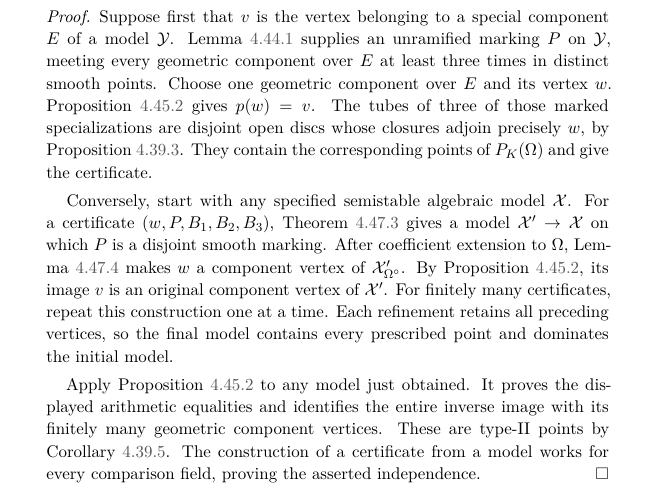
\begin{proof}
Suppose first that $v$ is the vertex belonging to a
special component $E$ of a model $\mathcal Y$.
Lemma~\ref{v036:f5:multisections} supplies an unramified
marking $P$ on $\mathcal Y$, meeting every geometric
component over $E$ at least three times in distinct smooth
points. Choose one geometric component over $E$ and its
vertex $w$. Proposition~\ref{v036:f5:vertexarithmetic}
gives $p(w)=v$. The tubes of three of those marked
specializations are disjoint open discs whose closures
adjoin precisely $w$, by
Proposition~\ref{v035:formal:tubeends}. They contain the
corresponding points of $P_K(\Omega)$ and give the certificate.

Conversely, start with any specified semistable algebraic
model $\mathcal X$. For a certificate $(w,P,B_1,B_2,B_3)$,
Theorem~\ref{v037:f5:unramifiedrefinement} gives a model
$\mathcal X'\to\mathcal X$ on which $P$ is a disjoint
smooth marking. After coefficient extension to $\Omega$,
Lemma~\ref{v037:f5:threebranches} makes $w$ a component
vertex of $\mathcal X'_{\Omega^\circ}$. By
Proposition~\ref{v036:f5:vertexarithmetic}, its image $v$
is an original component vertex of $\mathcal X'$.
For finitely many certificates, repeat this construction
one at a time. Each refinement retains all preceding
vertices, so the final model contains every prescribed
point and dominates the initial model.

Apply Proposition~\ref{v036:f5:vertexarithmetic} to any
model just obtained. It proves the displayed arithmetic
equalities and identifies the entire inverse image with
its finitely many geometric component vertices. These are
type-II points by Corollary~\ref{v035:formal:partition}.
The construction of a certificate from a model works for
every comparison field, proving the asserted independence.
\end{proof}
Standing context 1 · exact TeX
\label{v037:f5:certificatesection}

Fix the isometric algebraically closed comparison field
$\Omega$ of Lemma~\ref{v036:f5:comparisonfield}, and write
$p:C_\Omega^{\an}\to C^{\an}$ for the projection.

\begin{definition}[Unramified branch certificates]
\label{v037:f5:branchcertificate}
A point $v\in C^{\an}$ has an \emph{unramified branch
certificate} if there are a point $w\in p^{-1}(v)$,
an unramified marking datum $P$, and three pairwise
disjoint open analytic discs $B_1,B_2,B_3\subset
C_\Omega^{\an}$, with $w\notin\bigcup_iB_i$, such that
\[
          \overline{B_i}=B_i\cup\{w\},
                 \qquad B_i\cap P_K(\Omega)\ne\varnothing
                         \quad(1\leq i\leq3).
\]
Closures are taken in $C_\Omega^{\an}$.
\end{definition}
Typeset reader excerpt
Typed proof inputs
- NAG-002222 · selected whole (selected native whole)
- NAG-002224 · selected whole (selected native whole)
- NAG-002265 · selected whole (selected native whole)
- NAG-002271 · selected whole (selected native whole)
- NAG-002316 · selected whole (earlier exact whole review candidate)
- NAG-002317 · selected whole (selected native whole)
Reader cross-references
Proof map
Verified map inputs · NAG-002321
AND · joint registered proof inputs
- NAG-002222 · Formal smooth and nodal tube closures · accepted whole Exact source window 509–520
- Use actual smooth finite étale multisections on the component and its geometric lift, and three disjoint special-point tubes with the specified boundary vertex.
- NAG-002224 · The specialization partition of a formal curve · accepted whole Exact source window 531–542
- Iterate actual vertex-preserving refinements, then apply the original arithmetic and the marked tube partition at the finitely many geometric lifts. Independence is for the stated comparison-field choice.
- NAG-002265 · Result 4.44.1 · accepted whole Exact source window 509–520
- Use actual smooth finite étale multisections on the component and its geometric lift, and three disjoint special-point tubes with the specified boundary vertex.
- NAG-002271 · The arithmetic of a model vertex · accepted whole Exact source windows 509–520, 522–530, 531–542
- Use actual smooth finite étale multisections on the component and its geometric lift, and three disjoint special-point tubes with the specified boundary vertex.
- Start from a supplied original model; realize the certificate marking, apply three-branch recognition over the comparison field and descend the resulting vertex by the full inverse image identification.
- Iterate actual vertex-preserving refinements, then apply the original arithmetic and the marked tube partition at the finitely many geometric lifts. Independence is for the stated comparison-field choice.
- NAG-002316 · Realizing an unramified marking on the original model · accepted whole Exact source windows 522–530, 531–542
- Start from a supplied original model; realize the certificate marking, apply three-branch recognition over the comparison field and descend the resulting vertex by the full inverse image identification.
- Iterate actual vertex-preserving refinements, then apply the original arithmetic and the marked tube partition at the finitely many geometric lifts. Independence is for the stated comparison-field choice.
- NAG-002317 · Three marked branches force a vertex · accepted whole Exact source window 522–530
- Start from a supplied original model; realize the certificate marking, apply three-branch recognition over the comparison field and descend the resulting vertex by the full inverse image identification.
NAG-002321 · Which original-field points occur as model vertices · Chapter argument