NAG-002392 · Accepted whole
Analytic moment integrals and finite change of charts
5 Tropicalization, multiplicities and balancing
Open in the English reader · PDF page 1019
Statement · exact TeX
\begin{theorem}[Analytic moment integrals and finite change of charts]
\label{v037:integration:momenttests}
Let $X=\mathcal M(B)$ be a generalized affinoid space, pure
of analytic dimension $d$, over a complete non-Archimedean
field with its specified absolute value. For a unit tuple
$f$ write $t_f:X\to\mathbb R^n$ and
$U_f=\mathbb R^n\setminus t_f(\partial_KX)$.
For every finite $B$-module $M$, the formula
\[
 I_{M,f}(\alpha)
       =I_{\operatorname{Trop}_f(M)|_{U_f}}(\alpha)
\]
defines a linear functional on smooth top forms whose
tangential support is compact in $U_f$. It is nonnegative
when their tangential top coefficients are nonnegative.
It is additive in short exact sequences of modules and
satisfies
\[
                       I_{M,f}(d'\beta)=0,
                       \qquad I_{M,f}(d''\gamma)=0
\]
for smooth compactly supported tests of the indicated
complementary bidegrees in $U_f$.

Let $p:X=\mathcal M(B)\to Y=\mathcal M(A)$ be finite, with
$Y$ also pure of analytic dimension $d$. Suppose unit tuples
$f_X,f_Y$ and an integral map $a$ satisfy
$t_{f_Y}\circ p=a\circ t_{f_X}$. For every finite $B$-module
$M$, regarded also as a finite $A$-module, and every smooth
top form $\alpha$ with compact ambient support in $U_{f_Y}$,
\begin{equation}
\label{v037:eq:analyticintegralprojection}
                         I_{M,f_X}(a^*\alpha)=I_{M,f_Y}(\alpha).
\end{equation}
The support of the left-hand test on its actual source cycle
is compact and lies in its whole interior weight domain;
there $\alpha$ is understood to be extended by zero outside
$U_{f_Y}$.

In particular, let $f,g$ be two unit tuples on the same $X$,
let $\pi_f,\pi_g$ be the projections from the joint tuple
$(f,g)$, and let $\alpha,\beta$ be top forms with compact
ambient support in $U_f,U_g$, respectively. Extend them by zero
outside these open sets. If
\[
                         \pi_f^*\alpha=\pi_g^*\beta
\]
on every tangential $d$-plane of the actual joint local
moment image over
$\pi_f^{-1}(U_f)\cup\pi_g^{-1}(U_g)$, then
$I_{B,f}(\alpha)=I_{B,g}(\beta)$.

Adjoining unit coordinates is faithful on tangential
superforms in every bidegree: on $t_f(X)\cap U_f$, a smooth
superform is zero on all tangential faces if and only if its
pullback is zero on all tangential faces of the actual
joint image over $U_f$.
\end{theorem}
Full selected proof · exact TeX
\begin{proof}
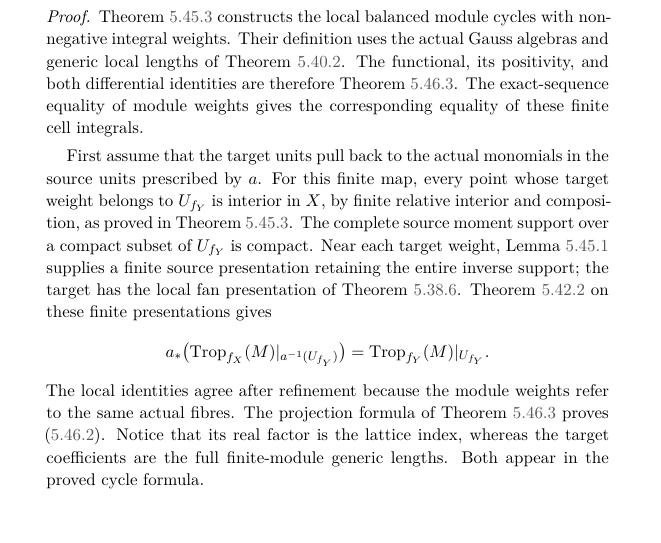
Theorem~\ref{v037:analytic:interiorcycle} constructs the local
balanced module cycles with nonnegative integral weights.
Their definition uses the actual Gauss algebras and generic
local lengths of Theorem~\ref{v037:degree:moduleweight}.
The functional, its positivity, and both differential
identities are therefore
Theorem~\ref{v037:integration:balancedcurrent}.
The exact-sequence equality of module weights gives the
corresponding equality of these finite cell integrals.

First assume that the target units pull back to the actual
monomials in the source units prescribed by $a$.
For this finite map, every point whose target weight belongs
to $U_{f_Y}$ is interior in $X$, by finite relative interior
and composition, as proved in
Theorem~\ref{v037:analytic:interiorcycle}. The complete source
moment support over a compact subset of $U_{f_Y}$ is compact.
Near each target weight,
Lemma~\ref{v037:analytic:finitepolyhedralpatching} supplies a
finite source presentation retaining the entire inverse
support; the target has the local fan presentation of
Theorem~\ref{v037:analytic:interiorlocalstar}.
Theorem~\ref{v037:degree:modulefunctoriality} on these finite
presentations gives
\[
 a_*\bigl(\operatorname{Trop}_{f_X}(M)|_{a^{-1}(U_{f_Y})}\bigr)
                      =\operatorname{Trop}_{f_Y}(M)|_{U_{f_Y}}.
\]
The local identities agree after refinement because the
module weights refer to the same actual fibres. The
projection formula of
Theorem~\ref{v037:integration:balancedcurrent} proves
\eqref{v037:eq:analyticintegralprojection}. Notice that its
real factor is the lattice index, whereas the target
coefficients are the full finite-module generic lengths.
Both appear in the proved cycle formula.

For a general equality of moment maps as in the statement,
use the joint source tuple $(f_X,p^*f_Y)$. Its actual image
is the graph of $a$. The case just proved applies both
to its projection onto $f_X$ with the identity morphism
and to its projection onto $f_Y$ with the morphism $p$.
The first graph projection is an integral isomorphism,
with inverse $u\mapsto(u,a(u))$. It identifies saturated
tangent lattices and has index one on every cell.
The second projection is $a$ after this identification.
The corresponding finite lattice-index sums therefore
give the same cycle formula for the stated moment-map
equality, and its integral follows from the same real
projection formula. All these comparisons are over
$U_{f_Y}$; finite relative interior and composition give
the required absolute interior on the whole source fibres.

Apply this result to $p=\operatorname{id}_X$ with source
tuple $(f,g)$ and target tuple $f$, and then with target
tuple $g$. The source structure module is $B$ in both cases.
A compactly supported smooth form on $U_f$ extends smoothly
by zero to $\mathbb R^n$: near the complement of $U_f$ its
support is absent. The support of its pullback on the joint
actual image is a closed subset of the compact set
$t_{(f,g)}(X)\cap\pi_f^{-1}(\operatorname{supp}\alpha)$.
Every point of that set lies over a whole interior $f$-fibre,
so the joint cycle is defined there. The same holds for
$\beta$. Their tangential equality gives equal cell
integrals on a common finite presentation. The two identity
projection formulas now give the asserted equality of
original integrals.

Finally consider a form $\eta$ of any bidegree on the
target moment image over $U_f$. If its tangential
restrictions vanish, refine the joint and target local
presentations so that every source cell maps into one target
cell. Pullback on tangent spaces then gives zero on the
source. Conversely suppose the joint pullback vanishes.
Near any target point take the finite presentations supplied
above, and remove the lower-dimensional target cells and
the images of lower-dimensional or rank-dropping source
cells, exactly as in
Theorem~\ref{v037:analytic:momentaugmentation}.
On the dense remaining part of every target $d$-cell,
the positive target weight is the sum of the positive
source weights times their lattice indices. Hence at least
one full-rank source cell lies above every such point.
Its tangent map is a real linear isomorphism onto the
target tangent plane, so pullback is injective on both
exterior factors. The tangential value of $\eta$ is zero
there. Continuity of its smooth coefficients extends this
vanishing over the entire target $d$-cell. Every smaller
face is contained in such a cell, and restriction to its
tangent space preserves zero. This proves the converse,
including the bidegrees above $d$, where all these
restrictions are already zero.
\end{proof}
Typeset reader excerpt
Typed proof inputs
- NAG-001496 · selected whole (selected native whole scoped use)
- NAG-001701 · selected whole (selected native whole scoped use)
- NAG-001704 · selected whole (selected native whole scoped use)
- NAG-002353 · selected whole (selected native whole scoped use)
- NAG-002362 · selected whole (selected native whole scoped use)
- NAG-002370 · selected whole (selected native whole scoped use)
- NAG-002372 · selected whole (selected native whole scoped use)
- NAG-002380 · selected whole (selected native whole scoped use)
- NAG-002383 · selected whole (selected native whole scoped use)
- NAG-002385 · selected whole (selected native whole scoped use)
- NAG-002391 · selected whole (selected native whole scoped use)
Reader cross-references
Proof map
Verified map inputs · NAG-002392
AND · joint registered proof inputs
- NAG-001496 · Compactness of the bounded spectrum · accepted whole Exact source window 388–394
- The actual source affinoid spectrum and its moment image are compact. Over a compact target subset the closed inverse-image support in the compact source moment image is compact.
- NAG-001701 · Finite algebras with their canonical norm · accepted whole Exact source window 385–389
- Finite analytic relative interior on the actual source affinoid.
- NAG-001704 · Presentation calculus for relative interior · accepted whole Exact source window 385–389
- Forward composition uses absolute interior on the target and relative interior for the finite map. No intermediate-image converse.
- NAG-002353 · The local tropical star of a whole interior fibre · accepted whole Exact source windows 452–464, 390–395
- The pure local fans give every lower face as a face of a top cell. Continuity and restriction propagate the detected vanishing.
- Pure local fans on every actual source fibre in this window and on the actual target fibre, all lying in their analytic interiors. Restrict a small convex piece for the target complex.
- NAG-002362 · Weights of finite modules on an interior flat germ · accepted whole Exact source window 375–381
- Use the selected actual full Gauss algebra and generic local lengths at flat rank-d cells, with the saturation divisor and restriction invariance under the stated whole-fibre hypotheses.
- NAG-002370 · Module cycles and finite geometric pushforward · accepted whole Exact source window 395–402
- Both actual complexes over the same convex target window and its full inverse image, same pure dimension, and actual character identities in the first case.
- NAG-002372 · Finite-module pushforward and composition · accepted whole Exact source windows 395–402, 410–424
- Actual weighted module-cycle pushforward with all finite local lengths and saturated lattice indices on the same complexes.
- Both projections from the actual joint tuple (f_X,p^*f_Y) satisfy the character identities. The first graph projection is an integral isomorphism with saturated tangent index one; compose the two weighted sums.
- NAG-002380 · Pushforward after adding analytic unit coordinates · accepted whole Exact source window 446–462
- The structure cycle has positive weights. On a dense open subset of each top-cell relative interior the entire joint inverse support is given by full-rank cells with index factors; their tangent isomorphisms detect either exterior factor.
- NAG-002383 · A finite presentation near a compact projected fibre · accepted whole Exact source windows 441–448, 390–394
- Use finite joint and target presentations over a convex neighbourhood contained in U_f with the full joint inverse support.
- Finite source presentation retains the entire inverse image over the local convex window; hypotheses are the local fans at every point of the compact source moment fibre.
- NAG-002385 · Analytic cycles on whole interior weight domains · accepted whole Exact source windows 373–376, 383–389
- Local cycles for the actual pure affinoid, the whole interior weight locus, and nonnegative module weights additive in exact sequences.
- For an actual finite chart map and its prescribed character identities, the whole inverse source support over the target interior-weight locus is in the source interior.
- NAG-002391 · Integration and closedness of a local balanced cycle · accepted whole Exact source windows 403–408, 419–439, 377–381
- Apply the selected local lattice-normalized projection formula over the target open. The support map is proper there by compactness of the full source moment inverse support over compact subsets.
- Use the same selected real projection formula under both identity morphisms to compare the compactly supported tests on a common actual finite presentation.
- The exact selected local weighted-cycle functional gives positivity, subdivision independence and the two compact-support differential identities. For d=0 the derivative assertions are empty.
NAG-002392 · Analytic moment integrals and finite change of charts · Chapter argument