NAG-002461 · Accepted whole
Moment chains on compact analytic domains
5 Tropicalization, multiplicities and balancing
Open in the English reader · PDF page 1069
Statement · exact TeX
\begin{theorem}[Moment chains on compact analytic domains]
\label{v038:degree:compactchain}
Let $Z$ be a compact good Hausdorff analytic space pure of
dimension $d$, let $\mathcal F$ be coherent on $Z_G$, and let
$f$ be a global unit tuple. There is a canonical finite
nonnegative integral $d$-chain $\mathcal T_{Z,f}(\mathcal F)$,
with support contained in the actual compact image $t_f(Z)$.
For any finite affinoid-domain cover $(U_i)_{i=1}^r$, it is
given by
\[
 \mathcal T_{Z,f}(\mathcal F)=
 \sum_{\varnothing\ne I\subseteq\{1,\ldots,r\}}
       (-1)^{|I|+1}
       \mathcal T_{f|_{U_I}}\bigl(\Gamma(U_I,\mathcal F)\bigr),
 \qquad U_I=\bigcap_{i\in I}U_i.
\]
Empty intersections contribute zero. This chain is additive in
short exact sequences of coherent modules. For every smooth
$(d,d)$-superform $\alpha$ defined near $t_f(Z)$,
\[
             \int_{\mathcal T_{Z,f}(\mathcal F)}\alpha
                         =\mathcal I_{Z,\mathcal F}(t_f^*\alpha).
\]
Here the right side is the compact finite-chart integral.

The same construction applies to a finite union of affinoid
domains in a good Hausdorff pure $d$-dimensional ambient space,
even if the union is not good. It is additive by finite
inclusion--exclusion for covers by such compact analytic domains.
The analogous inclusion--exclusion identity holds for compatible
finite moment-chart integrals, without requiring one global tuple.

If $Z_P=t_f^{-1}(P)$ is an affinoid moment domain, then
\[
 \mathcal T_{Z,f}(\mathcal F)|_{\operatorname{int}(P)}
   =\mathcal T_{f|_{Z_P}}\bigl(\Gamma(Z_P,\mathcal F)\bigr)
                                      |_{\operatorname{int}(P)}.
\]
If global unit tuples $g,f$ on $Z$ satisfy $t_f=a\circ t_g$
for an integral lattice map $a$, then
\[
                a_*\mathcal T_{Z,g}(\mathcal F)
                                      =\mathcal T_{Z,f}(\mathcal F).
\]
This pushforward is proper on the actual support. Cells on which
$a$ drops rank contribute zero.
\end{theorem}
Full selected proof · exact TeX
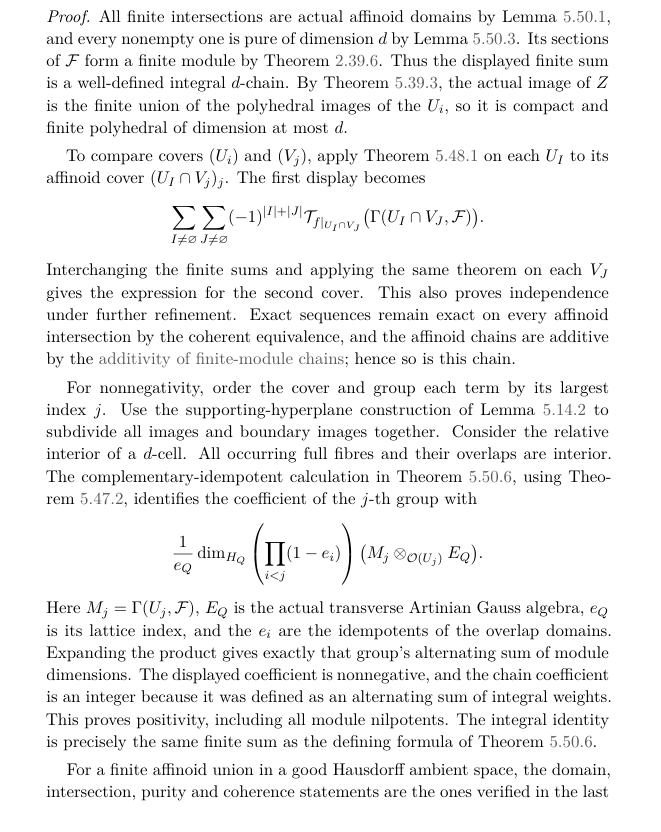
\begin{proof}
All finite intersections are actual affinoid domains by
Lemma~\ref{v037:integration:separatedintersections}, and every
nonempty one is pure of dimension $d$ by
Lemma~\ref{v037:integration:puritylocality}. Its sections of
$\mathcal F$ form a finite module by
Theorem~\ref{fnd:fullgkiehltheoremb}. Thus the displayed finite
sum is a well-defined integral $d$-chain. By
Theorem~\ref{v037:globaltrop:finiteimage}, the actual image of
$Z$ is the finite union of the polyhedral images of the $U_i$,
so it is compact and finite polyhedral of dimension at most $d$.

To compare covers $(U_i)$ and $(V_j)$, apply
Theorem~\ref{v037:localization:globalcoveradditivity} on each
$U_I$ to its affinoid cover $(U_I\cap V_j)_j$. The first
display becomes
\[
 \sum_{I\ne\varnothing}\sum_{J\ne\varnothing}
       (-1)^{|I|+|J|}
       \mathcal T_{f|_{U_I\cap V_J}}
                     \bigl(\Gamma(U_I\cap V_J,\mathcal F)\bigr).
\]
Interchanging the finite sums and applying the same theorem on
each $V_J$ gives the expression for the second cover. This also
proves independence under further refinement. Exact sequences
remain exact on every affinoid intersection by the coherent
equivalence, and the affinoid chains are additive by
the \hyperref[fnd:nag002405:global-finite-module-chain-weights]{additivity of finite-module chains}; hence so is this chain.

For nonnegativity, order the cover and group each term by its
largest index $j$. Use the supporting-hyperplane construction
of Lemma~\ref{cand:polyhedralrefinementproduct} to subdivide
all images and boundary images together. Consider the relative interior of a
$d$-cell. All occurring full fibres and their overlaps are
interior. The complementary-idempotent calculation in
Theorem~\ref{v037:integration:compactintegral}, using
Theorem~\ref{v037:localization:fibrecover}, identifies the
coefficient of the $j$-th group with
\[
  \frac{1}{e_Q}\dim_{H_Q}
   \left(\prod_{i<j}(1-e_i)\right)
        \bigl(M_j\otimes_{\mathcal O(U_j)}E_Q\bigr).
\]
Here $M_j=\Gamma(U_j,\mathcal F)$, $E_Q$ is the actual
transverse Artinian Gauss algebra, $e_Q$ is its lattice index,
and the $e_i$ are the idempotents of the overlap domains.
Expanding the product gives exactly that group's alternating
sum of module dimensions. The displayed coefficient is
nonnegative, and the chain coefficient is an integer because
it was defined as an alternating sum of integral weights.
This proves positivity, including all module nilpotents.
The integral identity is precisely the same finite sum as
the defining formula of
Theorem~\ref{v037:integration:compactintegral}.

For a finite affinoid union in a good Hausdorff ambient space,
the domain, intersection, purity and coherence statements are
the ones verified in the last paragraph of that theorem.
The preceding double-cover argument therefore applies verbatim
to the chains and to compatible finite chart data.
We give the finite-union bookkeeping explicitly. In the
commutative ring generated by symbols $[U]$ for the finitely
many affinoid domains involved, impose
$[U][V]=[U\cap V]$; all these symbols are idempotent.
A finite covering family is represented by
\[
                        1-\prod_i(1-[U_i]).
\]
Expanding gives its inclusion--exclusion expression.
Products represent intersection covers: the Boolean identity
\[
 (1-\prod_i(1-x_i))(1-\prod_j(1-y_j))
                       =1-\prod_{i,j}(1-x_i y_j)
\]
holds for commuting idempotents. To verify it, expand the
identity decomposition into the products which choose either
each variable or its complement. On every such product the
two sides are the same zero or one. A union of compact domains
represented by such covering expressions is consequently
represented by $1-\prod_l(1-P_l)$. Expansion first by the
$P_l$, or first by their affinoid constituents, gives the same
finite sum of intersection symbols. Cover independence just
proved permits either presentation of any intersection.
Applying its chain or compatible-integral value proves the
asserted finite inclusion--exclusion formula.

For the restriction assertion, intersect the chosen cover
with $Z_P$. On the interior of $P$, the whole moment fibre in
every $U_I$ is unchanged. Refine by the finitely many boundary
images of both $U_I$ and $U_I\cap Z_P$. At every remaining
generic $d$-cell, the whole-fibre module restriction assertion
of Theorem~\ref{v037:degree:moduleweight} identifies their
weights. Equality on these generic cells is equality of
$d$-chains. The restricted inclusion--exclusion sum is the
affinoid cover expression on $Z_P$, proving the claim.

Finally apply the
\hyperref[fnd:nag002405:same-affinoid-coordinate-augmentation]{same-affinoid chain projection} to the identity map
of each $U_I$, with its two restricted tuples. It gives the
claimed lattice pushforward on each term. Finite linearity of
the lattice-index formula gives the equality for their sum.
The actual source support is compact, so the pushforward is
proper. The rank-dropping convention is the one in that
affinoid theorem and is unchanged by finite summation.
\end{proof}
Typeset reader excerpt
Typed proof inputs
- CLAUSE:NAG-002405:global_finite_module_chain_weights · selected scope (explicit current dependencies)
- CLAUSE:NAG-002405:same_affinoid_coordinate_augmentation · selected scope (explicit current dependencies)
- NAG-001624 · selected whole (explicit current dependencies)
- NAG-002180 · selected whole (explicit current dependencies)
- NAG-002358 · selected whole (explicit current dependencies)
- NAG-002362 · selected whole (explicit current dependencies)
- NAG-002396 · selected whole (explicit current dependencies)
- NAG-002401 · selected whole (explicit current dependencies)
- NAG-002411 · selected whole (explicit current dependencies)
- NAG-002413 · selected whole (explicit current dependencies)
- NAG-002416 · selected whole (explicit current dependencies)
Reader cross-references
Proof map
Verified map inputs · NAG-002461
AND · joint registered proof inputs
- CLAUSE:NAG-002405:global_finite_module_chain_weights · global finite module chain weights · selected scope
- CLAUSE:NAG-002405:same_affinoid_coordinate_augmentation · same affinoid coordinate augmentation · selected scope
- NAG-001624 · Kiehl and Theorem B on the analytic G-site · accepted whole
- NAG-002180 · Refinement and products of balanced complexes · accepted whole
- NAG-002358 · Global polyhedrality and the tropicalized boundary · accepted whole
- NAG-002362 · Weights of finite modules on an interior flat germ · accepted whole
- NAG-002396 · Inclusion--exclusion on interior fibre covers · accepted whole
- NAG-002401 · Global additivity for a finite affinoid cover · accepted whole
- NAG-002411 · Affinoid intersections in a separated good space · accepted whole
- NAG-002413 · Purity is local on affinoid covers · accepted whole
- NAG-002416 · The integral on a compact good analytic space · accepted whole
NAG-002461 · Moment chains on compact analytic domains · Chapter argument