NAG-002591 · Accepted whole
Lengths, field degrees, and normalization
Proper direct image on historical ordinary compact tests
Open in the English reader · PDF page 1845
Statement · exact TeX
\begin{corollary}[Lengths, field degrees, and normalization]
\label{mpw:arithmetic}
Put $E_s=B\otimes_{R_P}H_s$ and $M_s=M\otimes_{R_P}H_s$.
For every $s\in P$,
\begin{align}
 D_M&=\sum_{\mathfrak q\in\operatorname{Min}B}
  \operatorname{length}_{B_{\mathfrak q}}(M_{\mathfrak q})
  [\operatorname{Frac}(B/\mathfrak q):F],\label{mpw:eqgenericlength}\\
 &=\sum_{\mathfrak m\in\operatorname{Max}E_s}
  \operatorname{length}_{(E_s)_{\mathfrak m}}((M_s)_{\mathfrak m})
  [\kappa(\mathfrak m):H_s].\label{mpw:eqlocallength}
\end{align}
At $s=s_0$ the second sum has one term, with residue field
$\mathcal H(x)$. All degrees are full degrees, including
inseparable degrees. The structure module retains nilpotent length.

After any complete isometric extension realizing the needed radii,
the normalized Gauss dimensions and lattice divisors give the same
coefficient on the full base-changed fibre. All its factors must
be retained; a selected lift of $x$ is not that full fibre.
\end{corollary}
Full selected proof · exact TeX
\begin{proof}
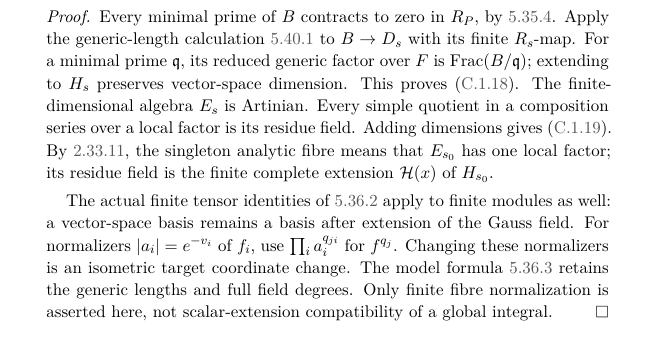
Every minimal prime of $B$ contracts to zero in $R_P$, by
\Dep{v036:analytic:polyannulusdegree}. Apply the generic-length
calculation \Dep{v037:degree:genericgauss} to $B\to D_s$ with
its finite $R_s$-map. For a minimal prime $\mathfrak q$, its
reduced generic factor over $F$ is
$\operatorname{Frac}(B/\mathfrak q)$; extending to $H_s$ preserves
vector-space dimension. This proves \eqref{mpw:eqgenericlength}.
The finite-dimensional algebra $E_s$ is Artinian. Every simple
quotient in a composition series over a local factor is its residue
field. Adding dimensions gives \eqref{mpw:eqlocallength}.
By \Dep{fnd:allpointaffinoidfibres}, the singleton analytic
fibre means that $E_{s_0}$ has one local factor; its residue field is the finite complete extension
$\mathcal H(x)$ of $H_{s_0}$.

The actual finite tensor identities of \Dep{v036:gaussbasechange}
apply to finite modules as well: a vector-space basis remains a
basis after extension of the Gauss field. For normalizers
$|a_i|=e^{-v_i}$ of $f_i$, use $\prod_i a_i^{q_{ji}}$ for
$f^{q_j}$. Changing these normalizers is an isometric target
coordinate change. The model formula \Dep{v036:gaussmodeldescent}
retains the generic lengths and full field degrees. Only finite
fibre normalization is asserted here, not scalar-extension
compatibility of a global integral.
\end{proof}
Typeset reader excerpt
Typed proof inputs
- NAG-001692 · selected whole (sealed whole native proof)
- NAG-001702 · selected whole (sealed whole native proof)
- NAG-002294 · selected whole (sealed whole native proof)
- NAG-002298 · selected whole (sealed whole native proof)
- NAG-002301 · selected whole (sealed whole native proof)
- NAG-002302 · selected whole (sealed whole native proof)
- NAG-002360 · selected whole, export unavailable (sealed whole native proof)
- NAG-001692 · selected whole
- NAG-001692 · selected whole (requires)
- NAG-001702 · selected whole
- NAG-001702 · selected whole (requires)
- NAG-002294 · selected whole
- NAG-002294 · selected whole (requires)
- NAG-002298 · selected whole
- NAG-002298 · selected whole (requires)
- NAG-002301 · selected whole
- NAG-002301 · selected whole (requires)
- NAG-002302 · selected whole
- NAG-002302 · selected whole (requires)
- NAG-002360 · selected whole, export unavailable
- NAG-002360 · selected whole, export unavailable (requires)
Proof map
Verified map inputs · NAG-002591
AND · joint registered proof inputs
- NAG-001692 · Affinoid fibres at all Berkovich points · accepted whole
- NAG-001702 · General finite base change · accepted whole
- NAG-002294 · Gauss degrees over a closed polyannulus · accepted whole
- NAG-002298 · Monomial covers of Gauss fields · accepted whole
- NAG-002301 · Scalar extension of a finite Gauss fibre · accepted whole
- NAG-002302 · Integral models computing an arbitrary-radius degree · accepted whole
- NAG-002360 · Result 5.40.1 · accepted whole; PDF destination
NAG-002591 · Lengths, field degrees, and normalization · Chapter argument