NAG-003132 · Accepted whole
Model independence on the prescribed generic supports
Proper direct image on historical ordinary compact tests
Open in the English reader · PDF page 1936
Statement · exact TeX
\begin{theorem}[Model independence on the prescribed generic supports]
\label{f9mi:independence}
Fix the data of \eqref{eq:f9mi:empty} and \eqref{eq:f9mi:criterion}.
The value \eqref{eq:f9mi:value} is a well-defined element of
$\lambda\mathbf Q$, independent of the computing model, all
generic-identity refinements, model exponents, signed presentations,
and model supports with the fixed generic restrictions $S_i$.
It is also independent of the chosen model extensions inducing
the same pointwise metrics $h_i$, with their specified generic
identifications.

The value is symmetric under simultaneous permutation of the inputs
and supports. It is additive under tensor product in any input when
the other inputs are fixed, using the union of the two generic
supports and requiring the displayed total-intersection condition.
If two systems of generic supports $S_i,S_i'$ both describe the same
metric and rational-section data, their values agree whenever
$\bigcap_i(S_i\cup S_i')=\varnothing$ and both systems satisfy
\eqref{eq:f9mi:criterion}.
\end{theorem}
Full selected proof · exact TeX
\begin{proof}
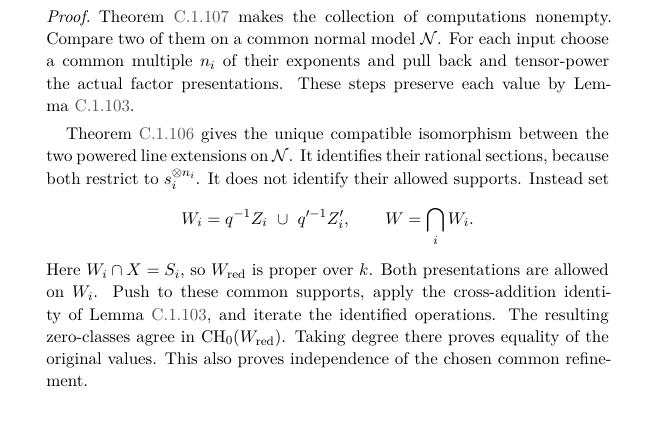
Theorem~\ref{f9mi:criterion} makes the collection of computations
nonempty. Compare two of them on a common normal model $\cN$.
For each input choose a common multiple $n_i$ of their exponents
and pull back and tensor-power the actual factor presentations.
These steps preserve each value by Lemma~\ref{f9mi:operations}.

Theorem~\ref{f9mi:metric} gives the unique compatible isomorphism
between the two powered line extensions on $\cN$. It identifies
their rational sections, because both restrict to $s_i^{\otimes n_i}$.
It does not identify their allowed supports. Instead set
\[
 W_i=q^{-1}Z_i\ \cup\ q'^{-1}Z_i',\qquad
                         W=\bigcap_iW_i.
\]
Here $W_i\cap X=S_i$, so $W_{\rm red}$ is proper over $k$.
Both presentations are allowed on $W_i$. Push to these common
supports, apply the cross-addition identity of
Lemma~\ref{f9mi:operations}, and iterate the identified operations.
The resulting zero-classes agree in $\CH_0(W_{\rm red})$.
Taking degree there proves equality of the original values.
This also proves independence of the chosen common refinement.

Symmetry is the supported commutation in the reviewed calculus.
For tensor additivity choose simultaneous computing data and common
exponents. Signed additivity on the union support makes the numerator
additive; the common denominators give the assertion. The same
comparison works for $S_i,S_i'$ when their componentwise union
still has empty total intersection. In each case it is this last
condition that makes the final degree comparison legitimate.
\end{proof}
Typeset reader excerpt
Typed proof inputs
- CLAUSE:NAG-003112:supported_gysin_1_4 · selected scope (exact reviewed native application)
- NAG-003036 · selected whole (exact reviewed native application)
- NAG-003116 · selected whole (exact reviewed native application)
- NAG-003126 · selected whole (exact reviewed native application)
- NAG-003129 · selected whole (exact reviewed native application)
- NAG-003131 · selected whole (exact reviewed native application)
Reader cross-references
Proof map
Verified map inputs · NAG-003132
AND · joint registered proof inputs
- CLAUSE:NAG-003112:supported_gysin_1_4 · supported gysin 1 4 · selected scope Exact source window 232
- Only the supported operations
- NAG-003036 · The normalized diagonal gives a common model · accepted whole Exact source window 211
- Same normalized diagonal construction for the two actual models
- NAG-003116 · Independence with no extra support · accepted whole Exact source window 234
- Signed tensor additivity on actual union supports
- NAG-003126 · Metric equality and compatible powered extensions · accepted whole Exact source window 216
- Identify actual powered generic line extensions
- NAG-003129 · Exact acquisition criterion, allowing tensor powers · accepted whole Exact source window 210
- Existence of the computing data under the exact generic criterion
- NAG-003131 · The supported comparison rules needed here · accepted whole Exact source window 214
- Pullback and tensor scaling
NAG-003132 · Model independence on the prescribed generic supports · Chapter argument